
25-03-2026 10:35
Hulda Caroline HolteHello,I collected this species growing on a dead b
24-03-2026 19:59
 William Slosse
Hello everyone,On 23/03/26, I found the following
21-03-2026 15:13
Lepista ZacariasHello everyone, Does any one know of any literatu
24-03-2026 21:37
Elisabeth StöckliBonsoir,Sur bois (tronc) très pourri de conifère
24-03-2026 21:07
Ethan CrensonHello all, A friend collected this asco in a wood
23-03-2026 20:16
 Miguel Ángel Ribes
Good eveningI'm unable to identify this Coprotus o
24-03-2026 15:44
Åge OterhalsI hope someone can confirm the name of this collec

20-10-2017 09:23
Garcia SusanaEste otro crecía en el mismo trocito de madera qu
 Hello,
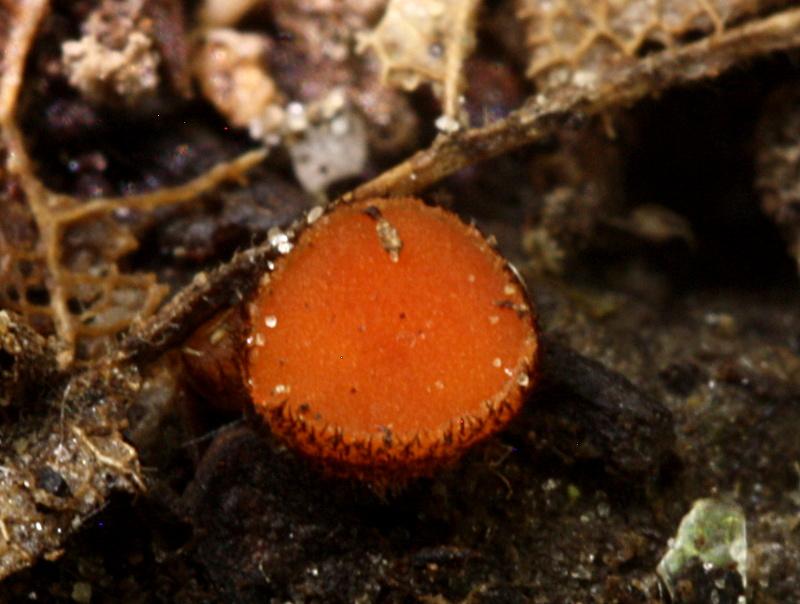
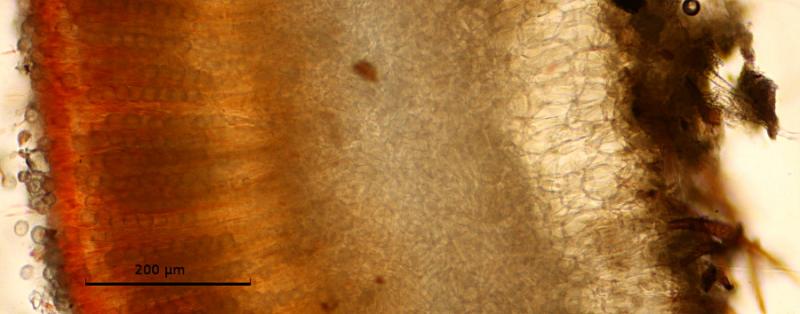
I'd like to ask for your help with this small Scutellinia. It was growing on a sandy soil (might be calcareous) among fallen leaves. Locality is warm in general, but this place is on a deeply cut forest path, maybe with a bit colder microclimate.
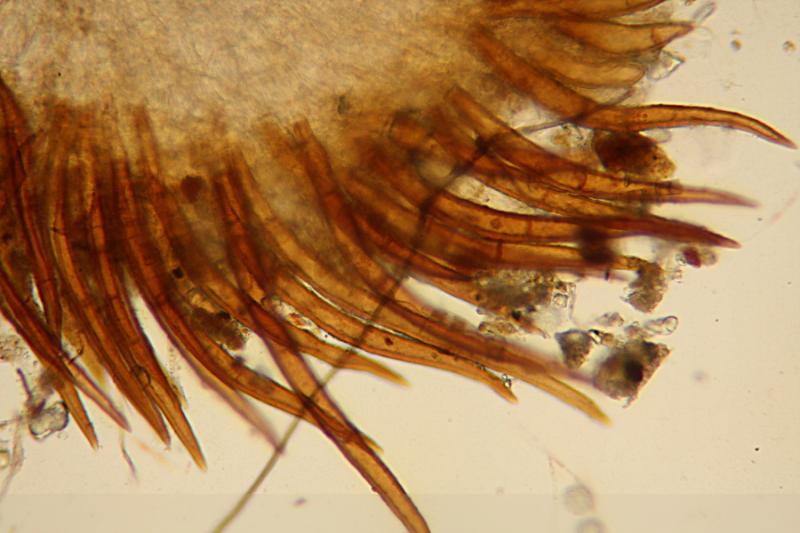
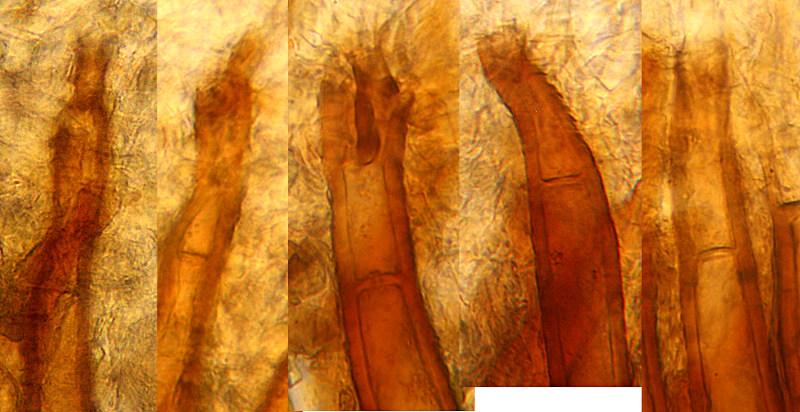
Marginal hairs short, 131-236 (285) × 16,9-18,3 (20,3) um, simple to bifurcate base, 1-4(-5)-septate.
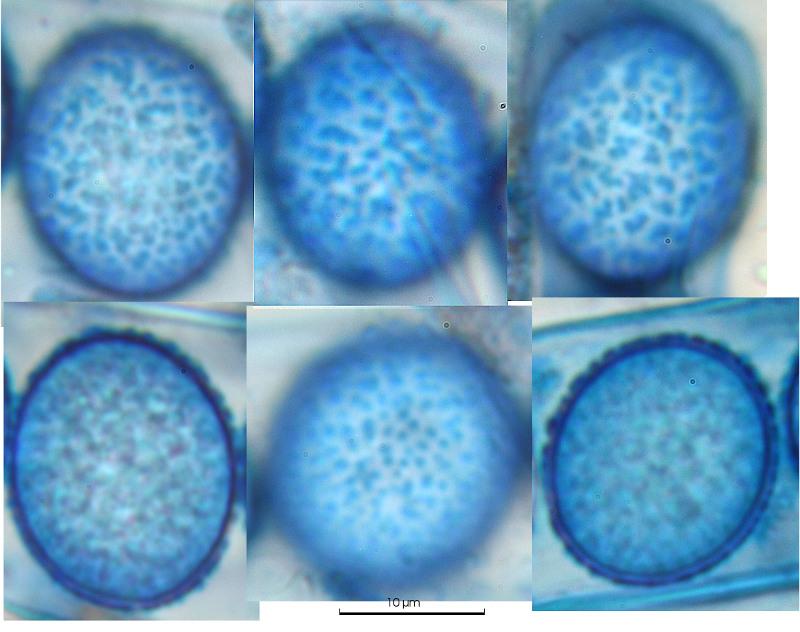
Spores subglobose, (17,4) 18,1–19,8 (20,4) × (16,1) 16,9–18,3 (18,9) um (live in water), Q = 1-1,1 (1,2), Me = 19 × 17,4 um.
Ornamentation: dense small warts about 0,5 um diam., usually in confluent clusters 0,7-1,7 (2,9) um wide, height 0,4-0,7 um.
The closest species I found in Schumacher and Cahiers FBMDS were S. hyperborea, which has isodiametric non-confluent warts and longer hairs, and S. patagonica, which has much longer hairs. S. subhirtella has more ellipsoid spores.
I'm not sure either, how to interpret the ornamentation, which one is the final one (small standalone warts, or clustered warts).
Thank you in advance.
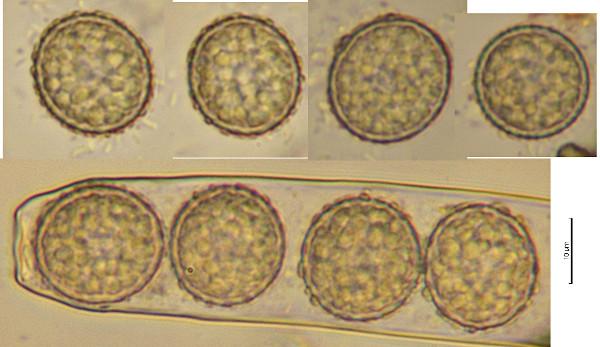
Je pense qu'il s'agit de Scutellinia patagonica (Rehm) Gamundi Je vous remets en dossiers attachés mes dessins de S patagonica et de S. hyperborea, pour comparaison (j'espèce que les images vont passer).
Cordialement
René
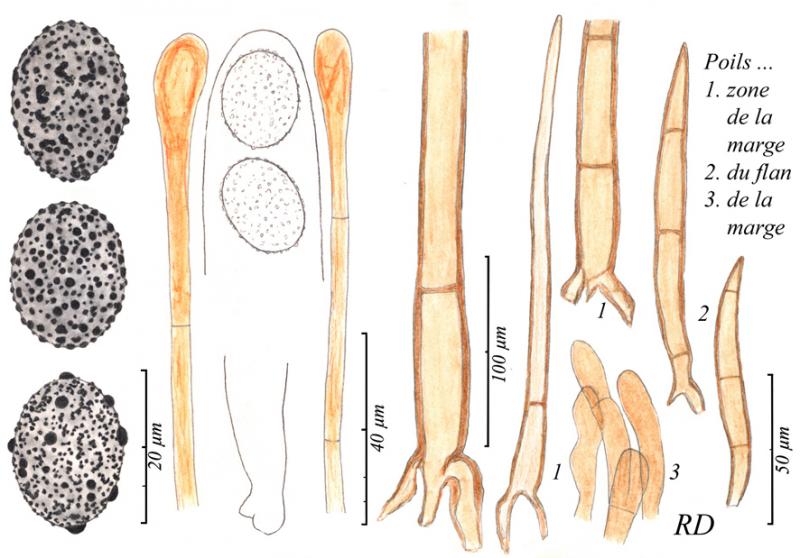
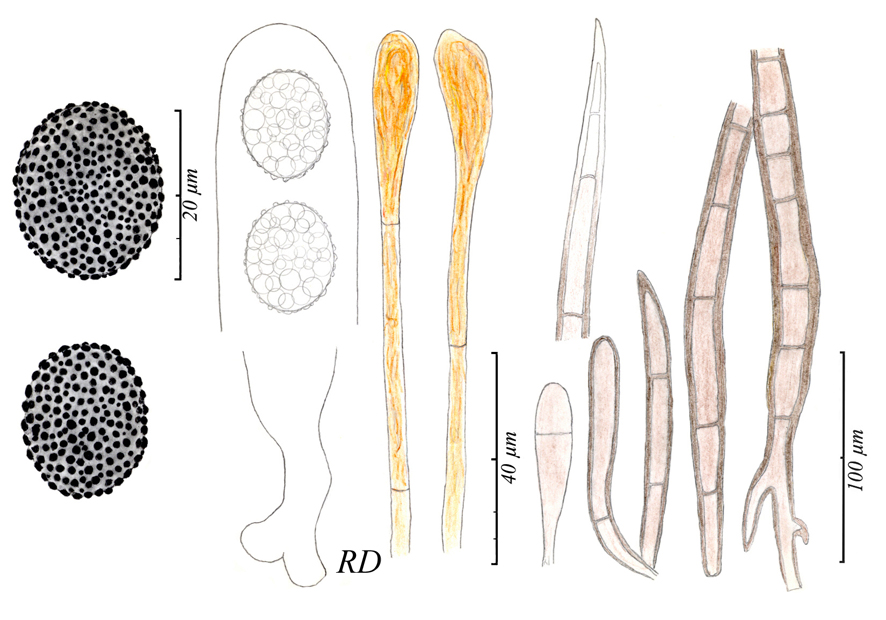 Scutellinia-hyperboera-M-1-0001.jpg
when comparing my find with your drawings (and, e.g. description given by B.Jeannerot in Ascomycete.org 5(5)), the spore shape, size and ornamentation speak for S. patagonica. However, two characters differ quite a lot: Hairs should be cca three times longer in S. patagonica and so far, I didn't find description of any collection with such a short hairs. From the macrophoto it is clear, that they barely reach beyond the apothecial margin (this excludes possibility, that I made preparation from a piece of margin that was inbetween longer hairs). Or is it still within species variability?
Other thing is its ecology: S. patagonica is referred to the boreo-polar group by Schumacher, collections described by Jeannerot (op.cit.) or Van Vooren (Cahiers de FMBDS) support this placement. This collection is from ca 250-300 m asl. in warm lowland, nordeastern slope, less than 1 km from one of the northernmost localities of a mediterranean orchid Himantoglossum adriaticum.
Unfortunately I didn't try if the perispore loosens or not, I'll check this when I'm at home at saturday. Yao & Spooner describe this feature for british finds of S. patagonica, but not for the neotype.
Other possibility would be S. peloponnesiaca J.Mor., with loosening perispore and ornamentation similar to S. patagonica but shorter hairs. There is another collection from Slovakia, determined as S. peloponnesiaca by S.Glejdura, with short hairs, 4spored asci and from cca 400-500 m asl., but I didn't see any microcharacters illustrated. My collection has constantly 8spored asci. But Schumacher wrote that Moravec's species is just a result of abnormal development with "eaten" hairs and synonymized it under patagonica.
... I guess I have to go there again and try to find more apothecia for a better knowledge of this collection.
update: S. Glejdura identified this collection as S. peloponnesiaca. He published 7 collections from 3 slovak localities, all have consistently short hairs, smaller spores than patagonica, and frequently less than 8 mature spores. There is also a scottish collection (see Yao & Spooner 1996) that would be useful to compare, with smaller spores than patagonica and loosening perispore, alas the hair size is not given.