
27-04-2026 20:52
 Lothar Krieglsteiner
Found on hanging tiwg of Olea europaea in dried-ou
27-04-2026 18:48
Tony MoverleyCollected 23rd April 2026, Norfolk, EnglandSwarms
27-04-2026 17:41
Lothar Krieglsteiner
.. Algarve, same leaf than the last post. The con
27-04-2026 18:05
Lothar Krieglsteiner
... still attached at standing tree. The green con
27-04-2026 17:16
Lothar Krieglsteiner
.. Algarve, moist lying.The conidiomata look like
27-04-2026 12:54
Steve ClementsBonjour. Ce petit champignon blanc résupiné et
27-04-2026 09:59
Pauline. PennaBonjour Can anyone advise me on these pycnidia fo

22-04-2026 20:54
 Enrique Rubio
Hi to everybody.This Pyrenopeziza grew in moist le
 Hi to everyone , Bonjour à tous,
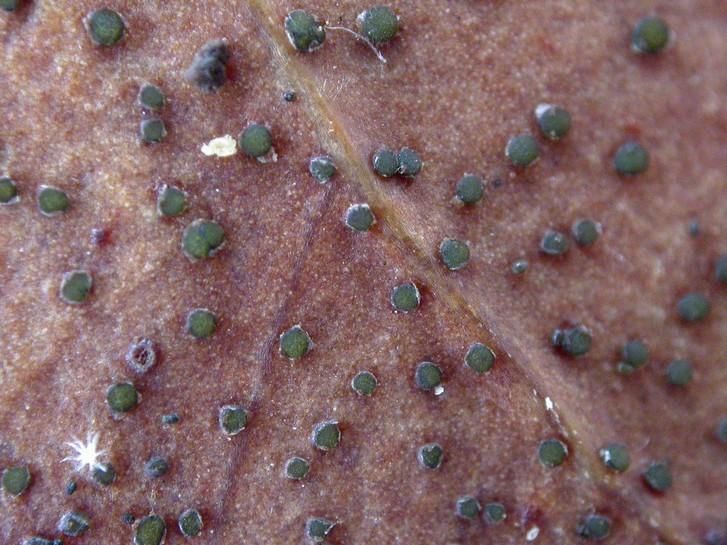
 Trochila laurocerasi is a common species (everywhere ?) .
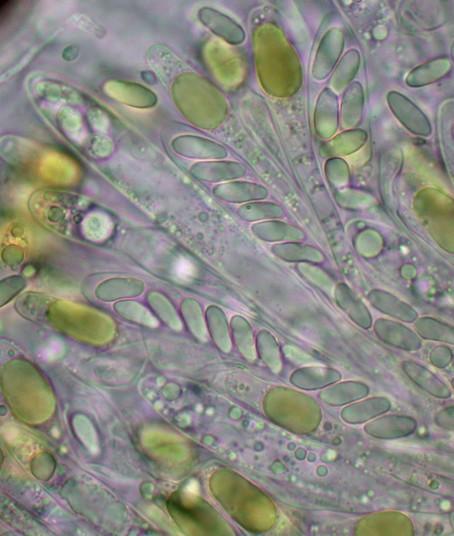
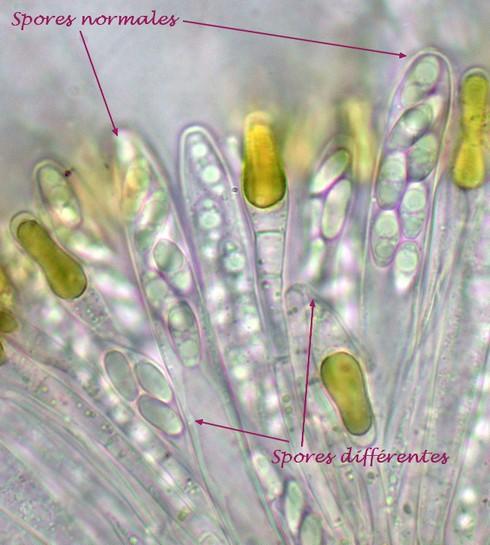
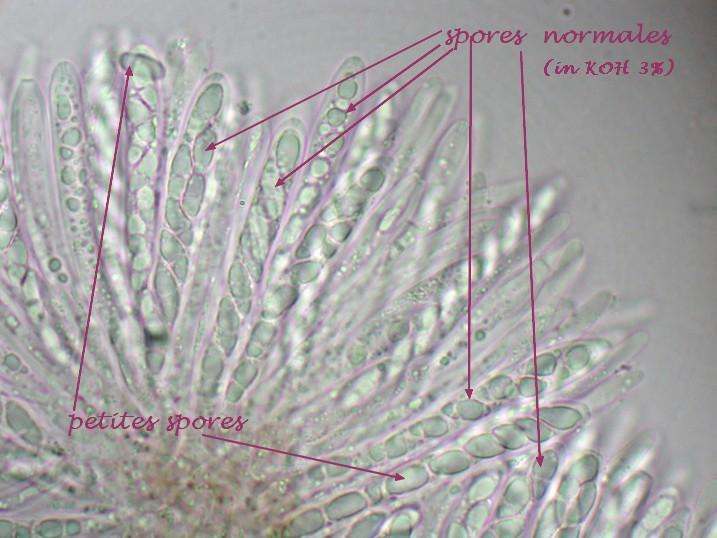
I am puzzled in finding 2 types of ascus and spores as seen in the following pictures.
Normal spores are largely fusiform, biguttulate, ca 11x4 µm
Other spores eguttulate, clavate, shorter , ca 8x 3 µm
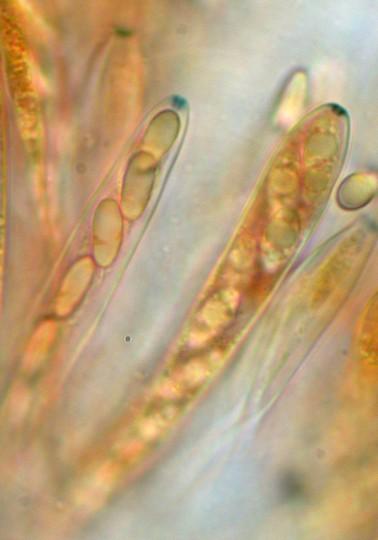
Ascus are also shorter in the 2nd form : 58-59 x 5-7,5 instead of 70-75 x 9 in the normal one.
Iki reaction is, as seen here, the same.
I do not feel that this difference is due to unmaturity .
Has someone an explanation ?
Amitiés
Michel

J'ai déjà observé cela pour Trochila craterium: quand les apothécies ne sont pas tout à fait mûres, les spores sont plus petites.
Je dois fouiller dans mes notes des années précédentes, je regarderai si j'ai toujous les mesures de plusieurs récoltes.
Je ne me rappelle pas avoir vu ce phénomène dans des asques différentes de la même apothécie comme illustré ici, mais je regarderai. Il y a toujours des asques à différents stades.
Dès que j'en ai de nouvelles récoltes.
Je n'ai pas de station de T. laurocerasi hélàs...
Amitiés - LUC.

That's easily explained: the smaller spore are the dead ones in which the LBs are hardly seen anymore. You can see on your photos that these small spores are only inside dead asci. You can make the test: add KOH, then the LBs will be visible again, but the difference between large and small will vanish.
I found this species in my village, but it's long ago, so I did not have any photos. Thanks!
Zotto

In this case I think it is only the melted together Lipidbodies in one that is seen and the very thin sporewall is hardly visible, i found this picture of a collection last year where I had this same phenomenon.
Amitiés
Stip
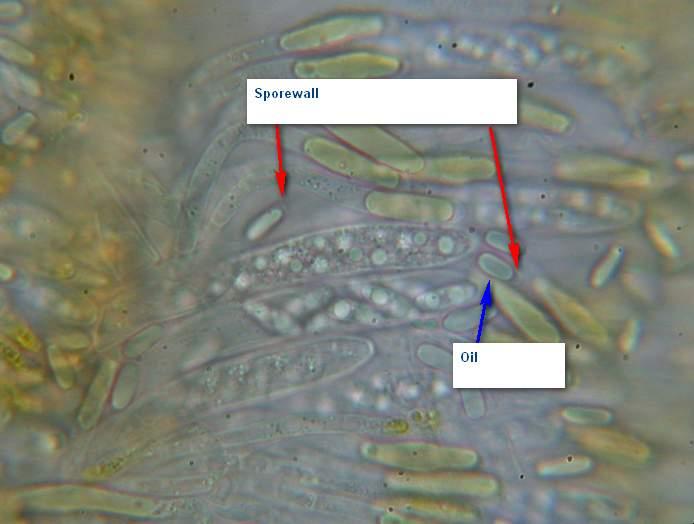
yes, that is a common phenomenon, especially with free spores. But on Michel's photo I faintly see the oil drops and predict that they reappear when you add KOH. When melted together, then the individual LBs are irreversibly lost.
Zotto
Hi Zotto,
Yes i saw that vague regions also in some spores but interpreted that as a empty region inside the LBs (perhaps the Necleus) they are less refractive as the LBs.
So Michel, there is work to do we would like to see it in KOH
Amitiés
Stip
Yes I easily think you might be right.
KOH (3%)does not make the bodies reappear as if they had melted .
KOH provokes shrinkage and lipid guttules melting inside the normal spores , but for a narrow ''septum'' which remains between the two halves , which is not the case in the other spores.
I could not check Stip's observation on the spore wall. In my case the vb seems to fill totally the spore. (After shriinkage ?)
Amitiés
Michel
you are a rising star!
thanks for sharing your observations, mine were in water mount probably there the sporewall did not shrink that much.
Amitiés
Stip
A la demande générale... voici une photo dans la potasse.
Excuse me for the bad quality of the picture but it shows that there is no change in KOH for the smaller spores .
I must add that this experiment was made after rehydratation of the substrate (but the normal spores appeared as large and guttulate as before dessication)
Good night from the rising star.
Michel
Zotto