
10-06-2026 21:16
 François Freléchoux
Bonsoir,Le dernier du jour, en attendant votre avi
11-06-2026 19:01
 William Slosse
Hello all,In an attempt to make a culture of a sus
11-06-2026 19:03
 Nicolas VAN VOOREN
Chers membres d'Ascofrance,Le site sera placé en

09-06-2026 18:32
Camille MertensSur morceau de roseau immergé 0,5 - 0,7 mm de dia
10-06-2026 12:54
Steve ClementsBonjour encore, Pouvez-vous m'aider, s'il vous pl
10-06-2026 21:07
François Freléchoux
Toutes les tiges de gentianes jaunes de l'an passÃ
10-06-2026 13:41
François Freléchoux
Bonjour à nouveau, Voici une trouvaille d'hier.
10-06-2026 11:53
Steve ClementsBonjour, This disco is abundant on dead stems of
Micropodia pteridina?
Tony Moverley,
27-04-2026 18:48
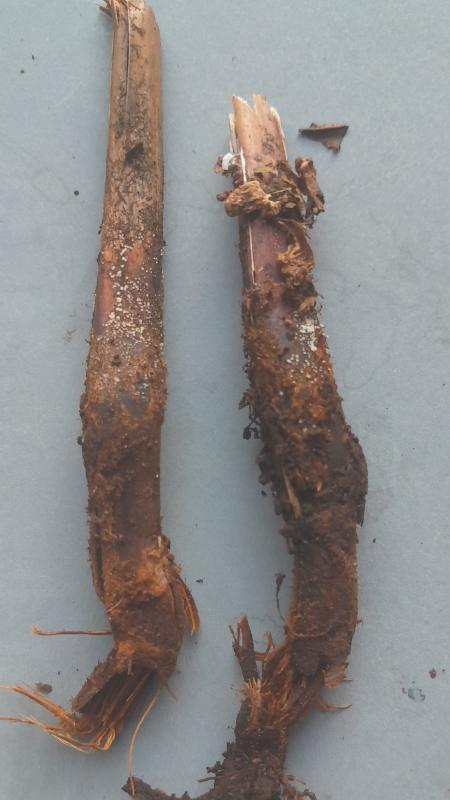
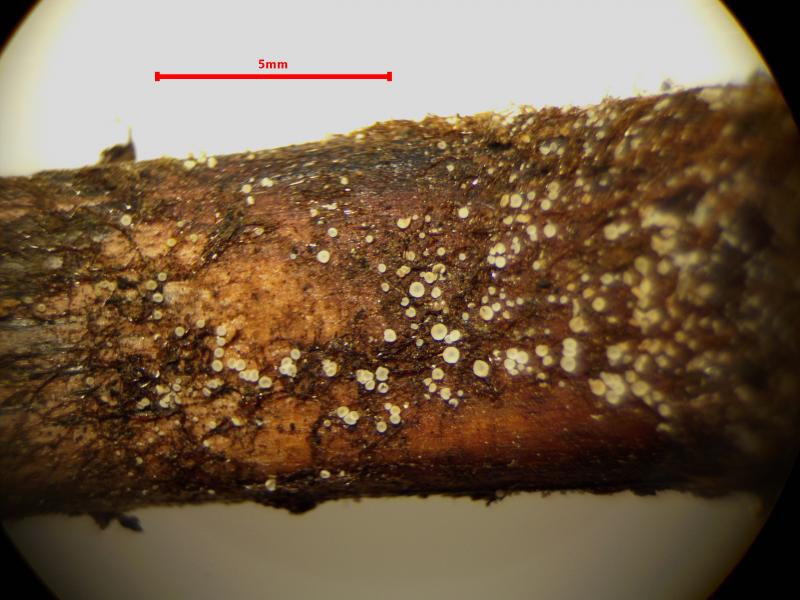
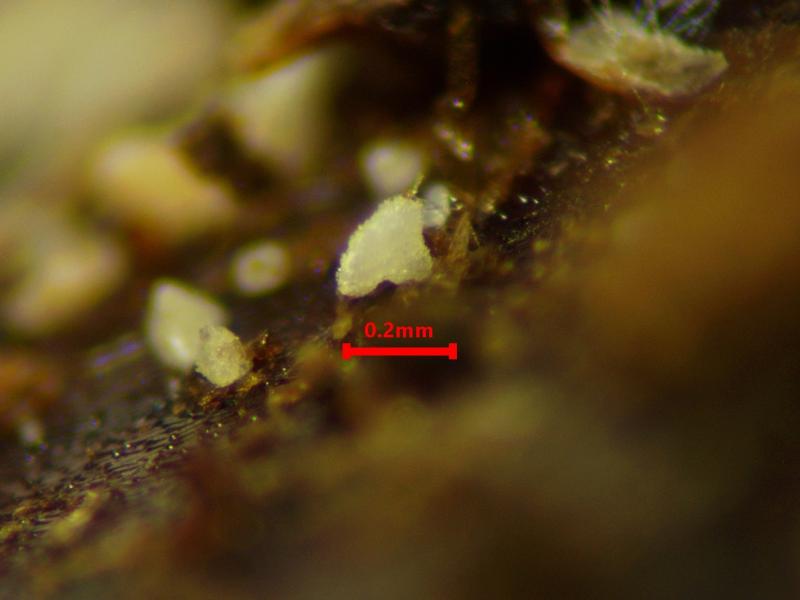
Swarms of white apothecia (0.1-0.2mm diameter) on surface of blackened Pteridium aquilinum (Bracken) stems, just below ground level.
Apothecia with short stalks
Superficial on the substrate surface (ie nor emerging from within the stem).
All white - no differentiation in colour between the internal hymenial disc, rim or external (ectal) surface.
No marginal hairs evident
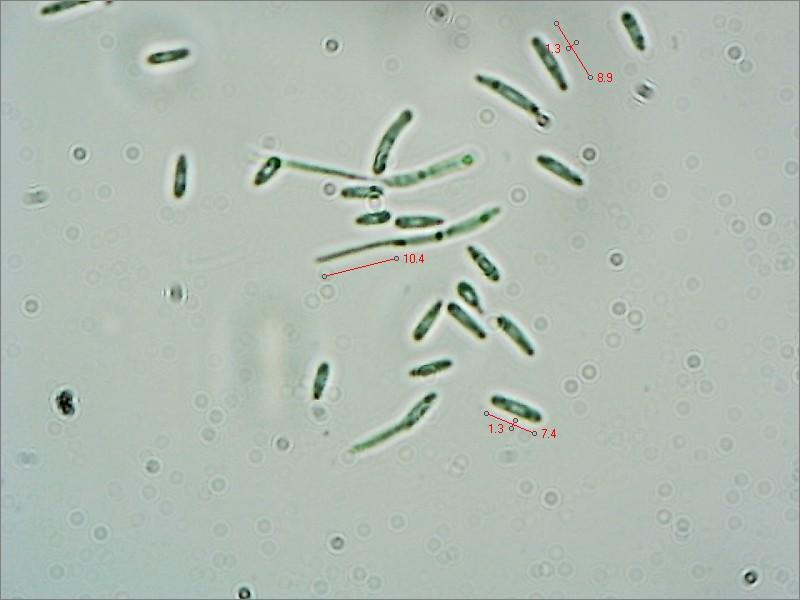
Ascospores (5.7-) 6.4 (-9.3) x (1.0-) 1.5 (-1.8) n=10 with guttules at each end.
In the UK, collections like this appear to be recorded as Micropodia pteridina, supported by the entry in Ellis & Ellis Microfungus on Land Plants (2nd Ed. 1997).
However, Zotto Baral (Micropodia pteridina, a misinterpreted fern-inhabiting discomycete with unclear relationship within the Helotiales, Baral H.-O., 2023, ascomycete.org 15 (1): 1-8) points out there are several confusion species:
Psilachnum sp. (chrysostigma agg.)
Fuscolachnum pteridis (sessile and with marginal hairs so ruled out in this case?)
Mycroscypha arenula (but only on leaves, not stems?)
Mollisia sp.
According to Zotto's paper, these species can be differentiated with regard to exicipular structure, presence/absence of marginal hairs and apothecial stipe and apothecial development.
I have the opportinity to ITS barcode but with no publicly available reference sequences for M. pteridina, is there any benefit?
Tony Moverley
Norfolk Fungus Study Group
Hans-Otto Baral,
27-04-2026 20:13
Re : Micropodia pteridina?
Hi Tom
it is a good idea to obtain a sequence. The true M. pteridina is sessile and erumpent. This one has a short stipe. I am quite sure this is the sibling of Psilachnum chrysostigma, differing in the ascus base (without croziers). Do you think you can verify this? Only from the spores there is no real differences. I recommend to mount in Congo Red by strong pressure to separate the elements.
Zotto
Tony Moverley,
27-04-2026 21:23
Re : Micropodia pteridina?
Hi Zotto,
Thanks for the help.. I did try without success to find some asci bases to check for croziers, having seen you mention that Mariko Parslow examined 2 collections in the Kew fungarium labelled 'Micropodia pteridina' which turned out to be Psilachnum sp. (lack of croziers). I'll try looking again.
All the best Tony
Thanks for the help.. I did try without success to find some asci bases to check for croziers, having seen you mention that Mariko Parslow examined 2 collections in the Kew fungarium labelled 'Micropodia pteridina' which turned out to be Psilachnum sp. (lack of croziers). I'll try looking again.
All the best Tony
Tony Moverley,
29-04-2026 20:21
Re : Micropodia pteridina?
So I've tried again to look for the bases of any asci but without any real success. I think I might have found some but my confidence in proving a negative (ie that the base are simple sepate as opposed to having croziers) is low.
In the absence of the asci base feature, is there anything definitive I can say about this collection? ie that is definitely NOT M. pteridina because I have short-stalked apothecia . . .
In the absence of the asci base feature, is there anything definitive I can say about this collection? ie that is definitely NOT M. pteridina because I have short-stalked apothecia . . .
Hans-Otto Baral,
29-04-2026 20:38
Re : Micropodia pteridina?
I think the question is only if it is P. chryststigma or P. basi-pteridii. The former I never saw on blackened substrate, so I would exclude it. The croziers is virtually the only difference between the two.
Tony Moverley,
30-04-2026 08:58
Re : Micropodia pteridina?
Hi Zotto, Thanks for that. Forgive my confusion here.
Do you have a description or protologue for Psilachnum basi-pteridis Baral nom. prov.? All I can find is on the CEMAS website:
https://www.centrodeestudiosmicologicosasturianos.org/?p=28526
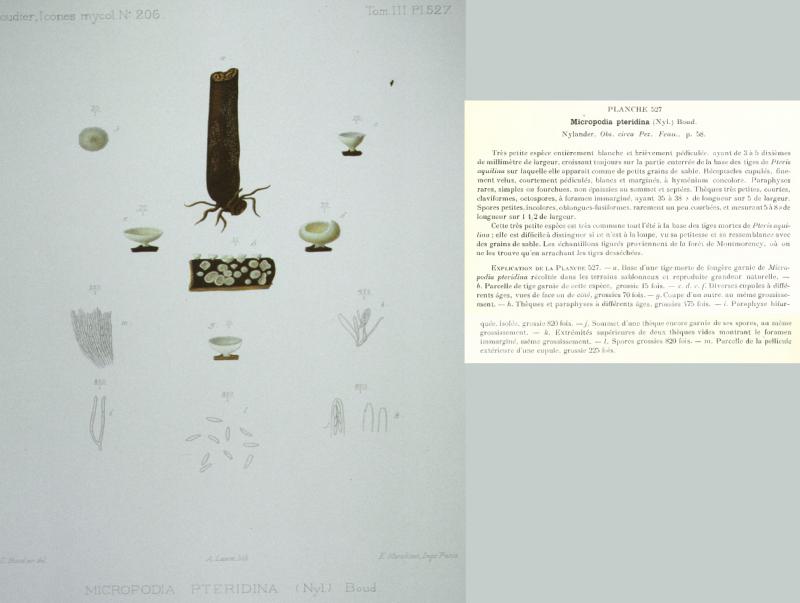
This shows a picture and description of Nylander's Micropodia pteridina (attached) on blackened stems with 'brievement pediculee' (short stalk/foot) and what appears to be simple sepatate asci bases. So is this actually a Psilachnum sp.?
Do you have a description or protologue for Psilachnum basi-pteridis Baral nom. prov.? All I can find is on the CEMAS website:
https://www.centrodeestudiosmicologicosasturianos.org/?p=28526
This shows a picture and description of Nylander's Micropodia pteridina (attached) on blackened stems with 'brievement pediculee' (short stalk/foot) and what appears to be simple sepatate asci bases. So is this actually a Psilachnum sp.?
Hans-Otto Baral,
30-04-2026 09:18
Re : Micropodia pteridina?
P basi-pteridis is undescribed, one reason is that no sequence exists.
About M. pteridina I recommend you to read my article in Ascomycete.org, 15 (1) : 1–8.
Boudier did not care about croziers, he never illustrated one as far as I know. Since M. pteridina was insufficiently described, he made this misidentification.
Tony Moverley,
30-04-2026 09:26
Re : Micropodia pteridina?
Thanks Zotto. I have read your article in Ascomycete.org, 15 (1) : 1–8 several times and I'm still trying to understand exactly what is going on!
All the best Tony
All the best Tony