
06-02-2017 20:07
Vivien HodgeThis Arnium was first found on 3-2-2017 on cow (Bo

06-02-2017 19:56
 Enrique Rubio
Hi to everybody. Hi Christian (by the way, what a
06-02-2017 06:44
Ethan CrensonIn Brooklyn, NYC on hardwood, possibly Fagus. In
06-02-2017 02:41
Ethan CrensonFound this on cones of Pinus sylvestris in Brookly
06-02-2017 10:50
 Blasco Rafael
Hola, alguno de Ustedes dispone de estos Articulos
04-02-2017 17:54
Carmel SammutFound this ascomcete in the North of Malta growing
Calycina ?
Patrice TANCHAUD,
06-02-2017 17:57
récolte sur pin dans un lieu incendié. Asques 30-38 µm. Spores 4-6 x 1,5-2,2 µm. Paraphyses simples.
Merci d'avance pour vos avis.
Patrice
 Doc1-0034.pdf
Michel Hairaud,
06-02-2017 18:20

Re : Calycina ?
Bonsoir Patrice,
Ta récolte est à rechercher dans le genre Ciliolarina. Pour l'espèce, c'est moins facile...
Michel
Ta récolte est à rechercher dans le genre Ciliolarina. Pour l'espèce, c'est moins facile...
Michel
Hans-Otto Baral,
06-02-2017 19:03

Re : Calycina ?
Yes, it could be Ciliolarina. Perhaps C. neglecta. But you ned to see short rough hairs at the margin. Did you see any parapahyses, are they with VBs?
With Melzer you mean Melzer?
Zotto
With Melzer you mean Melzer?
Zotto
Patrice TANCHAUD,
06-02-2017 22:29
Re : Calycina ?
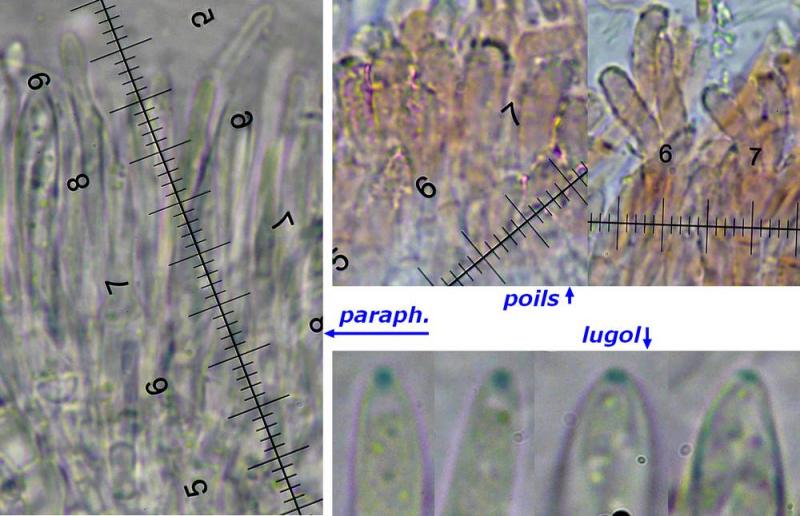
Merci Michel et Zotto pour vos interventions et de m'avoir aidé à aller dans le bon genre. Voici un peu plus de micro. Zotto, ma 1ère photo du sommet des asques était bien dans le melzer.
Patrice
Patrice
Hans-Otto Baral,
06-02-2017 23:13
Re : Calycina ?
Yes, clearly Ciliolarina!
Some species have hemiamyloid asci, so with melzer you will overlook this.
Some species have hemiamyloid asci, so with melzer you will overlook this.
Patrice TANCHAUD,
06-02-2017 23:19
Re : Calycina ?
Thanks Zotto. I see one paper on your DVD for C. neglecta, it seems close.
Hans-Otto Baral,
07-02-2017 07:58
Re : Calycina ?
Patrice TANCHAUD,
07-02-2017 18:18
Re : Calycina ?
Yes, I saw some photos. Thanks, beautiful work of course.
Patrice
Patrice