
08-04-2026 20:33
 Vasileios Kaounas
Found 07-04-26, in Abies cephalonica. Diameter 1,
08-04-2026 10:39
FRANCIS FOUCHIERBonjour , je recherche en pdf cet article: KORF R

06-04-2026 21:36
 Viktorie Halasu
Hello, could anyone please send me the article wi
06-04-2026 19:40
 David Gibbs
Help with this one much appreciated, on rotting Fa
06-04-2026 11:07
Louis DENYBonjour forum, Trouvé sur bois de feuillu très d
06-04-2026 16:24
Juuso ÄikäsLast Tuesday I found some tiny white Helotiales gr
Baited fungus, help with ID.
Spooren Marco,
31-12-2025 19:27

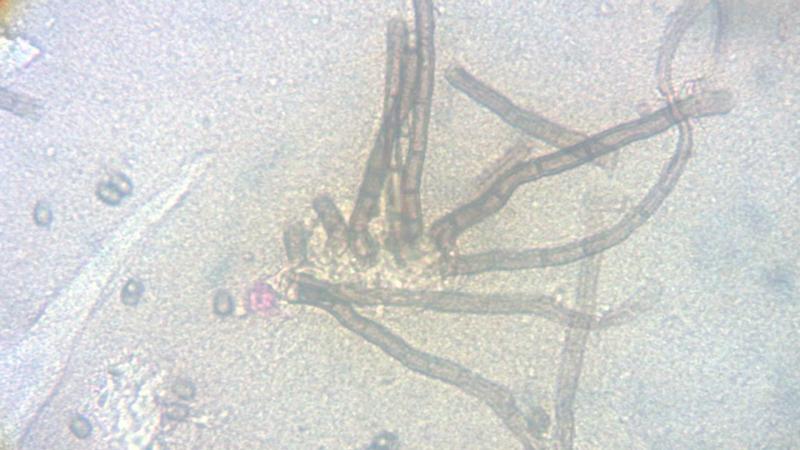
Collected from loamy soil, at waterside (completely wet soil thus )and baited on aquarellpaper,I detected a very small set of fungi, one anamorph, as depicted, and a perithecial fruitingbody assumely the teleomorph.
The other photograph depicts conidia, or ascospores from te ascomycete.The perithecia were to scanty and, mostly, to small ot prepare from the paper.The anamorph is captured under cellotape.
I do not have a clou where to search for the fungus/ fungi (I do not give mesurement at this point )if, a.i photograped conidia, b. I made a photograph of some, to me, strange spores.
Maybe someone has an idea ?(Giving pictures of the conidiogeous cell would be premature now, I think. )

Albert Ibars,
01-01-2026 08:05

Re : Baited fungus, help with ID.
Considering the cellulose-baiting from wet soil, some of the fungi involved are likely cellulolytic.
The brown spores show a general resemblance to Chaetomium-like ascospores, but this should be treated with caution in the absence of asci or perithecia.
The brown spores show a general resemblance to Chaetomium-like ascospores, but this should be treated with caution in the absence of asci or perithecia.
The conidiomatous structure could be Botryotrichum-like, a genus often associated with Chaetomium.
With the data currently available, this remains speculative and is only intended as a possible line of thought, should you wish to explore it further.
Best regards
Spooren Marco,
01-01-2026 15:22
Re : Baited fungus, any idea ?
Baiting with that paper is for collecting cellolytic fungi.So no suprise.
The idea about th anamorph is a nice one worth to dive in the literature for.
It is by no means a Chaetomium however from which are the black spores.The perithecia I mentioned lacked hairs or setae.Chaetomium has, as far I am aware, no spores with appendages, as seen on my photo.It is like a collarette, and realizing that, i remember seen pictures , or life material, of such spores. In the Sordariales ?