
10-06-2026 13:41
 François Freléchoux
Bonjour à nouveau, Voici une trouvaille d'hier.
10-06-2026 11:53
Steve ClementsBonjour, This disco is abundant on dead stems of
10-06-2026 12:54
Steve ClementsBonjour encore, Pouvez-vous m'aider, s'il vous pl
10-06-2026 10:45
François Freléchoux
Bonjour à nouveau, Encore une détermination qui
08-06-2026 10:16
 Spooren Marco
I don`t have a clou about this fungus,it is not in
10-06-2026 09:24
François Freléchoux
Bonjour, J'imagine que cette détermination ne do
09-06-2026 18:32
Camille MertensSur morceau de roseau immergé 0,5 - 0,7 mm de dia
08-06-2026 17:00
François BartholomeeusenGood day everyone, On June 5 2026, I collected de
07-06-2026 15:10
 William Slosse
Hello everyone,On 05-06-26, I found following asco
 Hello,
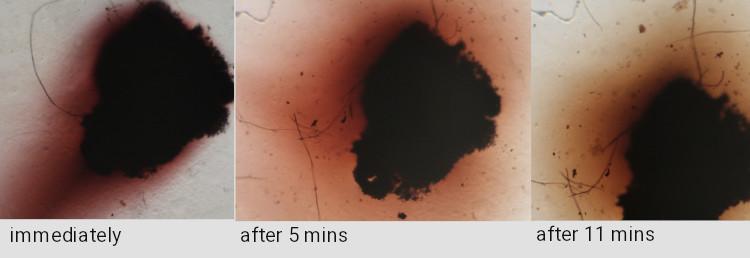
I've found here a Hypoxylon (or Hypomontagnella?) which looks like Hm. submonticulosa, but with longer spores better fitting those of Hm. austrobahiense. The extracted pigments are particular too - there is mostly violet pigment, but smaller amount of mostly brown (or rusty brown?) appeared too.
Two samples from the same riparian lowland hardwood forest, wet area, on decorticated wood laying on the ground. First on 10. Oct. 2021, on muddy bank of a periodically flooded depression, the other 9. Sept. 2022 on a ring-porous wood (Fraxinus?), on another place but with higher air humidity as well.
Is this still within the variability of Hm. submonticulosa?
Thanks a lot for an advice.
Viktorie
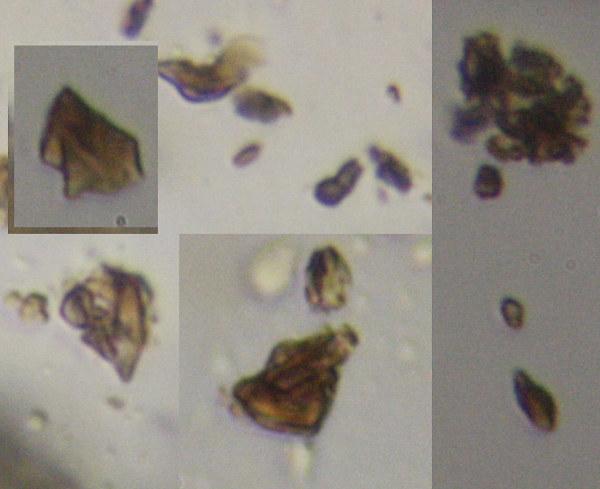
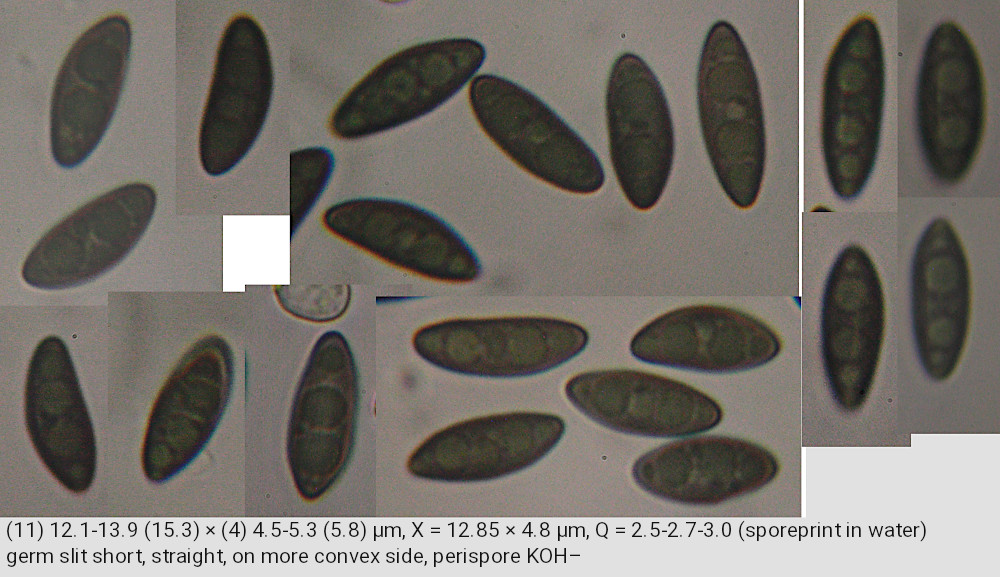
This is the first (2021) sample, spore size: (11) 11.6-13.8 (14.5) × (4.1) 4.6-5.5 (5.6) um, X = 12.5 × 5 um, Q = 2.2-2.5-2.9 (sporeprint in water).
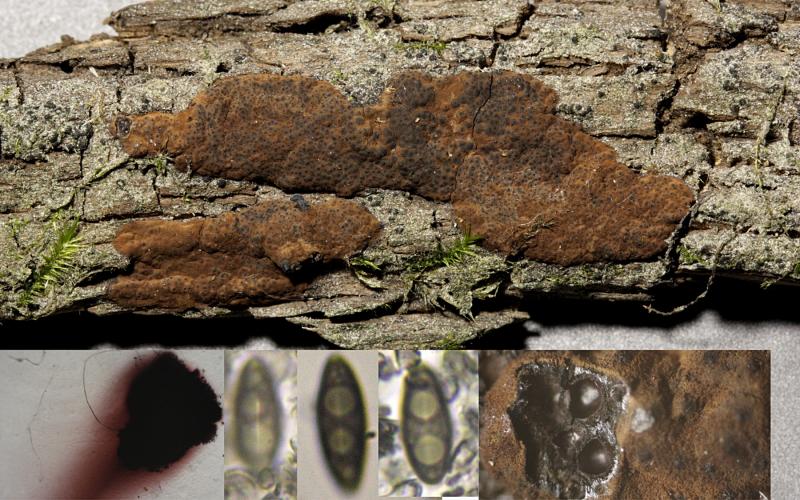
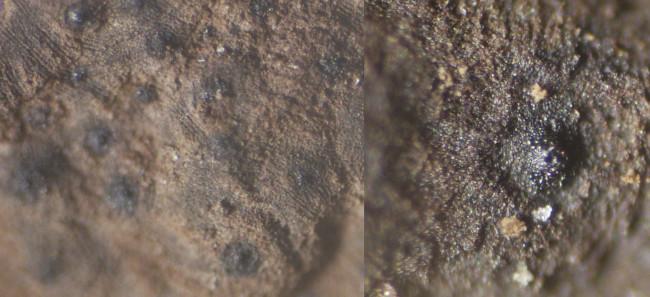
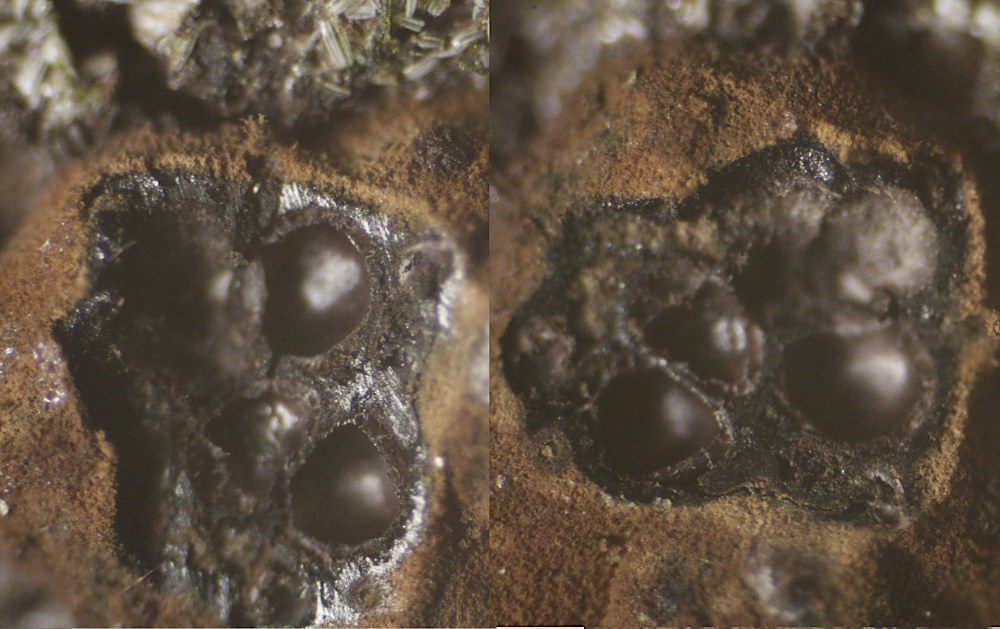 IMG-39407-makroCut-0001.JPG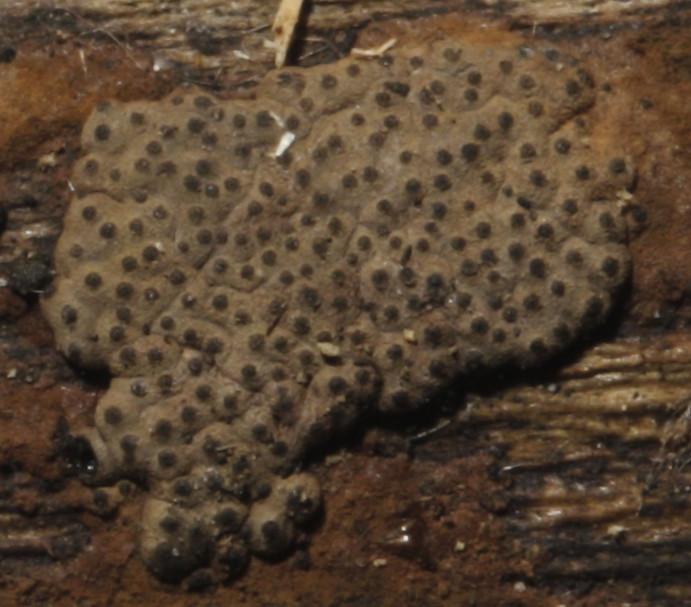
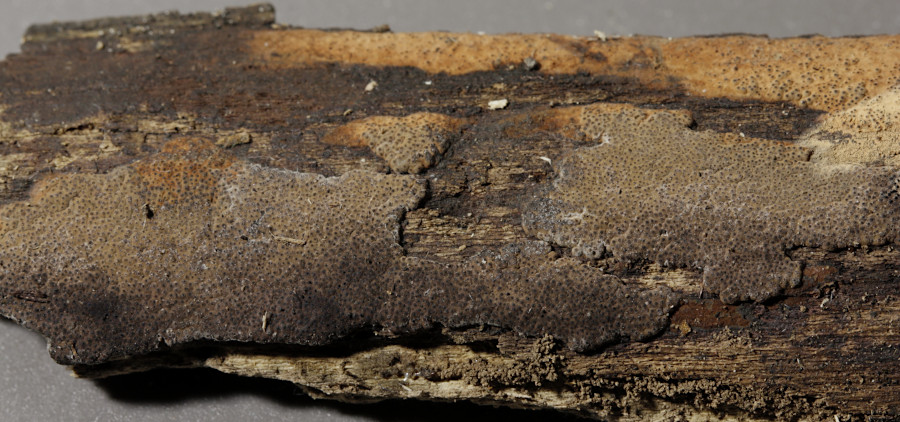 -MG-1527-cr900w-0001.JPG
 spores-0001.JPG
I think this is a very interesting, likely undescribed species, indeed related to H. submonticulosa.
First the carbonaceous nature of the stroma and the conic-papillate shape of ostioles should be clearly assessed to make sure you are in the good genus.
In the 2016 key to the species of Hypomontagnella, germ slit length is a key feature, not always easy to make out in water. Try in 10% KOH, heated chloral-lactophenol or Melzer. From what I guess from your images, it might be longer than what you recorded.
Keep in mind that it is located on the convex side and that it may be difficult to focus on its whole length, especially for a photo.
Anyway, spore dimensions and, above all, their narrowly ellipsoid outline does not fit well the known species.
Cheers,
Jacques
thank you very much. I'll try to make sure how exactly does the germ slit look like, on a better microscope. I havent seen old stromata yet so I don't know whether it too has black metallic look like submonticulosum. Fortunately, the locality is close to my home.
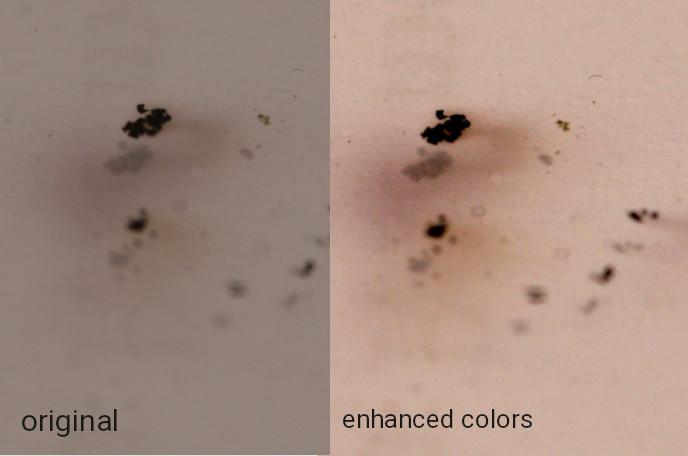
How do you interpret the pigments - does H. submonticulosum have the same brown pigment too, or violet one only? It looked like two separate pigments, brown one extracted a little bit later (or slower) than violet one, not oxidation. The photo from 2022 collection is taken 22 mins after adding 3% KOH, both colors still unchanged.
Viktorie
all your images of pigments show a reddish to purple colour, typical for submonticulosa and monticulosa, just varying in intensity with the age of the stroma and time of incubation.
In these species, the stroma is entirely carbonaceous and lacks colored granules inside. The pigments come from the superficial rust pruina which is composed of minute contorted hyphae with wall encrusted with minute brownish granules. You can easily observe under the microscopoe they turn purple when KOH is added to the prep and are responsible for the pigments observed with naked eye.
There is a photo in the 2022 file showing what might be brownish stromatic, crystal-like granules. Do you think they are related to this brown colour you mention? When you have them mounted in water under the microscope, check if they dissolve in contact with KOH and release any pigment.
If you are unsure, just mail me a part of a sample, air-dried and wrapped in paper and I will try to figure out what we can make with your fungus.
Cheers,
Jacques
Jacques Fournier
"Las Muros"
F 09420 Rimont