
21-04-2026 22:14
Margot en Geert VullingsThis cup fungus was found on April 10, 2026, on lo
21-04-2026 13:36
Gernot FriebesHi,I am out of ideas for this one. I collected Sal
21-04-2026 13:19
Gernot FriebesHi,this Lophodermium on Typha has ascospores measu
21-04-2026 13:05
Gernot FriebesHi,this hyphomycete feels familiar but I was not a
20-04-2026 22:00
 Malcolm Greaves
These pale yellow, hairy ascos were growing on cul
19-04-2026 21:23
Steve ClementsBonjour, I found this anamorphic fungus on old pl
19-04-2026 20:46
Steve Clements1 mm diameter approx spherical conidiophores on pl
12-04-2026 17:56
 Hardware Tony
Found on dead stems in February earlier this year
17-04-2026 19:16
 Enrique Rubio
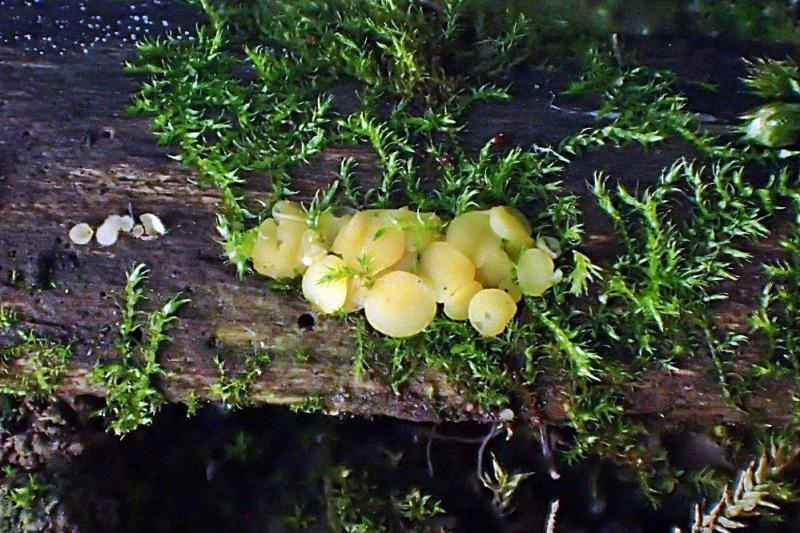
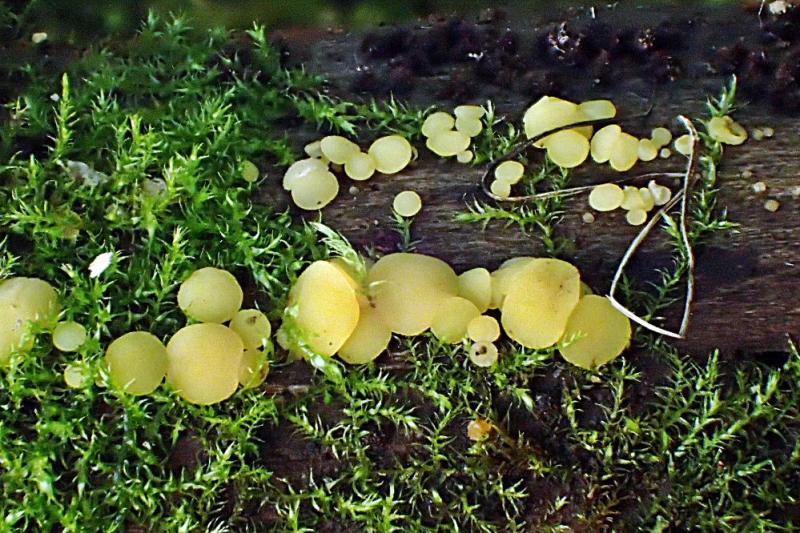
Hi to everybodyI would appreciate any assistance r
Asques longuement claviformes, 130-185 x 8-12 µm, crochets +, IKI très faiblement + mais pas certain (artefact ?).
Spores elliptiques avec de nombreuses gouttes jamais rangées de manière régulière et accompagnées de nombreuses guttules. Certaines spores sont plus étroites vers le centre. Quelques unes présentent une cloison. Hétérosporie importante : 14-21 x 5-6 µm.
Pas trouvé d'espèce correspondant surtout à cause de ces paraphyses très étrites et sans goutte.
Gilbert
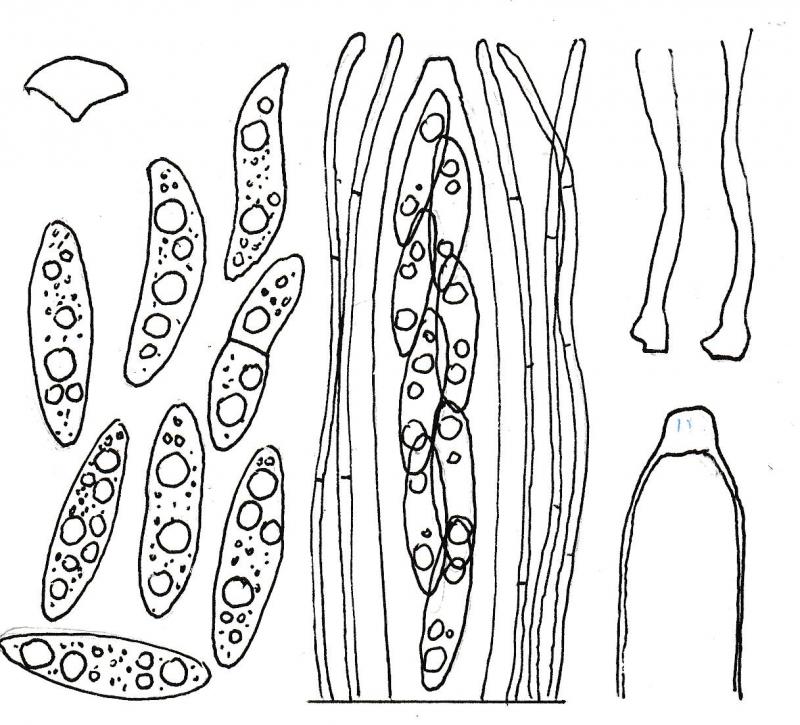

my first idea is Ph. monticola. Does anything not fit? The empty-looking paraphyses exclude Ph. epiphyllum (miltiguttulate), although Ph. monticola has elongate Vbs.
Zotto
Gilbert
If the subject is P. monticola, could you explain how this species differs from P. epiphylus?
Can the shape of the fruiting bodies also be an important feature during identification?
Sorry to ask but I still have trouble distinguishing them.
.
Thanks in advance.
Mirek
the colour is more yellow in monticola, more whitish-cream but also cream-yellow in epiphyllus.
The best character in my opinion is the content of the living paraphyses: multiguttulate VBs in epiphyllus, elongate VBs in P. monticola.
Genetically the two are very distant, therefore even the same genus is doubted.
Zotto
The first are large to several millimeters in diameter and grow on a variety of hardwoods. They are very common with me.
The other ones are very small, up to 1 mm in diameter, and I found them on leaves. The ones I present grew on Betula leaves.
Identical microscopic features?
Mirek
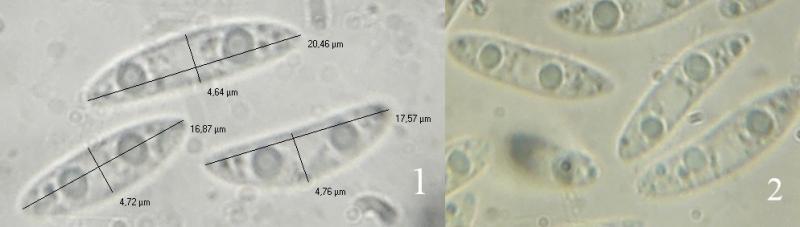
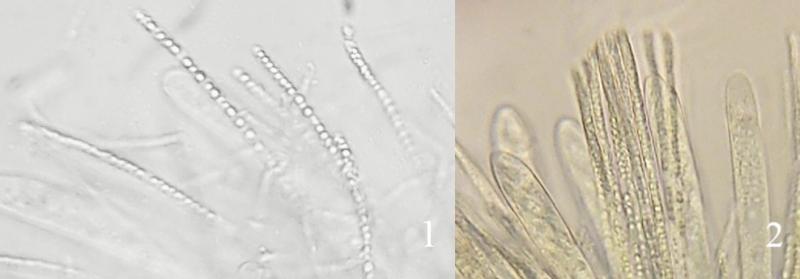
But the yellow colour of the first appears to be also possible in that species, and the VBs tell for that.
For instance, Hymenoscyphus epiphyllus, Eckel-1/2 looks like yours (I had it wrongly in monticola).
Your two samples do not look like very different in apo size, though.
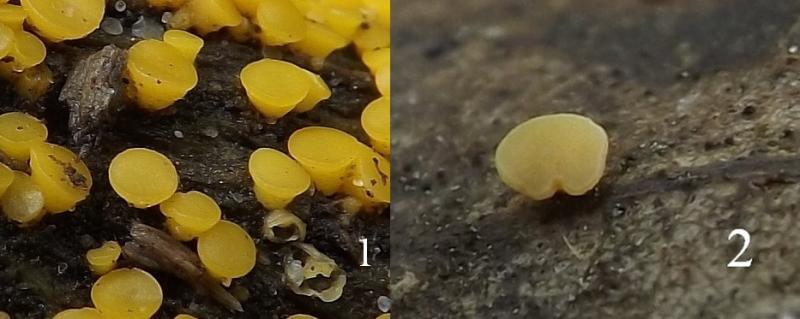
The others are on a 1: 1 scale
Fruitbodies marked with number 1 grow up to 6 mm.
I marked the number 2 with a maximum size of 1 mm.
Initially I marked them as Hymenoscyphus epiphyllus but without certainty.
thank you very much!
Mirek