
22-04-2026 01:06
 Richard VALERI
Bonjour à tous.Je vous présente cette Nectria s.
21-04-2026 13:36
Gernot FriebesHi,I am out of ideas for this one. I collected Sal
21-04-2026 13:19
Gernot FriebesHi,this Lophodermium on Typha has ascospores measu
21-04-2026 13:05
Gernot FriebesHi,this hyphomycete feels familiar but I was not a
20-04-2026 22:00
 Malcolm Greaves
These pale yellow, hairy ascos were growing on cul
19-04-2026 21:23
Steve ClementsBonjour, I found this anamorphic fungus on old pl
19-04-2026 20:46
Steve Clements1 mm diameter approx spherical conidiophores on pl
12-04-2026 17:56
 Hardware Tony
Found on dead stems in February earlier this year
Pyrenopeziza cf
Petra Eimann,
29-06-2019 17:19
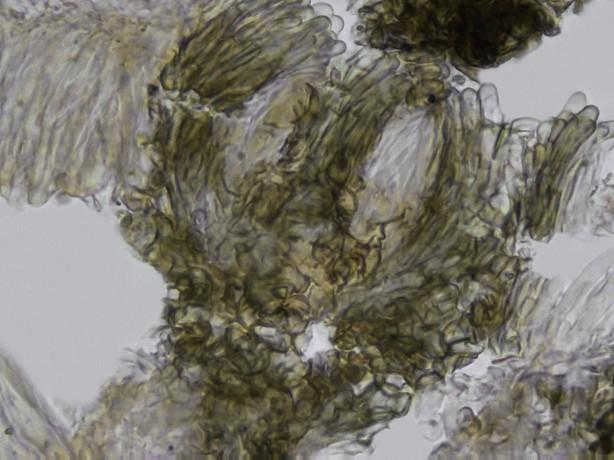
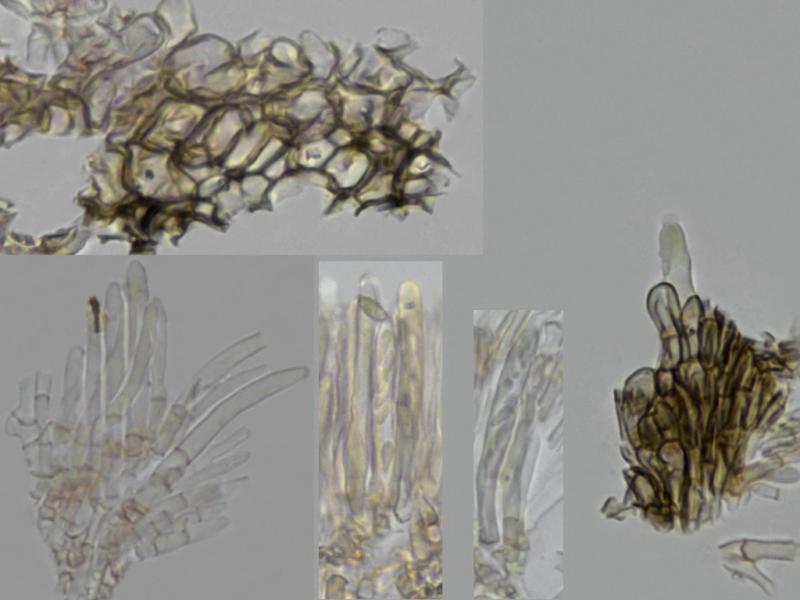
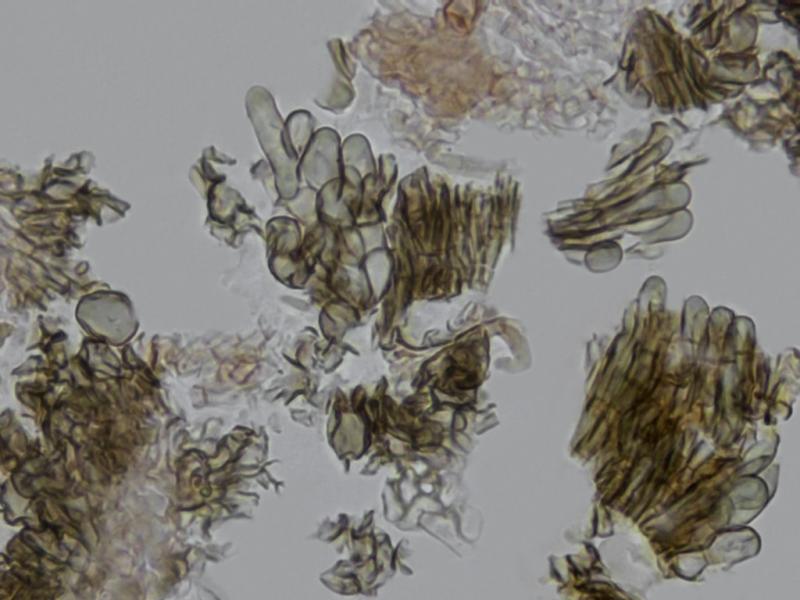
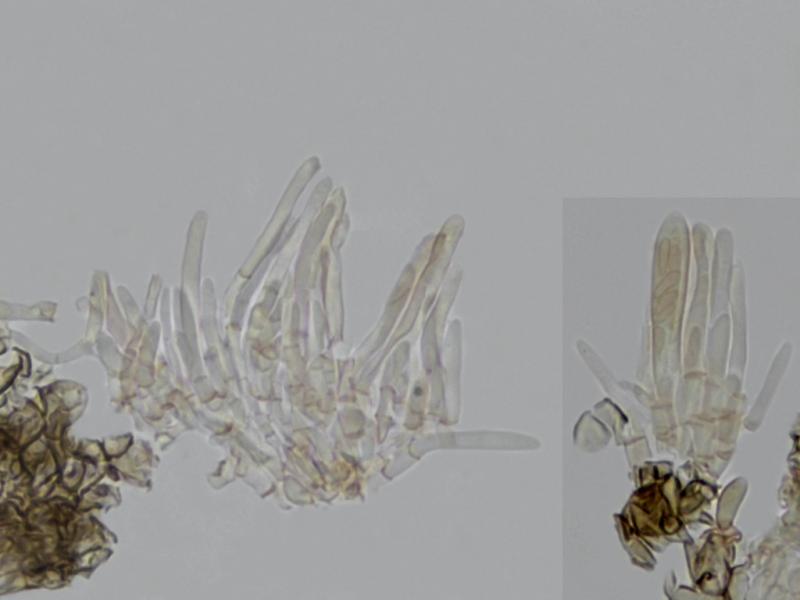
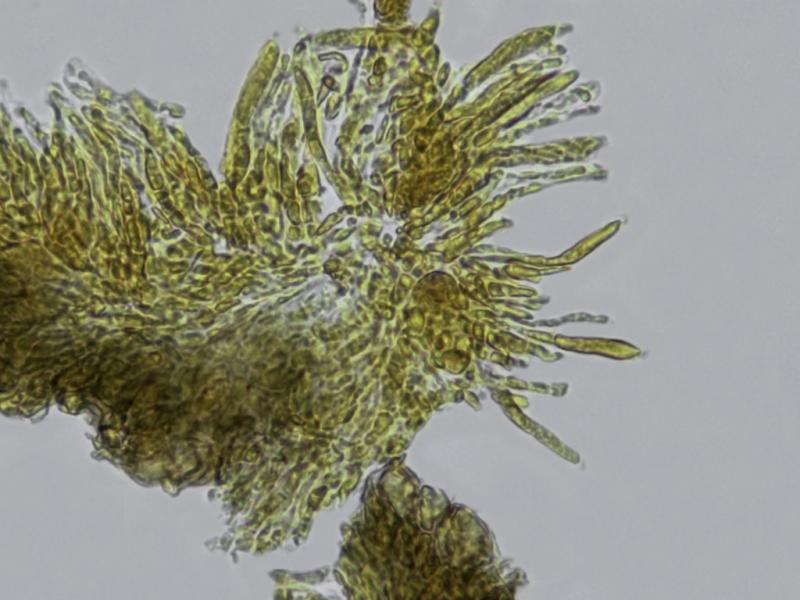
 Hello together, need some help. Found on 12.05.2019 on the inner side of substrate maybe Typha. Frkp. < 0,5mm, I can't find free spores, but in some Asci you can see spores. No IKI reaction. Maybe Pyrenopeziza, but I have no Key, so maybe someone knows the species.
Greetings Petra
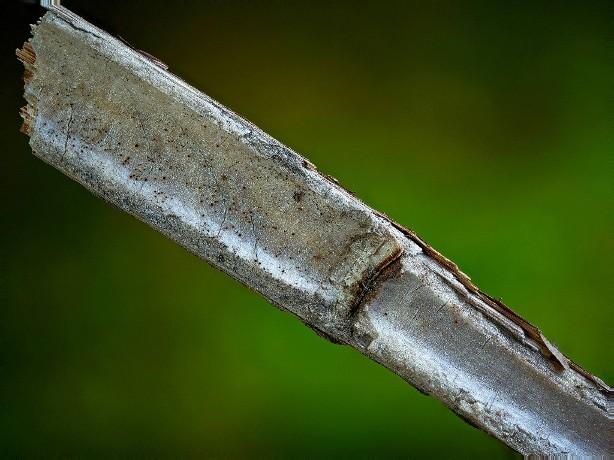
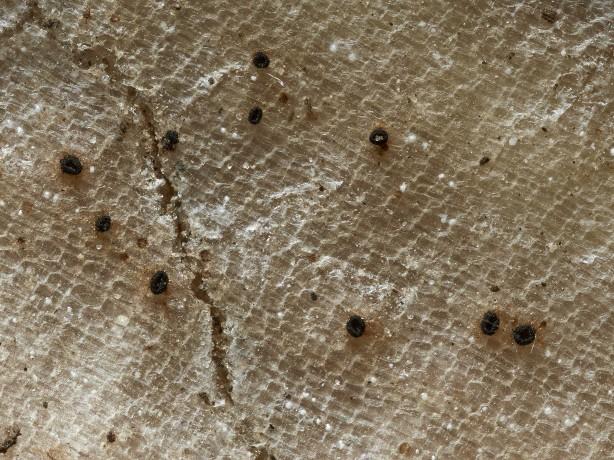
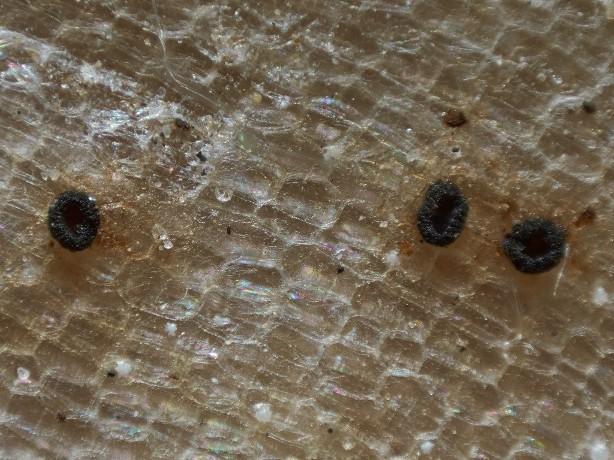
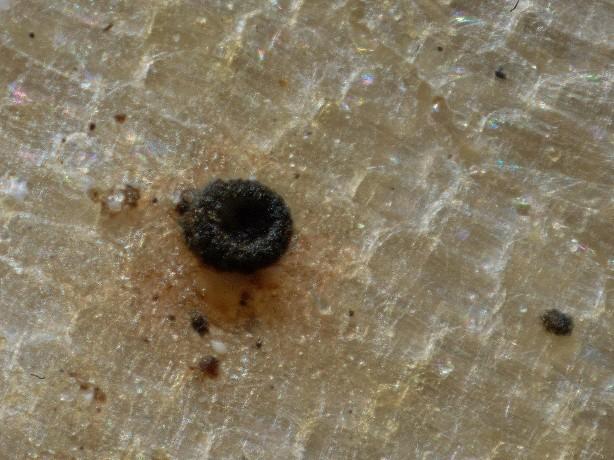
Hans-Otto Baral,
29-06-2019 21:37

Re : Pyrenopeziza cf
Hi Petra
the microscopic appearance is actually that of a Pyrenopeziza, but I would not trust without having seen living elements, especially paraphyses, in order to exclude a Mollisia.
The cuneate spores seem characteristic. For an identification a scale or spore size would be obligatory. I assume the spores are rather small. Inamyloid asci are rare, did you use Lugol or Mellzer? Your photo in iodine suggests an amyloid apical ring, isn't it?
Zotto
the microscopic appearance is actually that of a Pyrenopeziza, but I would not trust without having seen living elements, especially paraphyses, in order to exclude a Mollisia.
The cuneate spores seem characteristic. For an identification a scale or spore size would be obligatory. I assume the spores are rather small. Inamyloid asci are rare, did you use Lugol or Mellzer? Your photo in iodine suggests an amyloid apical ring, isn't it?
Zotto
Petra Eimann,
30-06-2019 00:08
Re : Pyrenopeziza cf
Hi Zotto,
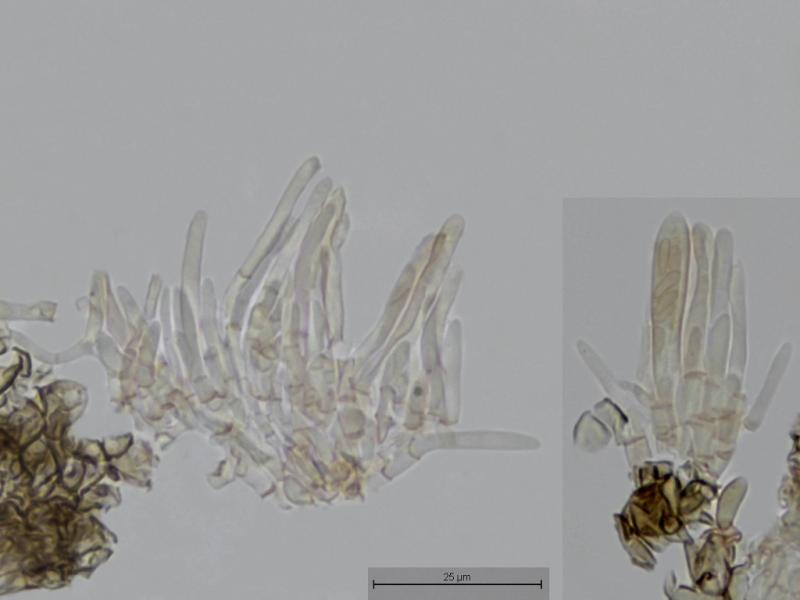
thank you for your opinion, unfortunately I did not find any free spores. The spores in the Ascus have the following dimensions:
5,45 x 1,82, 5,39 x 1,71, 4,75 x 1,85, 5,95 x 2,05, the scale I inserted into the picture. I used Lugol. Unfortunately I cannot judge the photo in iodine correctly whether it is an apical amyloid ring or not. There is an exsikkat available which I could send if necessary.
Petra
thank you for your opinion, unfortunately I did not find any free spores. The spores in the Ascus have the following dimensions:
5,45 x 1,82, 5,39 x 1,71, 4,75 x 1,85, 5,95 x 2,05, the scale I inserted into the picture. I used Lugol. Unfortunately I cannot judge the photo in iodine correctly whether it is an apical amyloid ring or not. There is an exsikkat available which I could send if necessary.
Petra
Hans-Otto Baral,
30-06-2019 10:10
Re : Pyrenopeziza cf
o.k., this means indeed small spores. With so small asci it is difficult to photograph the apical ring. Beter is to judge directly under the mic. Sorry, I have no time for that,´.
But a suggestion for a species I do not have.
My monocot folder of Pyrenopeziza gives spore sizes, and only one (on Acorus) has so small and narrow spores, but these are not tapered below.
But a suggestion for a species I do not have.
My monocot folder of Pyrenopeziza gives spore sizes, and only one (on Acorus) has so small and narrow spores, but these are not tapered below.
Petra Eimann,
30-06-2019 13:51
Re : Pyrenopeziza cf
Thank you Zotto. Then it's still called Pyrenopeziza cf.
Petra
Petra
Petra Eimann,
06-07-2019 22:19
Re : Pyrenopeziza cf
Hi Zotto,
Is it possible that it is not Pyrenopeziza but Pirottaea imbricata?
LG Petra
Is it possible that it is not Pyrenopeziza but Pirottaea imbricata?
LG Petra
Hans-Otto Baral,
06-07-2019 22:28
Re : Pyrenopeziza cf
P. imbricata I know with apically pr laterally thick-walled hair-cells, I do not see them here.
Petra Eimann,
06-07-2019 23:07
Re : Pyrenopeziza cf
Thank you Zotto, I suppose another genus is out of the question. LG Petra