
11-05-2016 20:37
 Zuzana Sochorová (Egertová)
Hi,this very little ascomycete grew on soil in a m
08-05-2026 11:55
Gernot FriebesHi,found on a decorticated Picea abies branch stil
09-05-2026 07:37
Zuzana Sochorová (Egertová)
Hello,please, could anyone share this paper?Ferná

05-05-2026 22:40
Gernot FriebesHi,I believe this is a Plagiostoma growing on a Sa
06-05-2026 11:25
 Castillo Joseba
Me mandan el material seco de Galicia (España) re
06-05-2026 17:23
Thomas Læssøehttps://svampe.databasen.org/observations/10594257
28-04-2026 20:07
 Lothar Krieglsteiner
... on twig in the air at standing Ceratonia siliq
04-05-2026 18:13
 Stephen Martin Mifsud
ID request for what seems to be a true aquatic fun
04-05-2026 16:39
Stephen Martin Mifsud
ID request: This specimen was collected in Malta o
Trichopeziza mollissima probable # 50620
Roland Labbé,
16-02-2017 02:40
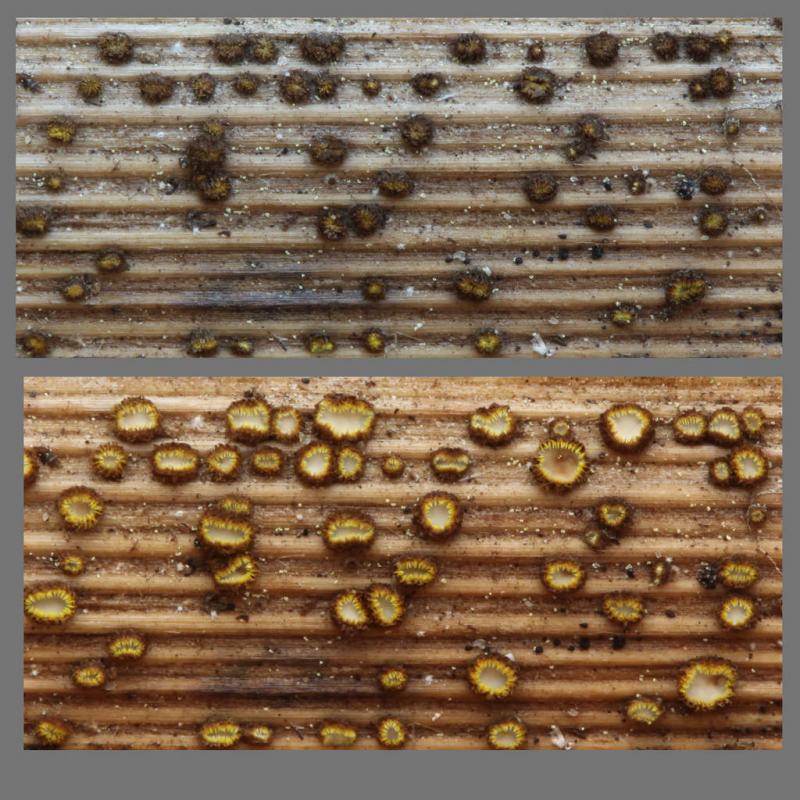
Voici un disco que nous croyons être du groupe Trichopeziza mollissima ?
Merci pour aider à son identification.
Amitiés !
Roland
Données :
Hôte : tige de renouée japonaise (Fallopia japonica var. japonica)
Apothécie : 1-2 mm de diam. (spécimen frais)
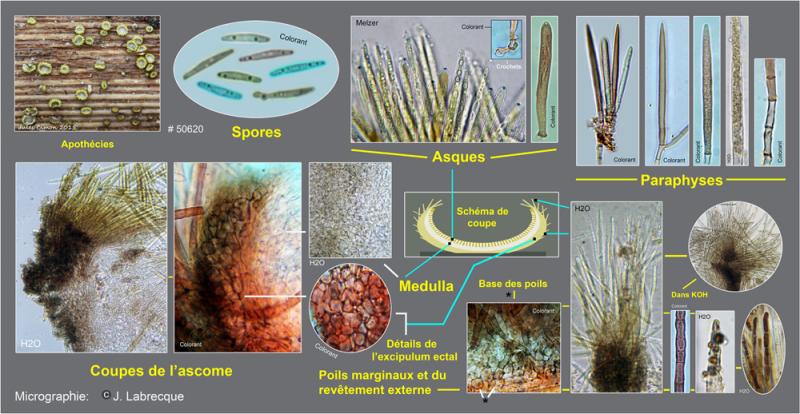
Spores cylindriques-fusoïdes, lisses, non septées, avec deux petites guttules polaires, hyalines, 8,6-10,5 x 1,4-1,5 µm, Q = 6,5
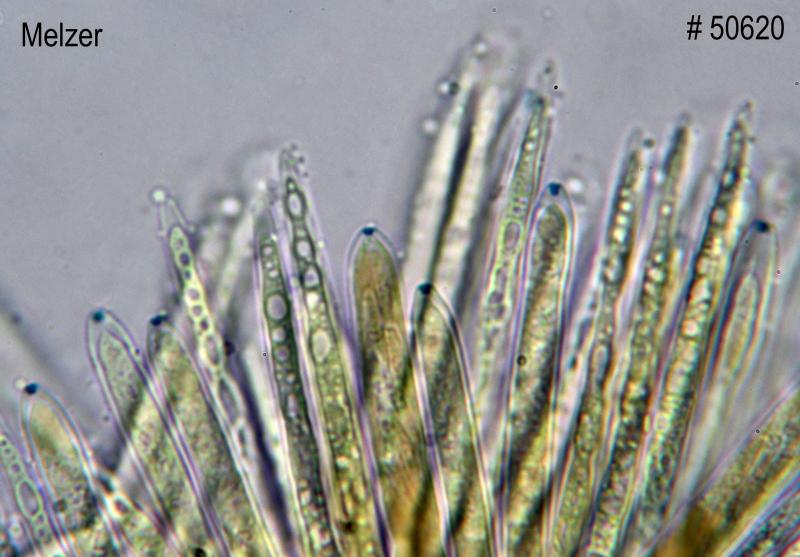
Asques cylindriques, à 8 spores bi ou trisériées (?), avec crochet à la base et pore apical amyloïde, à contenu dextrinoïde, 48,3-56 x 5-7 µm
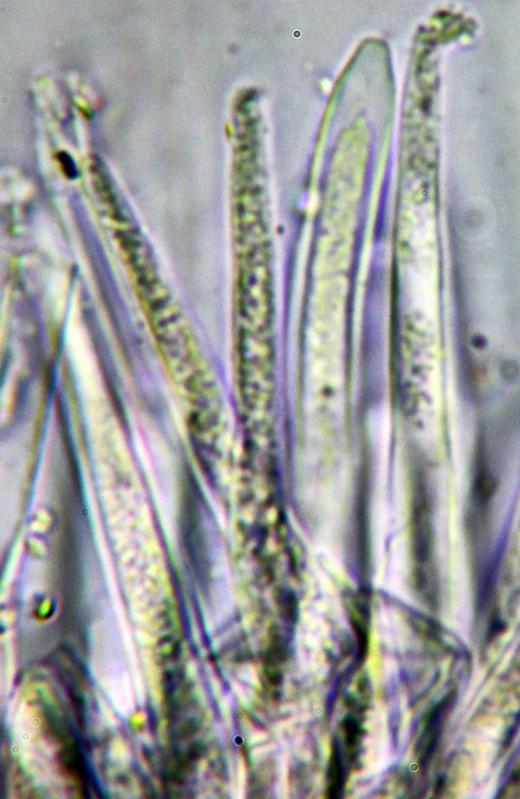
Paraphyses lancéolées, parfois ramifiées à la base, septées, à paroi modérément épaissie, à conte-nu entièrement huileux et finement granuleux (spécimen réhydraté), 51,4-52,5 x 3,1-3,3 µm, dépassant les asques de 9,3-10,7 µm
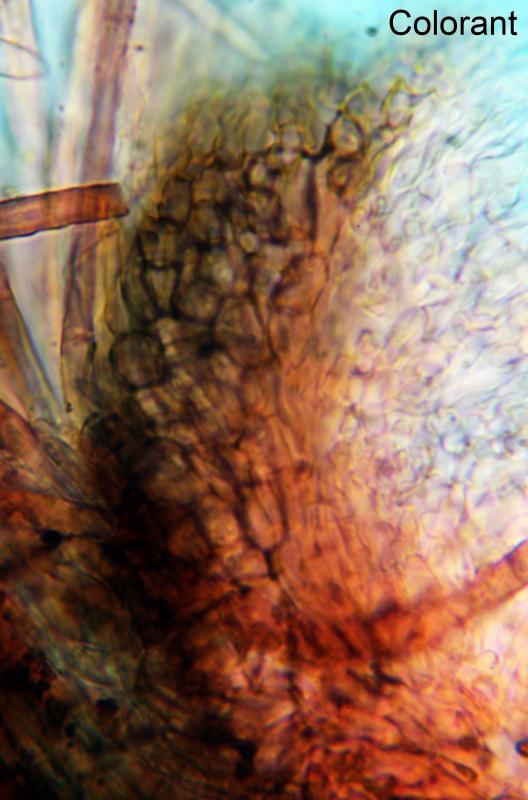
Medulla en textura epidermoidae, formée de cellules ± gélatinisées et hyalines
Excipulum ectal en textura globulosa angularis et prismatica (?)
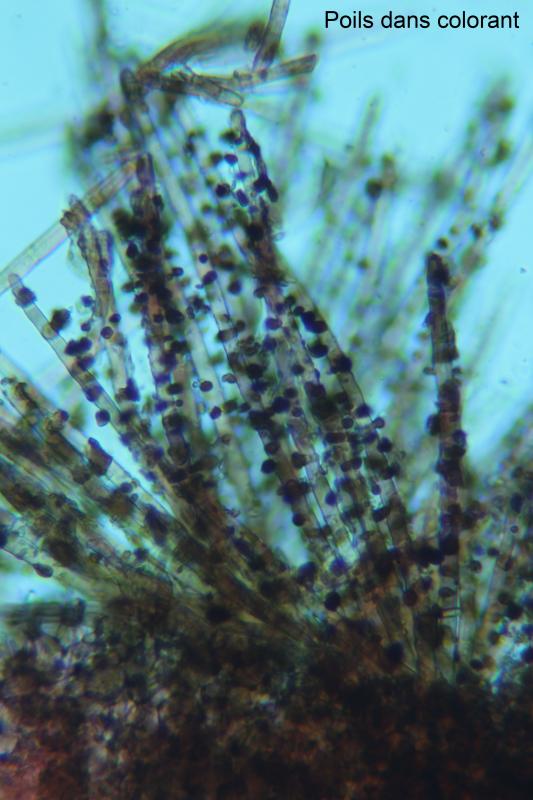
Poils externes et marginaux abondants, cylindriques, un peu renflés à la base, avec septa épais, à paroi 0,7 à 1,4 µm de diamètre, à contenu jaune à jaune olivâtre sur les 2/3 vers l'apex, brun plus foncé vers la base, fortement couverts d'incrustations souvent subglobuleuses, brun foncé et adhérant à la paroi externe, 123,5-240 x 3,2-5,5 µm
Explication :
3ème photo = asques dans le Melzer
4ème photo = coupe du disco
5ème photo = paraphyses
6ème photo = poils externes dans colorant
Hans-Otto Baral,
16-02-2017 07:56

Re : Trichopeziza mollissima probable # 50620
Yes, it belongs in this group which is very complicated and requires molecular study. It was probably a mistake to put T. mollissima and T. leucophaea in synonymy, at least it is so that purely white populations (T. mollissima in the original sense) are not the same as yellow ones for which at present no published names exist.
These brown lumps of exudate occurred in various collections and their taxonomic value is not explored. I think they dissolve in KOH and yield a red-brow stain to the medium.
Zotto
These brown lumps of exudate occurred in various collections and their taxonomic value is not explored. I think they dissolve in KOH and yield a red-brow stain to the medium.
Zotto
Roland Labbé,
17-02-2017 06:14
Re : Trichopeziza mollissima probable # 50620
Merci, Zotto !
You are a very efficient for us.
L'équipe de Québec.
You are a very efficient for us.
L'équipe de Québec.