
25-03-2026 20:53
François BartholomeeusenDear forum members,On 23 March 2026, I found sever
23-03-2026 20:16
 Miguel Ángel Ribes
Good eveningI'm unable to identify this Coprotus o
24-03-2026 15:44
Åge OterhalsI hope someone can confirm the name of this collec
25-03-2026 15:06
 Bernard CLESSE
Bonjour à toutes et tous,Pourriez-vous me confirm
25-03-2026 10:35
Hulda Caroline HolteHello,I collected this species growing on a dead b
25-03-2026 13:54
 Enrique Rubio
Does anyone know where I could download Paoletti's
25-03-2026 15:46
 Michel Hairaud
Bonjour, Je sollicite de l'aide pour cette récol
24-03-2026 19:59
 William Slosse
Hello everyone,On 23/03/26, I found the following
21-03-2026 15:13
Lepista ZacariasHello everyone, Does any one know of any literatu
24-03-2026 21:37
Elisabeth StöckliBonsoir,Sur bois (tronc) très pourri de conifère
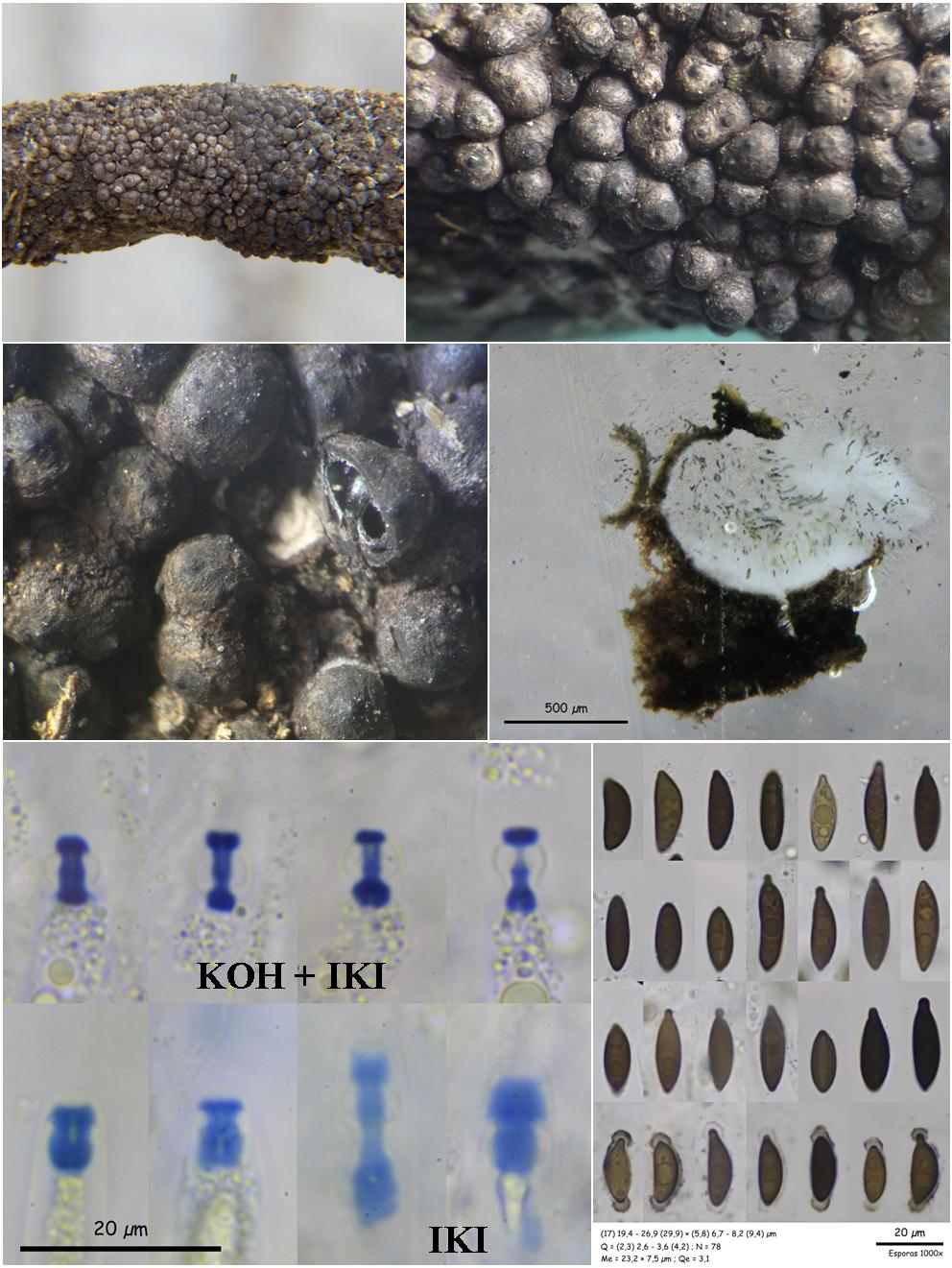
Esta Rosellinia la recogí en la primavera del año pasado, en Andalucía (España) a una altitud de 1290 m, creciendo en madera semienterrada de Genista cinerea.
Los ascomas miden hasta 1,5 mm y crecen sobre un subículo y las esporas miden (17) 19,3 - 26,4 (28,9) × (5,8) 6,7 - 8 (9,4) µm. ¿Podría ser R. britannica?
 Rosellinia-1-0001.jpg
a very interesting collection, as usual.
I do not think it is R. britannica which has smaller smooth stromata lacking subiculum at maturity.
Ascospores dimensions fit well indeed, bipolar slimy caps too but in R. britannica there is a thin, often inconspicuous slimy sheath on the flattened side, unlike what is shown on your photos where the sheath is over the convex side.
R. britannica proved to be a later synonym of R. marcucciana Ces. (Petrini 2013), thus adios britannica!
Your fungus may have affinities with R. aquila and R. corticium because of the large stromata associated with a subiculum. In this group ascospores have the germ slit on the most convex side, unlike in other groups. This should be checked first.
The presence of beaked ends is often in relation with the presence of cellular refractive appendages at one or both ends. This character is highly diagnostic and is often best seen on immature hyaline ascospores since it may disappear at maturity.
In Rosellinia, apical plugs of many species are fragile and easily ruptured upon mounting under the microscope. These stretched and odd-shaped apical plugs are atypical and should not be taken into account. I think the bottom left one is the most representative of an intact plug. Dimensions of intact apical plugs are likewise imortant to record.
Saludos,
Jacques
He estado revisando mis fotos y la ranura germinativa está en el lado convexo, pero no he visto ningún tapón apical, aunque si que he visto alguna espora en la que uno de los extremos termina plano, lo que hace pensar que si los pudiera haber. Haré otra preparación para fijarme mejor.
Por las medidas de las esporas pienso que se aproxima más a R. corticium.
Saludos.
Salvador.