
10-05-2026 09:02
Buckwheat PeteHello everybody, ould this be Lachnum subvirgineu
08-05-2026 11:55
Gernot FriebesHi,found on a decorticated Picea abies branch stil
11-05-2016 20:37
 Zuzana Sochorová (Egertová)
Hi,this very little ascomycete grew on soil in a m
09-05-2026 07:37
Zuzana Sochorová (Egertová)
Hello,please, could anyone share this paper?Ferná

05-05-2026 22:40
Gernot FriebesHi,I believe this is a Plagiostoma growing on a Sa
06-05-2026 11:25
 Castillo Joseba
Me mandan el material seco de Galicia (España) re
06-05-2026 17:23
Thomas Læssøehttps://svampe.databasen.org/observations/10594257
28-04-2026 20:07
 Lothar Krieglsteiner
... on twig in the air at standing Ceratonia siliq
04-05-2026 18:13
 Stephen Martin Mifsud
ID request for what seems to be a true aquatic fun
 Hello forum,
This ascomycete intrigues me. I found it on dead decorticated bleached twigs < 1cm diam of Buxus sempervirens, in a submediterranean environment, on a very dry and sun-exposed slope.
It appears as black erumpent hysterothecia, almost superficial at maturity, 1-1.2 mm long, with two thick black lips composed of wood cells and dark brown fungal tissue, opening over a dark grey elongated hymenium.
Hamathecium waxy, difficult to dissociate, composed of palisadic cellular pseudoparaphyses 1.8-2 µm diam, apically branched, with swollen tips coated with scattered greyish amorphous deposits, I-.
Asci few, likely bitunicate with a thin refractive ectoascus but lacking an ocular chamber and apparently not fissitunicate. They are clavate, subsessile, devoid of apical apparatus, 3-5-8-spored, I-.
Ascospores 16-21 x 8.5-10 µm, ellipsoid, hyaline, smooth, thin-walled, muriform, with 3-5 tranverse septa and 1-3 longitudinal or oblique septa in each cell, not constricted at septa, without slimy sheath.
I considered Patellarialles, especially because of the hamatecium anatomy but I failed to find a satisfactory genus in that order. This fungus is relatively conspicuous by its size and the contrast with the bleached wood, I hope someone will recognize it.
Thanks,
Jacques
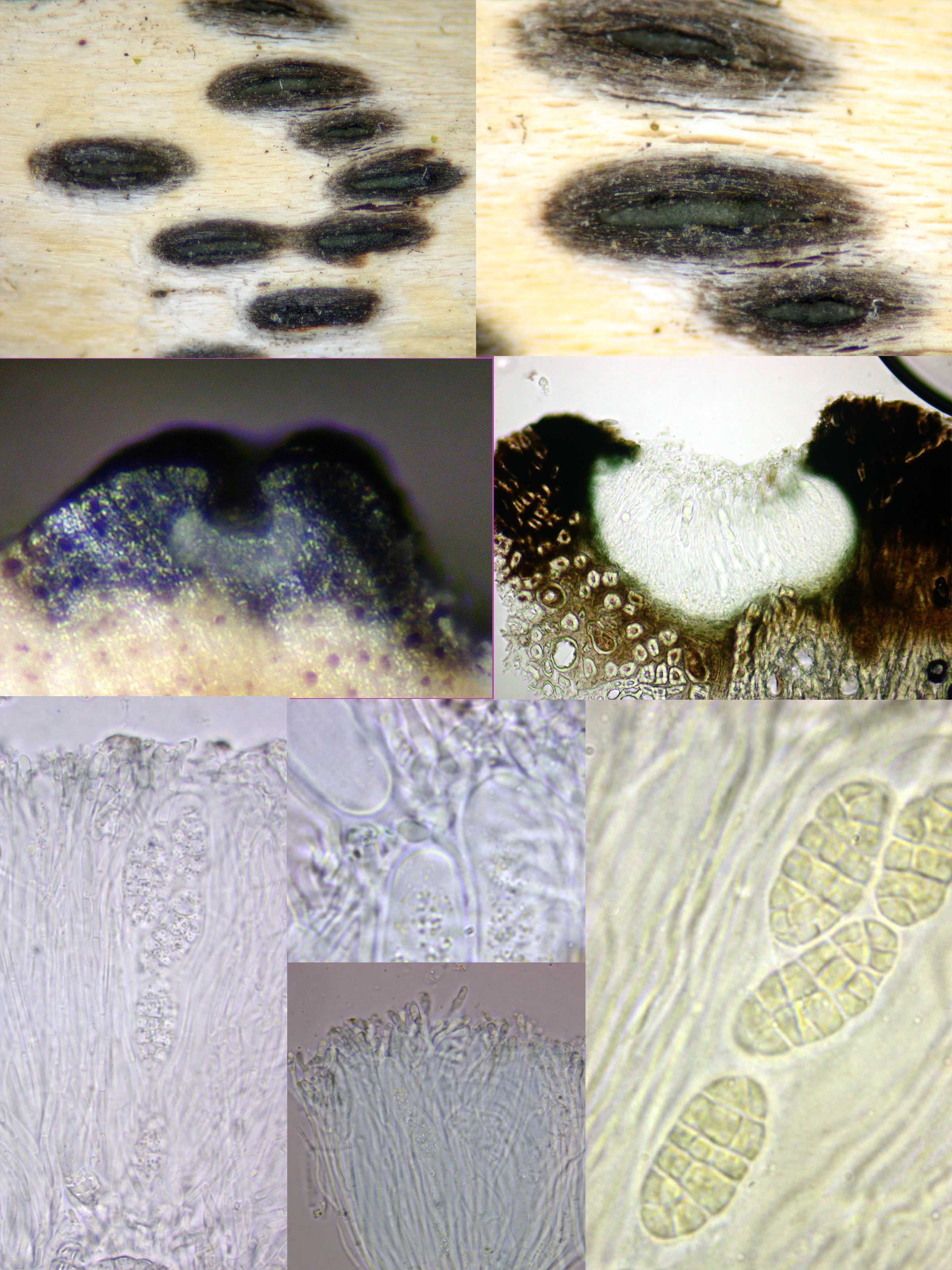 JF16038
it would probably be good to study immature dead asci for their possibly thick lateral and/or apical wall. In Patellariales I would expect bitunicate asci.
Zotto