08-05-2026 11:55
Gernot FriebesHi,found on a decorticated Picea abies branch stil
11-05-2016 20:37
 Zuzana Sochorová (Egertová)
Hi,this very little ascomycete grew on soil in a m
09-05-2026 07:37
Zuzana Sochorová (Egertová)
Hello,please, could anyone share this paper?Ferná

05-05-2026 22:40
Gernot FriebesHi,I believe this is a Plagiostoma growing on a Sa
06-05-2026 11:25
 Castillo Joseba
Me mandan el material seco de Galicia (España) re
06-05-2026 17:23
Thomas Læssøehttps://svampe.databasen.org/observations/10594257
28-04-2026 20:07
 Lothar Krieglsteiner
... on twig in the air at standing Ceratonia siliq
04-05-2026 18:13
 Stephen Martin Mifsud
ID request for what seems to be a true aquatic fun
04-05-2026 16:39
Stephen Martin Mifsud
ID request: This specimen was collected in Malta o
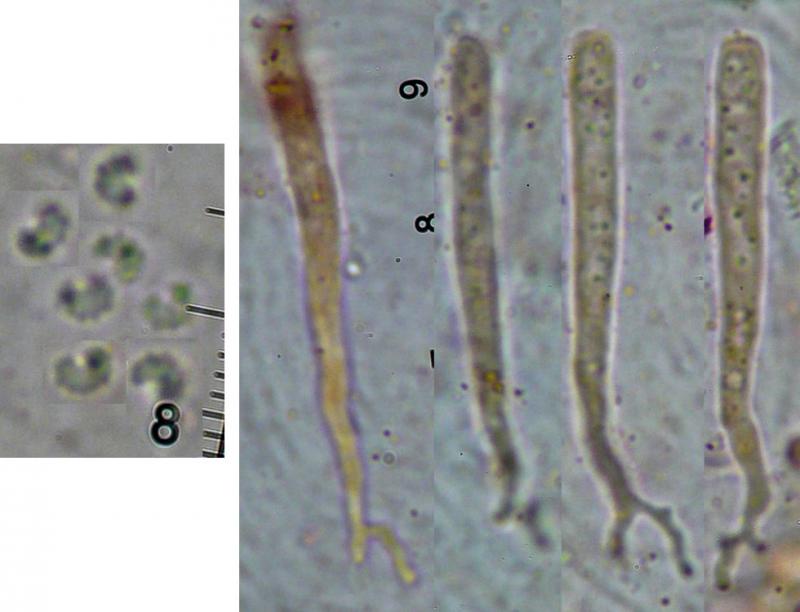
sur feuillu, spores 4,5-5,2 x 1,8-2,2 µm. Peut-être O. coccinella ?
Merci.
Patrice
 Doc1-0018.pdf
The spores look very cylindrical, quite unusual for O. eucalypti = coccinella s.auct. (typical O. coccinella is a nordic species with reniform spores).
Can you show me an ascus photo too? What is the substrate and was it on the moist ground? The colour is a bit intense, unless it grew exposed for repeated drying.
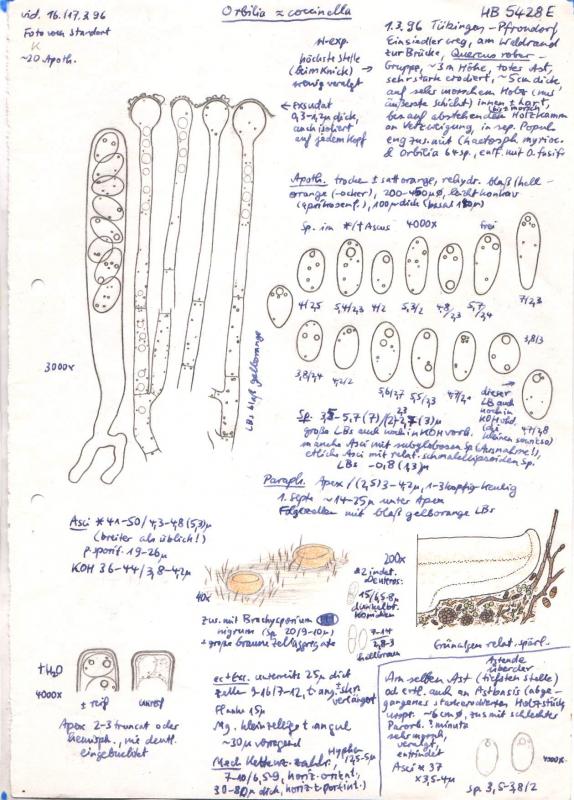
I have one collection with cylindrical spores, see below. It grew in 3 m above ground on an attached branch.
Zotto
I'm sorry but here are the spores that I observed, it is therefore O. leucostigma. The first observed were probably parasites spores because I doubt that there are two species here.
Patrice