27-04-2026 20:52
 Lothar Krieglsteiner
Found on hanging tiwg of Olea europaea in dried-ou
11-05-2026 20:22
Lothar Krieglsteiner
on attached twig of standing Ficus caricaquite uns
28-04-2026 20:07
Lothar Krieglsteiner
... on twig in the air at standing Ceratonia siliq
11-05-2026 12:32
 Bernard CLESSE
Pourriez-vous m'aider à identifier cette héloti
29-04-2026 10:44
Lothar Krieglsteiner
growing at moist, drying-out soil at the side of a
05-04-2026 22:46
Lothar Krieglsteiner
on wood of Ceratonia, Algarve, 3.4.2026.The color
10-05-2026 16:18
brigitte vignotbonjour trouvée en Ariège sur bois une petite
10-05-2026 23:17
 Andreas Gminder
Hello,today we found in a moist steep decidous for
Tengo estos peritecios que crecen en Pistacia lentiscus. Yo había pensado que podría ser Pleonectria virens, que también crece en alguna Anacardiaceae, pero no me termina de encajar, porque el hongo que os presento tiene las ascas más largas, uniseriadas, y las esporas no son hialinas. Supongo que Christian me podrá ayudar. Gracias.
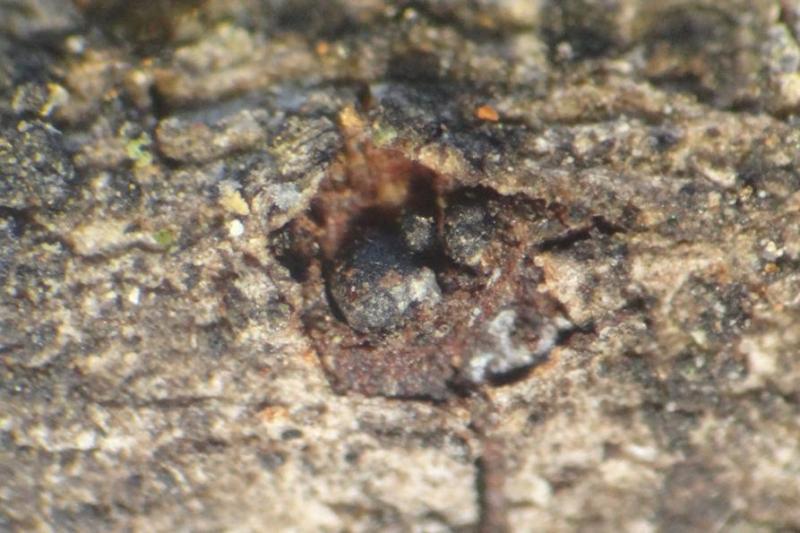
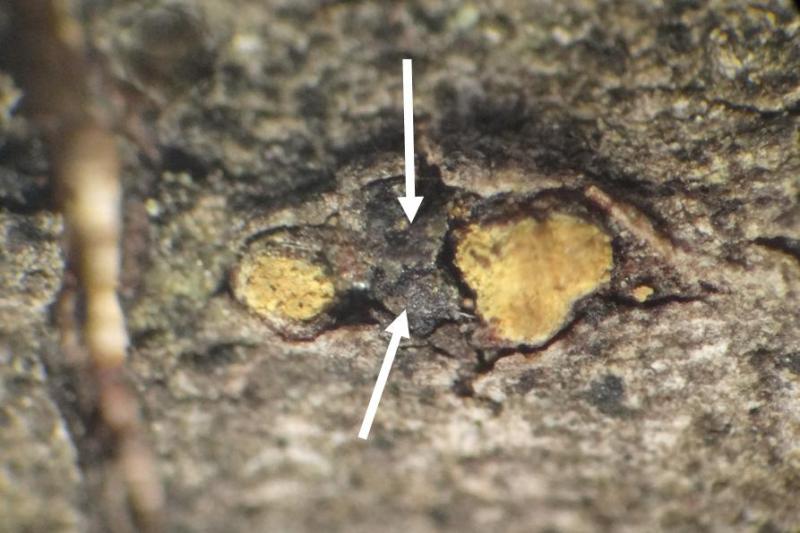
Peritecios de aproximadamente 0,5 mm de ancho, generalmente gregarios, cubiertos por una capa escamosa de color amarillo-verdoso, que vista en el microscopio está formada por cristales rojos, con el ostiolo visible más oscuro. Los peritecios en KOH reaccionan desprendiendo y coloreándose de color amarillo-anaranjado.
Ascas de (92,79) 94,16 - 116,03 (118,02) x (13,77) 14,28 - 17,17 (17,96) µm; Me = 105,24 x 15,80 µm, con 5 a 8 esporas.
Esporas de (12,65) 14,57 - 19,64 (21,06) x (8,52) 9,72 - 11,68 (12,38) µm; Me = 17,06 x 10,73 µm ; Qe = 1,60, muriformes, con el septo primario más señalado, de color marrón-grisáceo, o ligeramente verdosas, que en KOH se colorean intensamente de verde y les aparece un envoltorio gelatinoso (generalmente a las más inmaduras).
Paráfisis mucho más largas que las ascas, hialinas, septadas, estrechándose en el ápice.
Saludos.
Salvador.
 Imagen4-0011.jpg
Hi Salvador
Why not a member of the family Thyridiaceae?
Hola Salvador
Podría tratarse de un género de la familia Thyridiaceae ¿Thyridium?
Te mando en privado un artículo de Julia Checa sobre esta familia
Saludos
Salvador.
Muchas gracias.
Salvador.

I agree with Enrique about Thyridiaceae. Mattirolia roseovirens Berl. & Bres. fits well. There is a description in Rossman & Samuels 1999, Studies in Mycology 42, in excluded genera.
I found it once on Sarothamnus and I suspect it is fungicolous. Something to check on your material.
Saludos,
Jacques
A mi me encaja mejor también con Mattirolia roseovirens, pero en el artículo que me ha enviado Enrique dice que Mattirolia no tiene reacción con KOH, por lo que me hace ir a Thyridium.
Crecía cerca de Orbilia aristata, pero no me he dado cuenta de que creciese sobre otros hongos, lo miraré mejor.
Saludos.
Salvador.

yes, this fungus has close affinities to Mattirolia roseovirens and morphologically fits that species very well, apart from the host which are usually fabaceous shrubs, but as Jacques already mentioned above it is rather growing on pyrenomycetous fungi... We (Walter Jaklitsch and me) are currently working on these fungi, so we would be very interested to obtain vital material for cultivation and morphological investigations.
With best wishes
Hermann
Como no estaba convencido de que fuese Thyridium chrysomallum, ya le había escrito un correo a Julia Checa para ofrecerle el material y que me sacase de dudas. Tengo muy poco material, y estoy esperando a que me conteste Julia. De todas formas intentaré buscar más hongos en el mismo sitio, Si Julia no quiere el material o encuentro más se lo enviaré.
Saludos.
Salvador.
Dear Salvador, many thanks and no problem - if you find additional sufficient material it would be nice to investigate it...
With best wishes,
Hermann
Saludos.
Salvador.