
29-04-2026 10:44
 Lothar Krieglsteiner
growing at moist, drying-out soil at the side of a
28-04-2026 20:07
Lothar Krieglsteiner
... on twig in the air at standing Ceratonia siliq
11-05-2026 12:32
 Bernard CLESSE
Pourriez-vous m'aider à identifier cette héloti
05-04-2026 22:46
Lothar Krieglsteiner
on wood of Ceratonia, Algarve, 3.4.2026.The color
10-05-2026 16:18
brigitte vignotbonjour trouvée en Ariège sur bois une petite
10-05-2026 23:17
 Andreas Gminder
Hello,today we found in a moist steep decidous for
27-04-2026 17:16
Lothar Krieglsteiner
.. Algarve, moist lying.The conidiomata look like
10-05-2026 09:02
Buckwheat PeteHello everybody, ould this be Lachnum subvirgineu
08-05-2026 11:55
Gernot FriebesHi,found on a decorticated Picea abies branch stil
FOUND IN ARECACEAE INFLORESCENCE
Francisco Calaça,
06-01-2014 23:20
 Hello to all,
I found this Ascomycete in dry inflorescence of Arecaceae, does anyone have any idea?
Could share with me?
Thanks in advance,
Francisco.
ASCOSPORES:
28,5-34 X 15,5-18,2 µm. Septate.
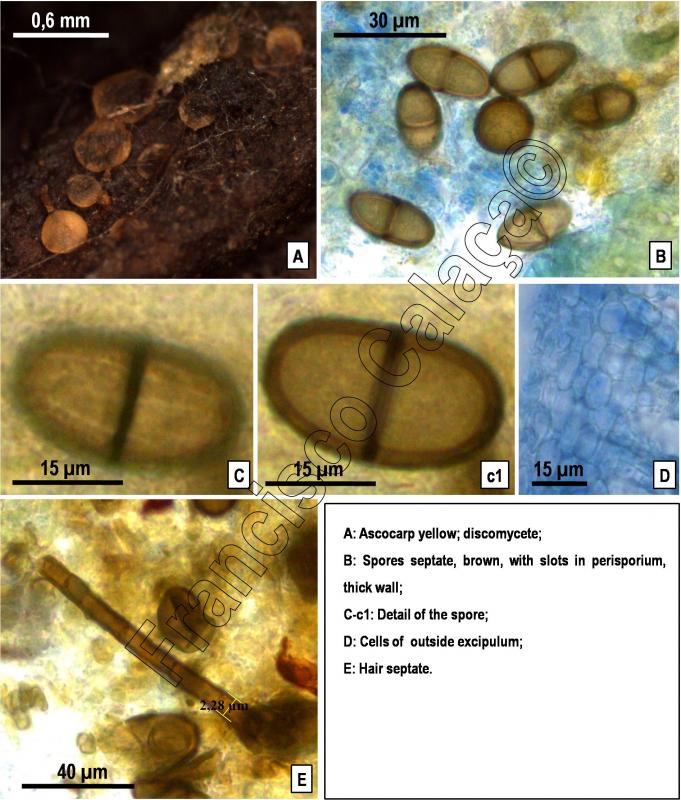
Hans-Otto Baral,
07-01-2014 09:35

Re : FOUND IN ARECACEAE INFLORESCENCE
dEAR fRANCESCO
Are you sure that these brown spores were formed in asci? Did you see the asci?
Zotto
Are you sure that these brown spores were formed in asci? Did you see the asci?
Zotto
Francisco Calaça,
07-01-2014 10:05
Re : FOUND IN ARECACEAE INFLORESCENCE
Dear Zotto, hello
not visualized the asci, but there were only these spores in the material seen under a microscope... I found it very strange...
not visualized the asci, but there were only these spores in the material seen under a microscope... I found it very strange...
Hans-Otto Baral,
07-01-2014 10:13
Re : FOUND IN ARECACEAE INFLORESCENCE
Apos look a bit like an Orbilia, and the brown elements like a hyphomycete, but I am not sure
Francisco Calaça,
07-01-2014 10:20
Re : FOUND IN ARECACEAE INFLORESCENCE
I had thought to Orbilia, but the absence of asci is confusing. You have some work about the genus Orbilia? Could share?
Thanks.
Thanks.
Hans-Otto Baral,
07-01-2014 10:41
Re : FOUND IN ARECACEAE INFLORESCENCE
400 species of Orbilia exist at least. Asci are often rather small and spores always hyaline. Maybe your apos are overmature or immature, or you overlooked them.