
06-05-2026 17:23
Thomas Læssøehttps://svampe.databasen.org/observations/10594257
06-05-2026 11:25
 Castillo Joseba
Me mandan el material seco de Galicia (España) re
28-04-2026 20:07
 Lothar Krieglsteiner
... on twig in the air at standing Ceratonia siliq
05-05-2026 22:40
Gernot FriebesHi,I believe this is a Plagiostoma growing on a Sa
04-05-2026 18:13
 Stephen Martin Mifsud
ID request for what seems to be a true aquatic fun
04-05-2026 16:39
Stephen Martin Mifsud
ID request: This specimen was collected in Malta o
28-07-2011 18:31
 Alex Akulov
Dear FriendsToday I made the pdf file of Velenovsk
04-05-2026 09:50
Castillo Joseba
Me mandan el material seco de Galicia,(España) re
02-05-2026 12:42
Alain BRISSARDBonjour à tousJeuidi 30 avril dernier on m'a remi
I want to share with you my field notes while i am searching through plant litter at ombrotrophic bog at West Siberian field station. I have chosen 12 dominated plants in this community to examine their different parts by direct observation through vegetation season. Now the early summer period is finished and i found there about 60 form-species of ascomycetes from different groups (disco-, pyreno-, imperfect-, etc.). The time is now short for working with literature and identification. But the microphotographs and the descriptions in vital are prepared, and all data are stored in the data base (db of 2013 season is now here: https://www.cubby.com/pl/2013_Myco_db_Kh/_c5d5cbc678524779bc0ced335b10d5f1).
In several next posts i will be doing short descriptions (with sketches) of fungal communities by plant hosts. It is ok if there will no comments on identification, since i myself did not tried to do it yet. But i am looking forward to process this collection later (in winter time) and to publish results. And i hope to find here contacts, specialists in particular groups who may be interested in collaboration.
So, here the first observation of the plant,
Rubus chamaemorus fungal community (30.05.2013)
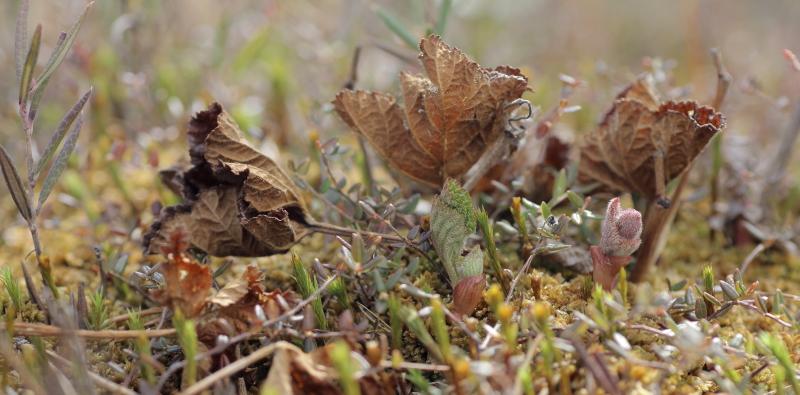
Cloudberry shoots only start to emerge at sun exposed hummocks, but at its last year litter fungal community is already shriving. There are three perithecioid species with fertile structures, forming them at early summer (now the night temperatures here are still near the zero). Plus two anamorphic stages were observed, probably related to those perithecia but i am not sure exactly.
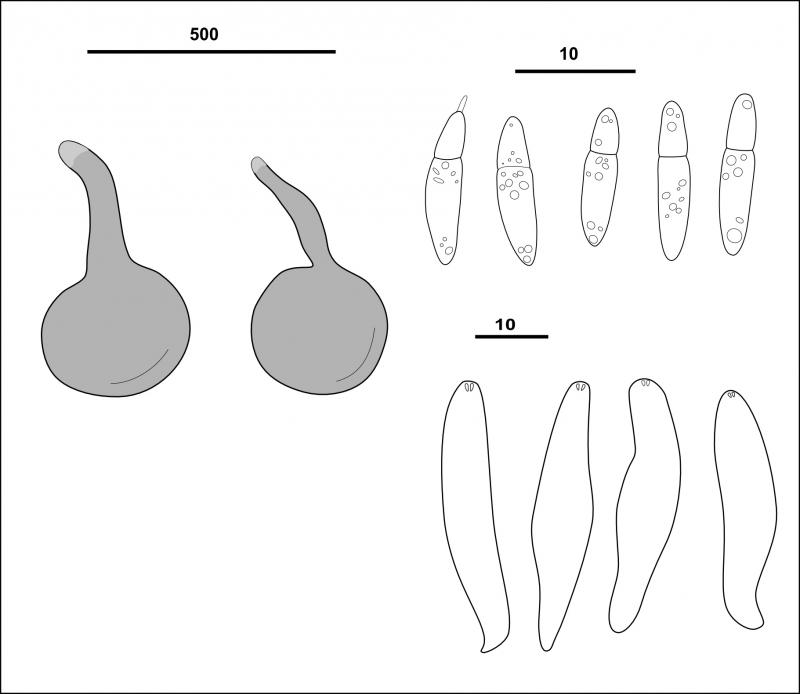
One of perithecioids which was already identified from previous year collection, is Gnomoniopsis chamaemori. It has large spherical perithecia with long emerging necks. It is easily seen and recognized. Most of fruitbodies are placed at leaf nerves, with some scattered at other leaf and stem surfaces.
(#4161 - https://www.cubby.com/pl/%234161/_e114de20070a4cf3a4d6c48b108618cf)
Another two species are two Mycosphaerella's. They are tiny comparatively, and site densely immersed in leaf (mostly between nerves). The first one common at lower surface of the leaf.
(#4160 - https://www.cubby.com/pl/%234161/_e114de20070a4cf3a4d6c48b108618cf)
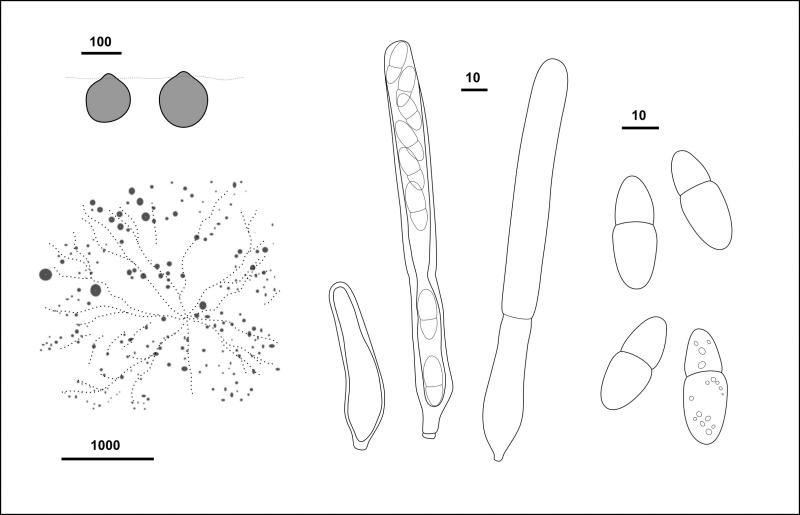
And the second differ in having radially arranged subiculum (black threads). The asci and spores are different in these two species as well. But the perithecia often grow mixed and they are close in size, so that they could be mixed up under the lens.
(#4164 - https://www.cubby.com/pl/%234164/_077e5a7e191d42d9b47f4023c2be79cc)
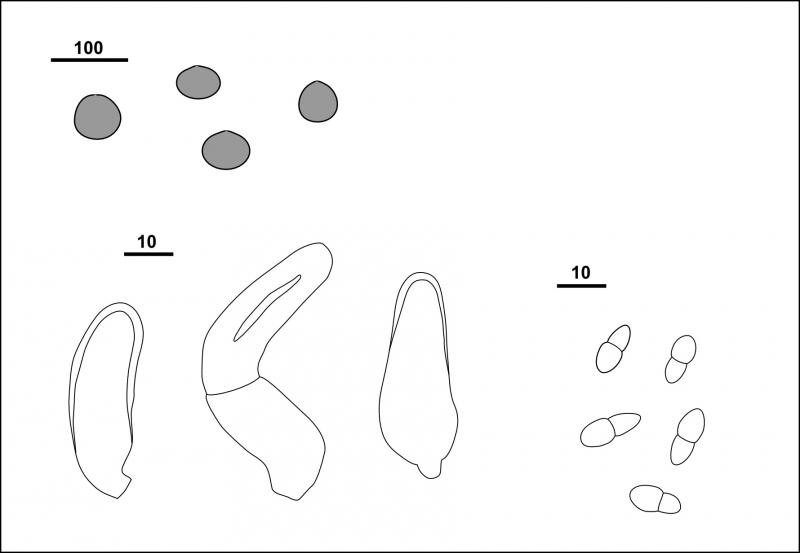
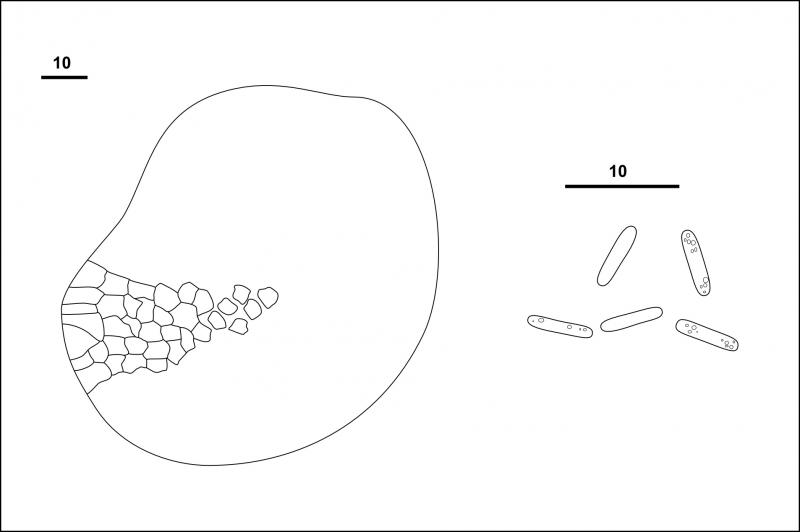
Flat black shields of anamorphic stage of some species also common, the conidiomas merge with one another forming continuous cover at petioles and lower surface of the leaf. Small rod-shaped conidia formed abundantly inside of them.
(#4162 - https://www.cubby.com/pl/%234162/_30af4d193032429f8723897e4b8eadd4)
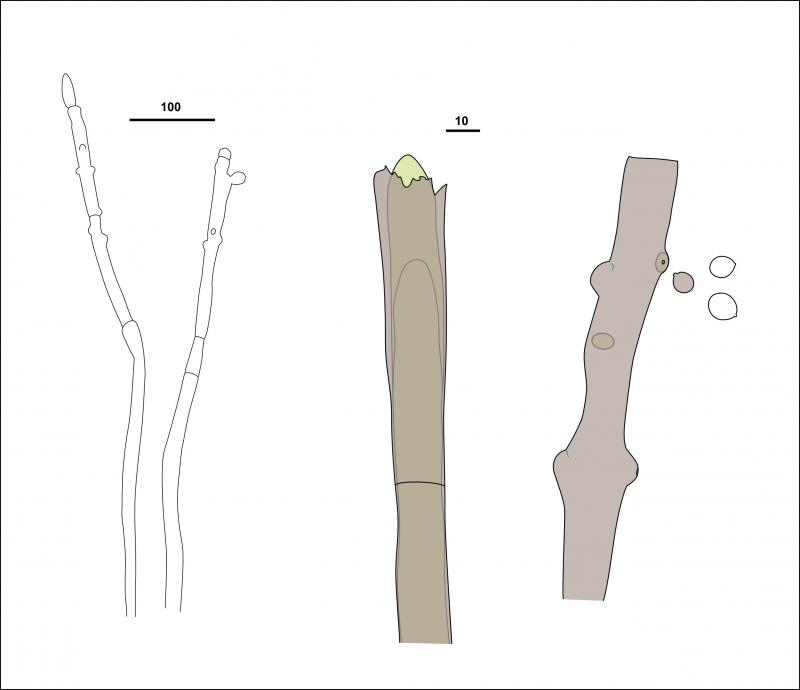
And the last beautiful anamorphic species was collected several times. It is the bushes made from thick straight hyphae, forming at black sclerotia. The growth of new branches of hyphae starts from inside of old ones. The conidia are forming as bubbles at upper part of the hyphae, hyaline and near spherical.
(#4163 - https://www.cubby.com/pl/%234163/_f623ff12c45f4de19d238c41e1ee2db1)
The Best,
Nina.?
your documentations are very interesting, thanks for posting!
Best wishes,
Genrot