
28-07-2011 18:31
 Alex Akulov
Dear FriendsToday I made the pdf file of Velenovsk
11-09-2025 16:57
 Jason Karakehian
Our revision of Marthamycetales (Leotiomycetes) is
12-11-2019 10:32
 Miguel Ángel Ribes
Hi againExactly at the same place than my previous
25-12-2019 17:54
Valencia Lopez Francisco JavierHola a todos/asEstas supuestas pezizas estaban en
12-07-2015 00:05
 Nedim Jukic
This one from the same locality as the previous on


30-05-2026 21:12
Philippe PELLICIERSur branche de mélèze (Larix) près de la neige,
31-05-2026 10:35
Hulda Caroline HolteHello,I collected this species growing on a rather
25-05-2026 16:35
 Bernard CLESSE
Bonjour à toutes et tous,J'ai trouvé récemment,
Hyaloscyphaceae de La Torre
Javier Ormad,
27-11-2010 21:35
Je vous présente une espèce qui comprend au Hyaloscyphaceae, je pouvais parler à près de Hyalopeziza même Urceolella, mais la vérité est que je ne peux pas entre les genres. Arriver à l'espèce serait un plaisir.
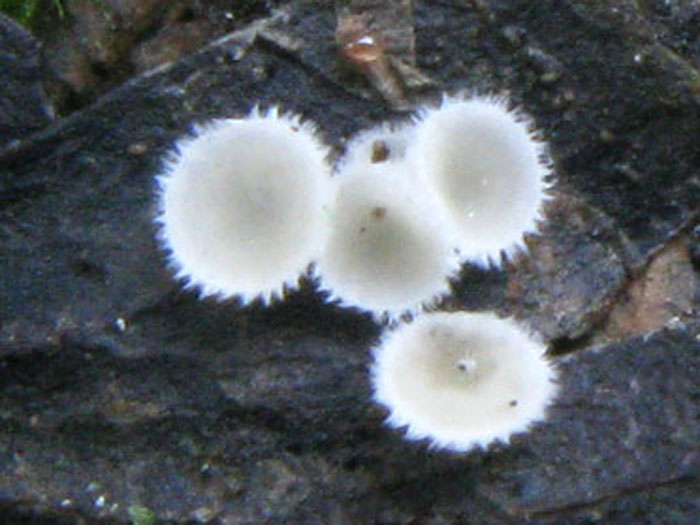
Apothécies disciformes, sessiles, jusqu'à 2 mm. de diamètre. Hyménium lisse ou très finement rugueux, crème grisâtre avec des zones plus claires. Surface extérieure rugueuse, concolores avec hyménium. Marge circulaire, couvert de poils, formant des touffes par regroupement de plusieurs pilosités.
Apotecios disciformes, sesiles de hasta 2 mm. de diámetro. Himenio liso o muy finamente rugoso, de color crema grisáceo con zonas más claras. Superficie externa rugosa y concolora a himenio. Margen circular, cubierto de pelos, que forman mechones por agrupación de varias pilosidades.
Javier Ormad,
27-11-2010 21:37
Re: Hyaloscyphaceae de La Torre
Micro:
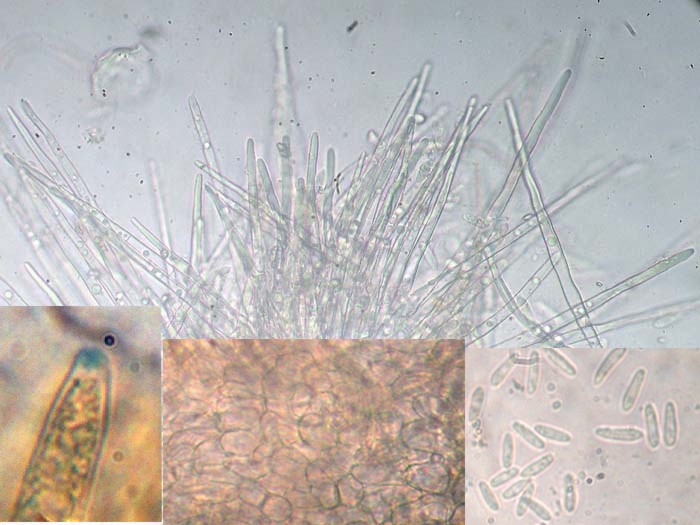
Asques claviformes cylindrique, octosporeés, uni ou bisériés, sans croziers, amyloïde de 70 x 8 microns. Les ascospores ellipsoïdes, hyalines, lisses, avec petits gútules tant dans un nombre comme position de manière irrégulière, avec un cloisson central de 15-17 x 3-4 microns. Paraphyses filiformes, épaisseur variable, uniformes en longueur jusqu'à 5 microns. Poils abondante, cloisonnées, lisses, hyalines, à sommet émoussé gels, de perdre la cohérence de la paroi, jusqu'à 125 x 5 microns. Ectal excípulum avec structure angulaire présentant certaines cellules subglobuleuses.
Ascas cilíndrico-claviformes, octosporadas, uni o biseriadas, sin uncínulos, amiloides de hasta 70 x 8 micras. Ascosporas elipsoidales, hialinas, lisas, con pequeñas gútulas tanto en número como posición de manera irregular, con un septo central de 15-17 x 3-4 micras. Parafisis filiformes, de varios grosores, uniformes en su longitud de hasta 5 micras. Pelos muy abundantes, septados, lisos, hialinos, con ápice romo que se gelifica, perdiendo la consistencia de la pared, de hasta 125 x 5 micras. Excípulo ectal de estructura angular presentando algunas células subglobosas.
Asques claviformes cylindrique, octosporeés, uni ou bisériés, sans croziers, amyloïde de 70 x 8 microns. Les ascospores ellipsoïdes, hyalines, lisses, avec petits gútules tant dans un nombre comme position de manière irrégulière, avec un cloisson central de 15-17 x 3-4 microns. Paraphyses filiformes, épaisseur variable, uniformes en longueur jusqu'à 5 microns. Poils abondante, cloisonnées, lisses, hyalines, à sommet émoussé gels, de perdre la cohérence de la paroi, jusqu'à 125 x 5 microns. Ectal excípulum avec structure angulaire présentant certaines cellules subglobuleuses.
Ascas cilíndrico-claviformes, octosporadas, uni o biseriadas, sin uncínulos, amiloides de hasta 70 x 8 micras. Ascosporas elipsoidales, hialinas, lisas, con pequeñas gútulas tanto en número como posición de manera irregular, con un septo central de 15-17 x 3-4 micras. Parafisis filiformes, de varios grosores, uniformes en su longitud de hasta 5 micras. Pelos muy abundantes, septados, lisos, hialinos, con ápice romo que se gelifica, perdiendo la consistencia de la pared, de hasta 125 x 5 micras. Excípulo ectal de estructura angular presentando algunas células subglobosas.
Hans-Otto Baral,
27-11-2010 22:22

Re: Hyaloscyphaceae de La Torre
Are you sure the spores are so big? It reminds me of Hyaloscypha leuconica, but that has mch smaller spores.
Hyalopeziza conspicua has such large spores, but the hairs are more thick-walled.
On what does it grow?
Zotto
Hyalopeziza conspicua has such large spores, but the hairs are more thick-walled.
On what does it grow?
Zotto
Javier Ormad,
28-11-2010 20:22
Re: Hyaloscyphaceae de La Torre
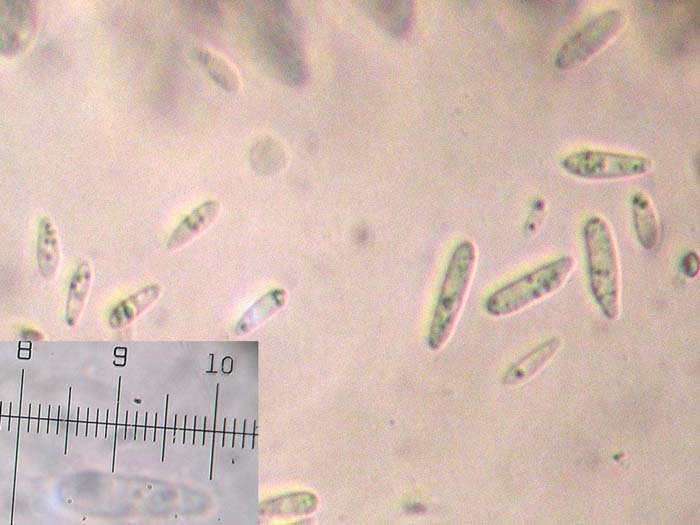
The spores are consistent with the measures provided, but I turned to look and see other kinds of spores in addition to the above. They are smaller and transparent 10-12 x 3-3.5 microns.
The substrate of these specimens are remnants of dried leaves of Crataegus monogyna and Pinus halepensis.
Hyaloscypha leuconica indeed have smaller spores
Sorry I can not provide sharper images.
Las esporas se ajustan a las medidas aportadas, pero he vuelto a mirar y veo otros tipo de esporas además de las anteriores. Son más pequeñas y transparentes de 10-12 x 3-3.5 micras.
El sustrato de estos ejemplares es restos de hojas secas de Crataegus monogyna y de Pinus halepensis.
Hyaloscypha leuconica, en efecto tiene esporas menores
Siento no poder aportar imágenes más nítidas.
The substrate of these specimens are remnants of dried leaves of Crataegus monogyna and Pinus halepensis.
Hyaloscypha leuconica indeed have smaller spores
Sorry I can not provide sharper images.
Las esporas se ajustan a las medidas aportadas, pero he vuelto a mirar y veo otros tipo de esporas además de las anteriores. Son más pequeñas y transparentes de 10-12 x 3-3.5 micras.
El sustrato de estos ejemplares es restos de hojas secas de Crataegus monogyna y de Pinus halepensis.
Hyaloscypha leuconica, en efecto tiene esporas menores
Siento no poder aportar imágenes más nítidas.
Hans-Otto Baral,
28-11-2010 21:11
Re: Hyaloscyphaceae de La Torre
The photos are quite good! Also the oil drops exclude Hyaloscypha leuconica. Could you show us a hair tip in larger magnification. I feel it is very thickwalled, i.e. solid there?
Zotto
Zotto
Javier Ormad,
28-11-2010 21:53
Re: Hyaloscyphaceae de La Torre
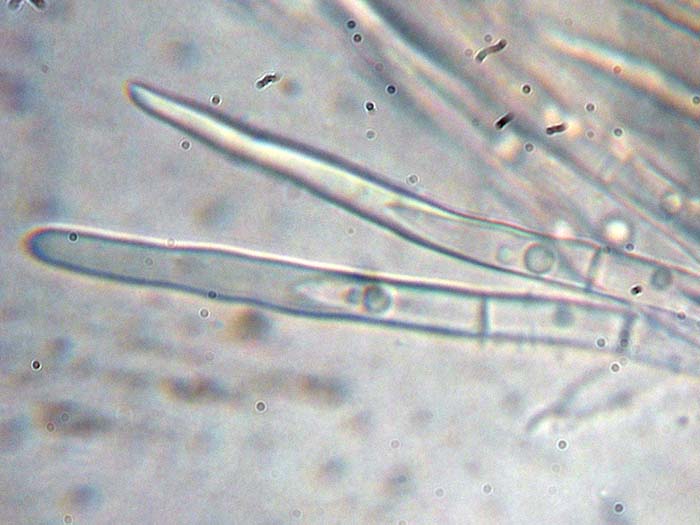
The hairs on the end lose the sharpness of the wall thickening, also with inside oil drops
Hans-Otto Baral,
28-11-2010 22:21
Re: Hyaloscyphaceae de La Torre
Yes, wonderful! Urceolella conspicua. You can see my images on the DVD, HB 7602.
The drops are not oil, they disappear in KOH (SCBs). Also the glassy wall disappears when you treyt with strong KOH (10%), or perhaps when heating a KOH-slide.
Zotto
The drops are not oil, they disappear in KOH (SCBs). Also the glassy wall disappears when you treyt with strong KOH (10%), or perhaps when heating a KOH-slide.
Zotto
NC NC,
29-11-2010 22:06
Re: Hyaloscyphaceae de La Torre
Yes seems to be that.
I can not see a photo online macro.
A million thanks. Always
I can not see a photo online macro.
A million thanks. Always
Javier Ormad,
29-11-2010 22:08
Re: Hyaloscyphaceae de La Torre
Yes seems to be that.
I can not see a photo online macro.
A million thanks. Always
Javier
I can not see a photo online macro.
A million thanks. Always
Javier
Javier Ormad,
18-12-2010 19:36
Re: Hyaloscyphaceae de La Torre
What would be the valid name?
Urceolella conspicua Huhtinen (1987) or Urceolella juniperi (Velen.) Huthinen (2001)
Thanks
Urceolella conspicua Huhtinen (1987) or Urceolella juniperi (Velen.) Huthinen (2001)
Thanks
Hans-Otto Baral,
18-12-2010 20:09
Re: Hyaloscyphaceae de La Torre
Urceolella juniperi. When Huhtinen described conspicua, he was unaware of Velenovsky`s taxon, or perhaps better to say, you often can only get an idea of Velenovsky taxa until you study the type material .
Zotto
Zotto