
05-06-2026 11:02
Thomas Læssøehttps://svampe.databasen.org/observations/10596691

04-06-2026 11:36
Gernot FriebesHi,found on Vaccinium myrtillus.Asci: IKI –, 8-s
19-05-2026 10:27
Patrice TANCHAUDBonjour, récolte récente sur terre retournée i
04-06-2026 18:39
Gernot FriebesHi,I collected this species in two different locat
22-05-2026 13:29
Gernot FriebesHi,I am curious to hear your opinion on this mater
04-06-2026 10:50
 François Freléchoux
Bonjour, J'ai trouvé hier un petit asco observé
04-06-2026 07:02
François Freléchoux
Bonjour, Voici la description d'une espèce qui p
04-06-2026 13:34
Gernot FriebesHi,I am interested to hear your opinion on this Le
Gelatinous on Carex
Marja Pennanen,
02-09-2010 10:38
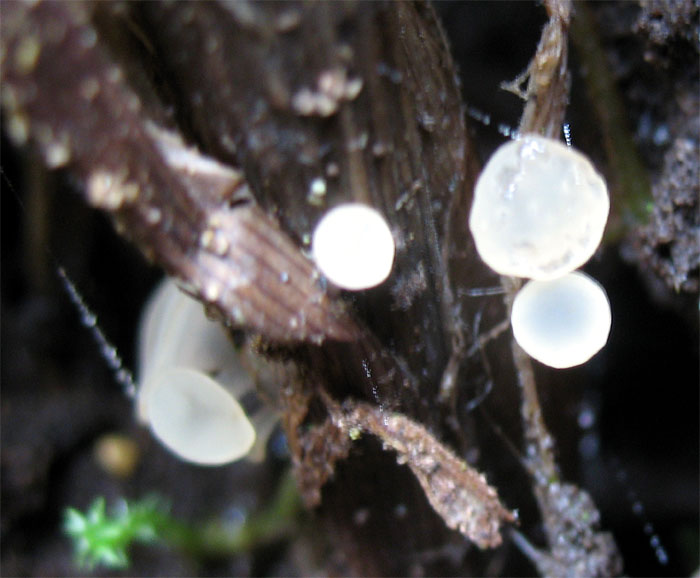
I found these on some Carex yesterday.
They are 1-5mm wide and 3-5 mm high.
Marja Pennanen,
02-09-2010 10:43
Re:Gelatinous on Carex
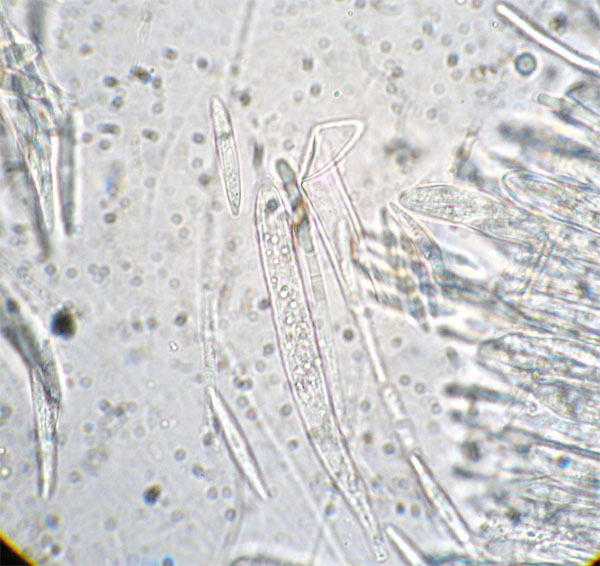
The spores are 16-30x3-4 containing some small droplets.
Asci are 75-95x8-10, IKI+ and paraphyses are 2-3 mm wide, septate and may be a little longer than asci.
The top cell of the paraphyses is somehow different, maybe it's walls are thicker or something.
Marja
Asci are 75-95x8-10, IKI+ and paraphyses are 2-3 mm wide, septate and may be a little longer than asci.
The top cell of the paraphyses is somehow different, maybe it's walls are thicker or something.
Marja
Marja Pennanen,
02-09-2010 11:35
Re:Gelatinous on Carex
One photo more.
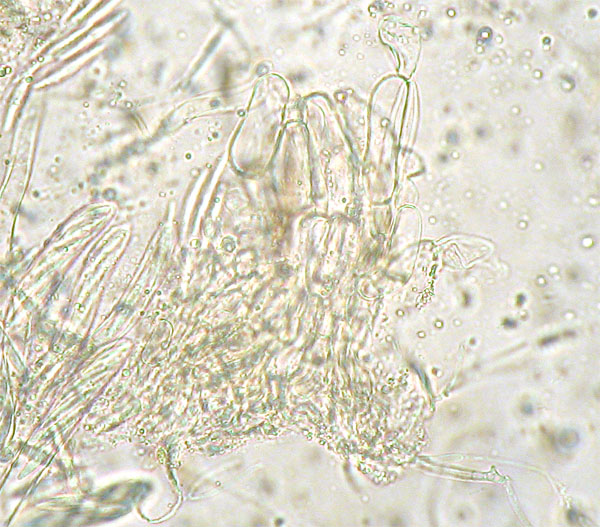
I just studied a little piece of the fungi and there were very little to see of the cells.
Marja
I just studied a little piece of the fungi and there were very little to see of the cells.
Marja
Hans-Otto Baral,
02-09-2010 12:13

Re:Gelatinous on Carex
Good find!!
The top cell contains a VB, i.e. a refractive vacuole (like in Mollisia). If you add KOH or MLZ these VBs disappear, also in the herbarium.
This species is Ombrophila pileata (= Hymenoscyphus pileatus). Gel and apical ring tpye clearly exclude Hymenoscyphus, still the current name in IF (although I corrected to Ombrophila already in 1985). The problem is only that in Karsten's type material which I studied is a mixtum: it contains also a very similar species with distinctly smaller and narrower and rather strongly curved spores, O. lacustris. regrettably, Karsten's is not clear in this point, giving +/- both spore types. So I have to select one of them as lectotype.
Zotto
The top cell contains a VB, i.e. a refractive vacuole (like in Mollisia). If you add KOH or MLZ these VBs disappear, also in the herbarium.
This species is Ombrophila pileata (= Hymenoscyphus pileatus). Gel and apical ring tpye clearly exclude Hymenoscyphus, still the current name in IF (although I corrected to Ombrophila already in 1985). The problem is only that in Karsten's type material which I studied is a mixtum: it contains also a very similar species with distinctly smaller and narrower and rather strongly curved spores, O. lacustris. regrettably, Karsten's is not clear in this point, giving +/- both spore types. So I have to select one of them as lectotype.
Zotto
Marja Pennanen,
02-09-2010 12:23
Re:Gelatinous on Carex
Thank you for det. and explanations :)
Marja
Marja