07-06-2026 15:10
 William Slosse
Hello everyone,On 05-06-26, I found following asco
07-06-2026 12:09
 François Freléchoux
Bonjour, Voici une brève description de ce qui m
05-06-2026 11:02
Thomas Læssøehttps://svampe.databasen.org/observations/10596691
07-06-2026 12:43
Steve ClementsBojour. This was a strange find on a stick on my
12-07-2015 00:05
 Nedim Jukic
This one from the same locality as the previous on
06-06-2026 17:44
Steve ClementsBonjour, This disco was on planed wood 3 x 1.5 cm
14-08-2016 23:15
 Alex Akulov
Dear friendsCan you help me to find the descriptio

04-06-2026 11:36
Gernot FriebesHi,found on Vaccinium myrtillus.Asci: IKI –, 8-s
Podospora - multispored
Chris Johnson,
17-02-2015 11:50
This was found a few days ago on pony dung. The first multispored Podospora I have found.
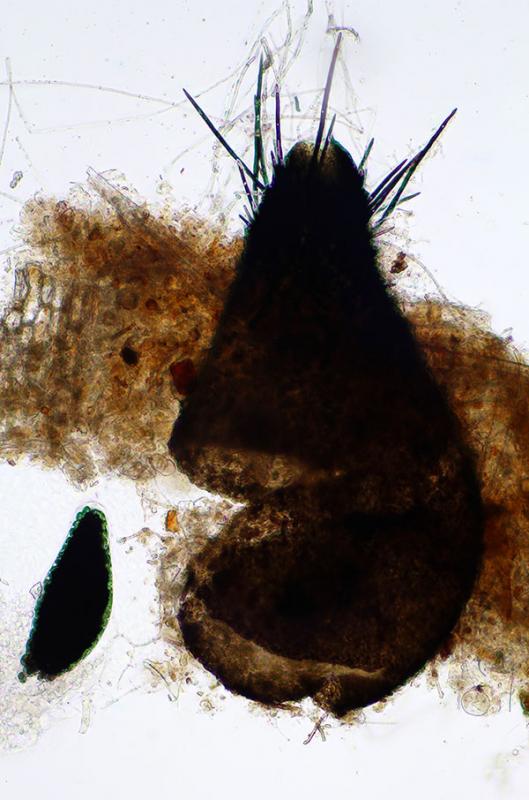
Perithecium 500 x 300 µm, partly immersed.
Hairs restricted to the neck, up to 150 µm long x 4-5 µm wide.
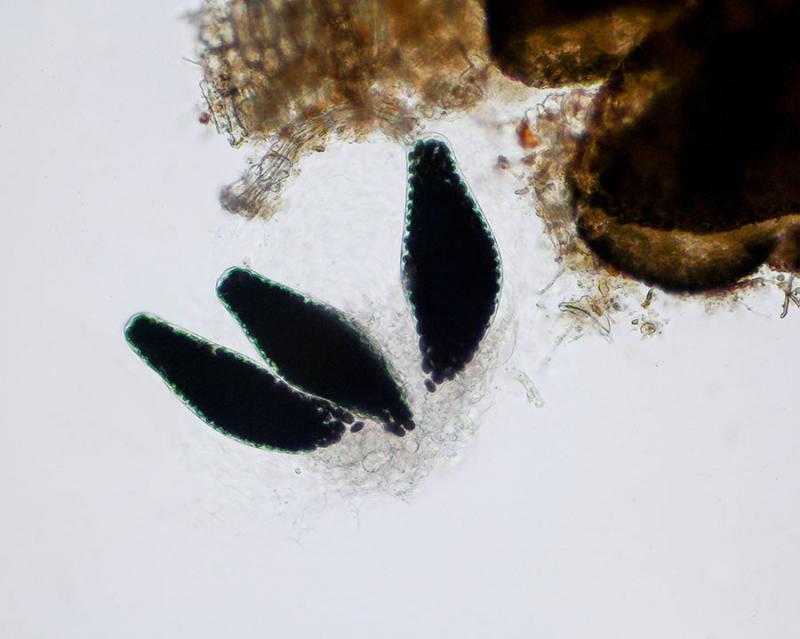
Three asci, 175-190 x 65-74 µm
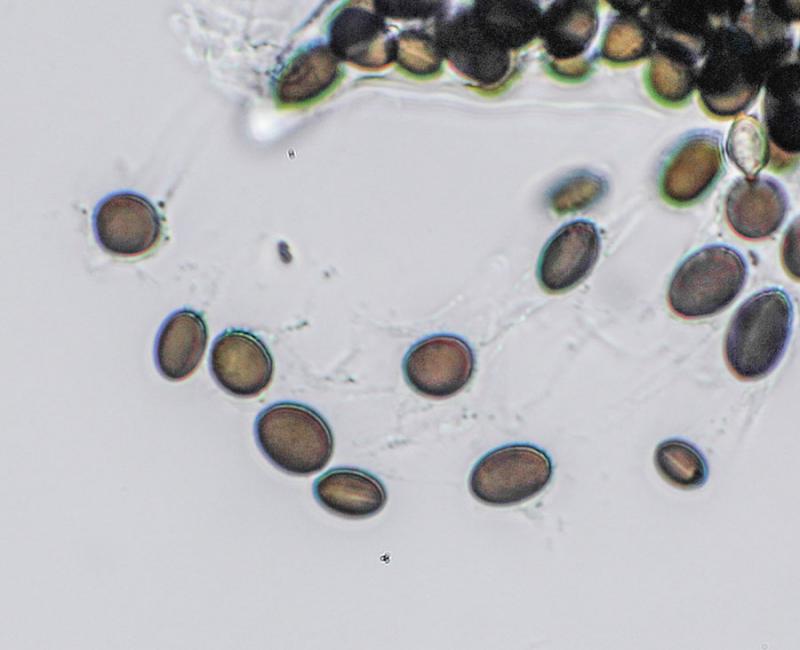
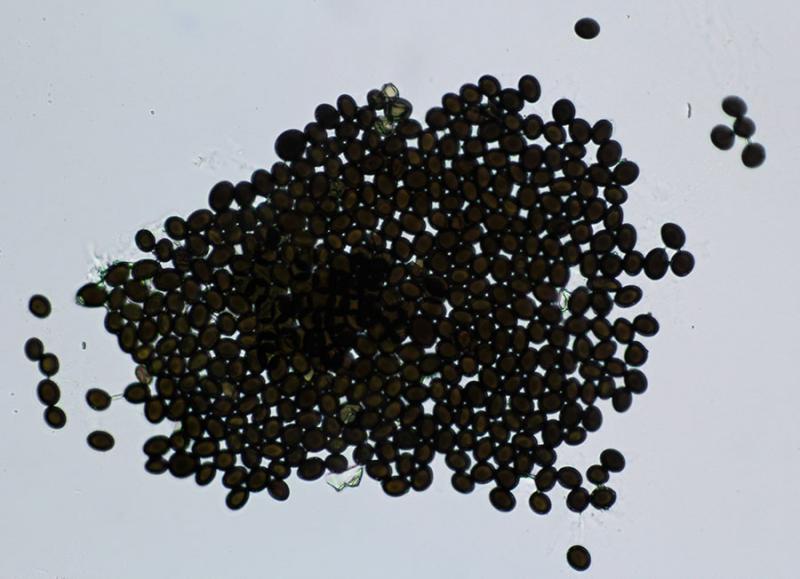
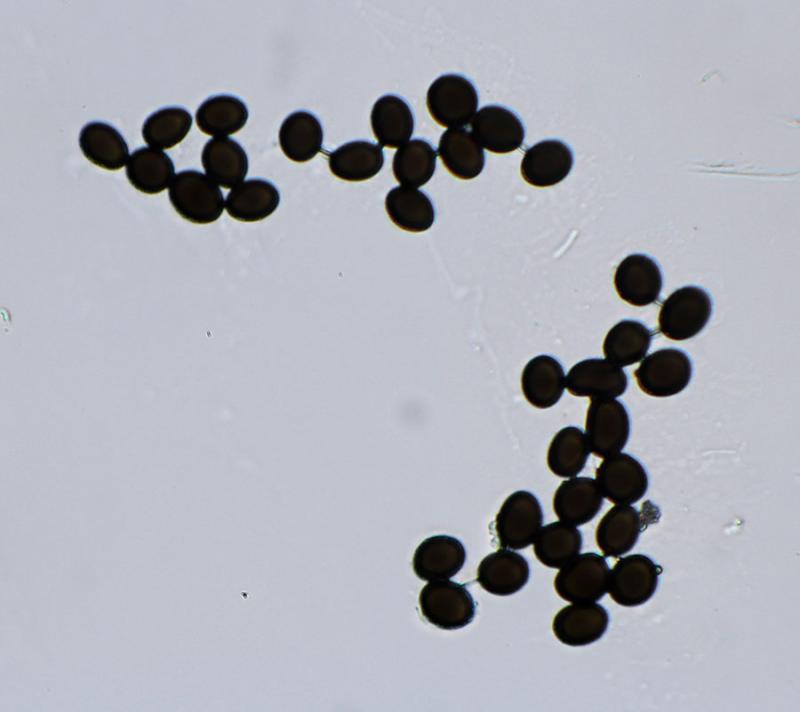
Spores 9.6-11.8 x 6.5-9.1 µm, Me = 11.0 x 7.8 µm
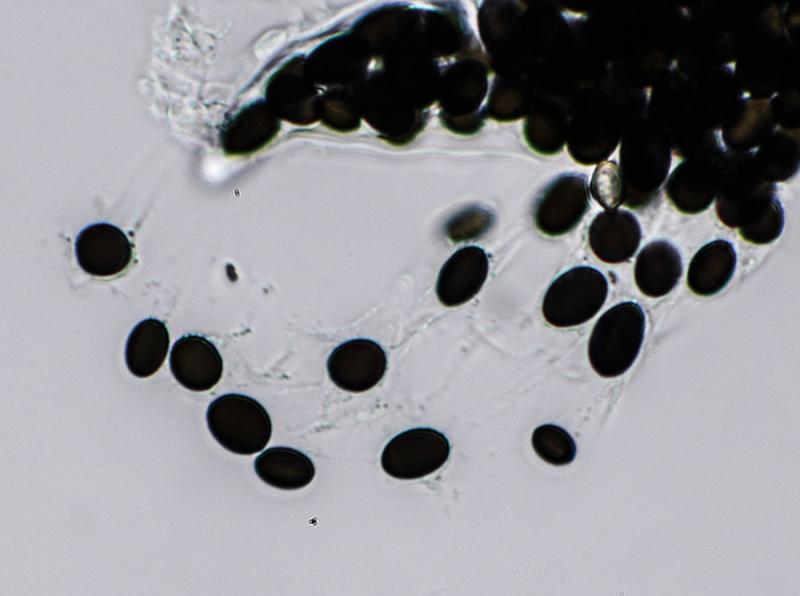
The two spore images are from the same ascus and a careful count on a grid gives 440 plus an estimated 50-60 'double layered' provides an assumed mass of 512.
No additional perithecia have been found to date.
There are not too many species with 512 spores and they tend to have larger spores.
Any help welcome.
Best wishes, Chris
Michel Delpont,
17-02-2015 12:19

Re : Podospora - multispored
Hello Chris.
Could you make more accurate pictures of spores?
Michel.
Could you make more accurate pictures of spores?
Michel.
Chris Johnson,
17-02-2015 13:17
Re : Podospora - multispored
Hello Michel
This is the best of some poor images. It fails to show attachments clearly.
Chris
This is the best of some poor images. It fails to show attachments clearly.
Chris
Chris Yeates,
17-02-2015 14:08

Re : Podospora - multispored
It doesn't say Podospora to me based on what I can see here - did it definitely have a pedicel? appendages?
The spores call to mind Coniochaeta; any sign of a germ slit? As Michel has pointed out better spore images would be desirable; hopefully more perithecia will appear in due course
best wishes
Chris
The spores call to mind Coniochaeta; any sign of a germ slit? As Michel has pointed out better spore images would be desirable; hopefully more perithecia will appear in due course
best wishes
Chris
Michel Delpont,
17-02-2015 14:33
Re : Podospora - multispored
I also thought the genre Coniochaeta but no distinction germination slot. There are several species of Coniochaeta coprophilous with polysporés asci. Hopefully more details with more photos.
Michel.
Michel.
Chris Johnson,
17-02-2015 17:25
Re : Podospora - multispored
Hi Chris and Michel
I didn't observe any germ splits through the microscope but I will lighten a couple of images to see what that reveals. No obvious pedicels noted - Podospora was an assumption on my part.
Thanks, Chris
I didn't observe any germ splits through the microscope but I will lighten a couple of images to see what that reveals. No obvious pedicels noted - Podospora was an assumption on my part.
Thanks, Chris
Chris Yeates,
18-02-2015 02:43
Re : Podospora - multispored
Hello Chris
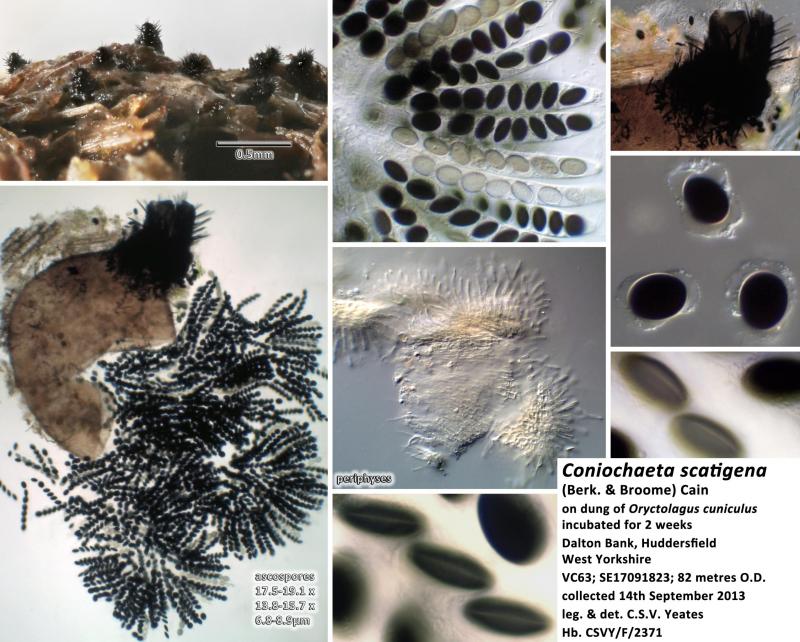
your images seem to suggest rather flattened spores - such as you find in Coniochaeta
see for example: http://www.ascofrance.fr/search_recolte/2621
and the image below; admittedly a lot harder with multispored asci such as you have encountered
Chris
your images seem to suggest rather flattened spores - such as you find in Coniochaeta
see for example: http://www.ascofrance.fr/search_recolte/2621
and the image below; admittedly a lot harder with multispored asci such as you have encountered
Chris
Chris Johnson,
18-02-2015 11:09
Re : Podospora - multispored
Hi Chris
I have lightened one of the images and the details seem to bear out what you are saying.
Searching the literature, I can only find one species with 512 spores: Coniochaeta polysperma, which is not on the British list.
Lets hope for some more specimens.
Regards, Chris
I have lightened one of the images and the details seem to bear out what you are saying.
Searching the literature, I can only find one species with 512 spores: Coniochaeta polysperma, which is not on the British list.
Lets hope for some more specimens.
Regards, Chris