Accès membres

Mot de passe perdu? S'inscrire

30-12-2016 22:13

Stephen Martin Mifsud Stephen Martin Mifsud

I have found a Morchella which is extremely rare i

30-01-2017 18:25

Angel Pintos Angel Pintos

Hello, in died twigs of Olea I found this one. Asc

30-01-2017 23:23

Lepista Zacarias

Hi everyone, I think it's a Hysterobrevium again

30-01-2017 17:38

David Vaudoré David Vaudoré

Bonjour à tousPour mon premier message je vous so

30-01-2017 09:10

Castillo Joseba Castillo Joseba

En madera muy degradada de quercusSolo he podido v

29-01-2017 21:58

Lothar Krieglsteiner Lothar Krieglsteiner

Yesterday I found Octosporella erythrostigma for

30-01-2017 00:35

Elsa Sousa

Hi,I would appreciate some help, if possible. I ha

28-01-2017 22:49

Rubén Martínez-Gil Rubén Martínez-Gil

Hola a todos. Subo unas fotos de un asco que hemo

29-01-2017 01:09

Elsa Sousa

I was trying to scope some disc on pinus branch, a

28-01-2017 08:28

Michel Hairaud Michel Hairaud

Bonjour, Je cherche à me procurer l'article suiva

« < 823 824 825 826 827 > »
Morchella species from the Mal tese islands
Stephen Martin Mifsud, 30-12-2016 22:13
Stephen Martin MifsudI have found a Morchella which is extremely rare in my country (only 2 reports). It was growing in a weedy area attached to what I think a root. It had a brownish-mustard yellow colour with wide alveoli made by rather thin walls. I tried to find some literature, ideally a key but I was not successful. The literature on ascofrance provides a monograph, but based on phylogenetics. I have collected the specimen but I have not carried any microscopical tests yet.

I don't really know what/how to examine Morchella and what charachters are determinant. Any help / keys would be essential for me.

  • message #46370
  • message #46370
Stephen Martin Mifsud, 31-12-2016 15:54
Stephen Martin Mifsud
Re : Morchella species from the Mal tese islands
Micro data and other characters

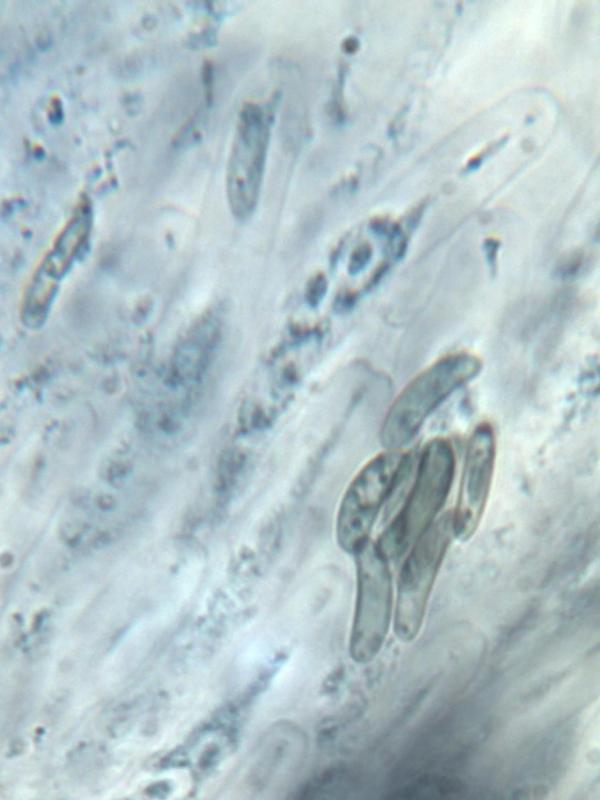
Paraphyses: Present, not frequent, septate, shorter from asci
Paraphyses shape (apex): Capitate, with a rounded, elliptic-rectangular or rarely irregaular-deltate head, (24.1-)30.7(-34.1) µm long
Paraphyses width: Column 6.8-9.5µm (mean 8.37µm) ; apical head (widest part): 12-17.8µm (mean 14.1µm)
Paraphyses length: Total length 142-174µm (mean = 161.4µm); Length of apical hypha 98-129µm (mean = 113.4µm)

Other remarks: Paraphyses dextrinoid in IKI, especially its head. They are 1- to 2- (3- septate), with the septa located at the basal third of the paraphyses.


Ascum


Shape: Cylindrical, straight or slightly sinusoidial-irregular, usually with a distinct kink at the base
No. of Spores: 8
Operculum Not: observed
Tunic (Wall): Uni-tunicate
Ascum length (range): 220 - 288 µm
Ascum length (mean): 262.7 µm
Ascum width (range): 15.2 - 20.8 µm
Ascum width (mean): 17.7 µm
Ascum L:W ratio: 15
Iodine reaction (J +/J -): J-ve but dextrinoid
Orifice: Absent
Remarks: Sometimes spore are clustered at the top of the ascum making it to swell nad bulge


Spore
Spore length (range): 20.26 - 24.9 µm
Spore length (mean): 22.7 µm
Spore width (range): 9.97 - 15.9 µm
Spore width (mean): 12.4 µm
Spore Q factor (range): 1.54 - 2.24 µm
Spore Q factor (mean): 1.84
Spore shape: Fusoid-elliptical, widest at the centre with two identical rounded poles
Spore septa: Aseptate
Spore surface: Finely course or rugolose
Oil bodies: Absent
Arrangement of spores: Spores arranged obliquely, sometimes aggregated at the upper part of the ascum.
Excipulum (medullary): Profusely branched, intricate and reticulate hypha forming a textura intricata, with hyphal elements 3-6um wide and 24-45um long.

  • message #46386
  • message #46386
  • message #46386
  • message #46386
  • message #46386
  • message #46386
  • message #46386
  • message #46386
  • message #46386
  • message #46386
  • message #46386
  • message #46386
  • message #46386
  • message #46386
  • message #46386
  • message #46386
  • message #46386
  • message #46386
  • message #46386
  • message #46386
Stephen Martin Mifsud, 01-01-2017 08:54
Stephen Martin Mifsud
Re : Morchella species from the Mal tese islands
Happy New year!  I thought that this is an easy fungus! Does anyone have keys for this genus? I only found a monograph involving phylogenetics while there is a key for American morels leading to M. angusticeps (or the northern M. septentrionalis)
Nicolas VAN VOOREN, 03-01-2017 21:20
Nicolas VAN VOOREN
Re : Morchella species from the Mal tese islands
What is the ecology and the tree(s) growing around?
The habits with those larges pits reminds me two species: Morchella castaneae L. Romero & Clowez or M. galilaea S. Masaphy & Clowez
Stephen Martin Mifsud, 06-01-2017 19:29
Stephen Martin Mifsud
Re : Morchella species from the Mal tese islands
Hi Nicholas, many thanks for your help.


The habitat is as follows. It was found growing from rather bare soil margining a weedy area in turn an understory of olive trees. As you can see, the morel was attached to what I think is a dead root. Ascocarp found in 26 Dec 2016.

I check the species you mentioned, while what do you think about Morchella rufobrunnea or M. esculentoides?


Thanks
  • message #46478
Stephen Martin Mifsud, 16-01-2017 04:12
Stephen Martin Mifsud
Re : Morchella species from the Mal tese islands
I sent a sample for sequencing to Richard Franck as he found it interesting. Morchella galilaea is a good option too. I'll keep you updated
Stephen Martin Mifsud, 31-01-2017 18:52
Stephen Martin Mifsud
Re : Morchella species from the Mal tese islands
I've got a confirmation from Richard Franck that following DNA sequencing, the species corresponds to Morchella galilaea. Where else from Israel, Turkey and Malta does this species occur in Europe (or the Mediterranean region)?