
28-07-2011 18:31
 Alex Akulov
Dear FriendsToday I made the pdf file of Velenovsk
28-04-2026 20:07
 Lothar Krieglsteiner
... on twig in the air at standing Ceratonia siliq
04-05-2026 18:13
 Stephen Martin Mifsud
ID request for what seems to be a true aquatic fun
04-05-2026 16:39
Stephen Martin Mifsud
ID request: This specimen was collected in Malta o
04-05-2026 09:50
 Castillo Joseba
Me mandan el material seco de Galicia,(España) re
02-05-2026 12:42
Alain BRISSARDBonjour à tousJeuidi 30 avril dernier on m'a remi
02-05-2026 13:06
Pauline. PennaBonjour Please can someone help me with this id
01-05-2026 22:45
 Thierry Blondelle
Bonjour à tous, Une récolte sur bouse séchée d
14-04-2026 05:32
Ethan CrensonHi all, A few weeks back a friend pointed out som
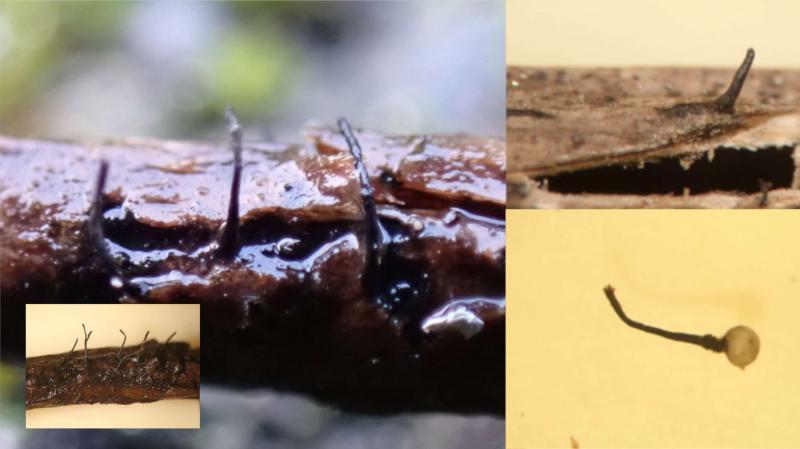
On the 2nd of February 2026, I found a 10 cm long twig covered with perithecia with strikingly long necks (up to 1.5 mm) on Hedera helix. Under the bark was a black stroma.
Perithecia were spherical, up to 440 µm in diameter, black with straight or slightly curved thread-like ostioles up to 1500 µm in length.
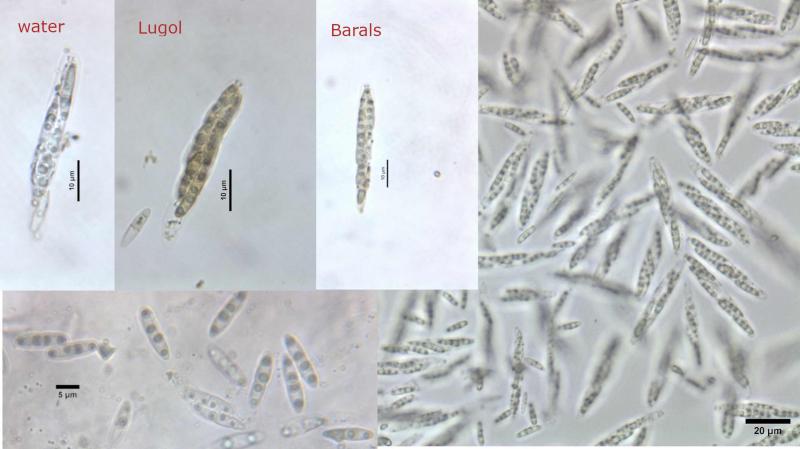
Inside the perithecia was a gelatinous content consisting of hundreds of asci (average: 48 x 6.8 µm; Q= 7.2).
Spores (average 12 x 3.1 µm Q = 3.9), usually with septum in the centre and two large droplets in each half.
The reaction of the apical ring in Lugol's or Baral's solution is difficult to determine; Congo red not tested.
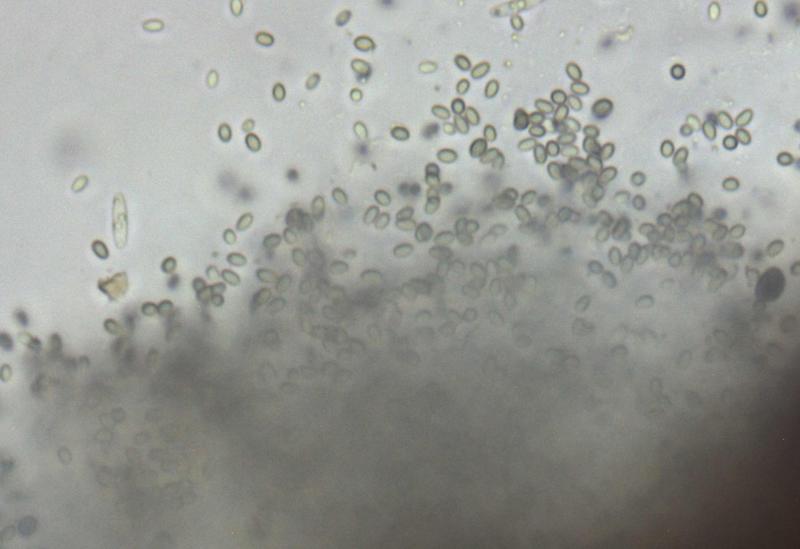
While viewing one of the preparations, I found ellipsoidal light brown conidia with the following dimensions: 3.6 x 2.1 µm, no conidiophores found.
Using the key mentioned in the publication by L.E. Wehmeyer(*), I identify the ascomata as D. medusaea (according to Mycobank: current name D. rudis).
This raises two questions:
1. Is Diaporthe rudis correct?
2. Is there a connection with the conidia?
Many thanks in advance,
François Bartholomeeusen
(*)Wehmeyer, L.E. (1933) The British species of the genus Diaporthe Nits. and its segregates. Transactions of the British Mycological Society 17: 237-295D. medusaea

Thank you very much for your detailed information. The choice of D. pulla is the most obvious (good old Ellis&Ellis remains useful!). Several studies have moved away from the host specificity of Diaporthe and assume that multiple species can occur on different plant hosts (Mycosphere 8(5) 485–511 (2017)).
Kind regards from Flanders,
François