
06-04-2026 19:40
 David Gibbs
Help with this one much appreciated, on rotting Fa
06-04-2026 11:07
Louis DENYBonjour forum, Trouvé sur bois de feuillu très d
06-04-2026 16:24
Juuso ÄikäsLast Tuesday I found some tiny white Helotiales gr

05-04-2026 20:40
 Robin Isaksson
Hi!Found i Japan on bark of Abies sp. Spores 35-4
06-04-2026 08:15
 Lothar Krieglsteiner
some days ago, on the lower surface of leaf of Que
05-04-2026 22:46
Lothar Krieglsteiner
on wood of Ceratonia, Algarve, 3.4.2026.The color
31-03-2026 21:18
 Miguel Ángel Ribes
Good evening. oes anyone have the original descrip
Eutypa on Rhamnus
Enrique Rubio,
19-01-2025 19:29
 Good evening to all of you.
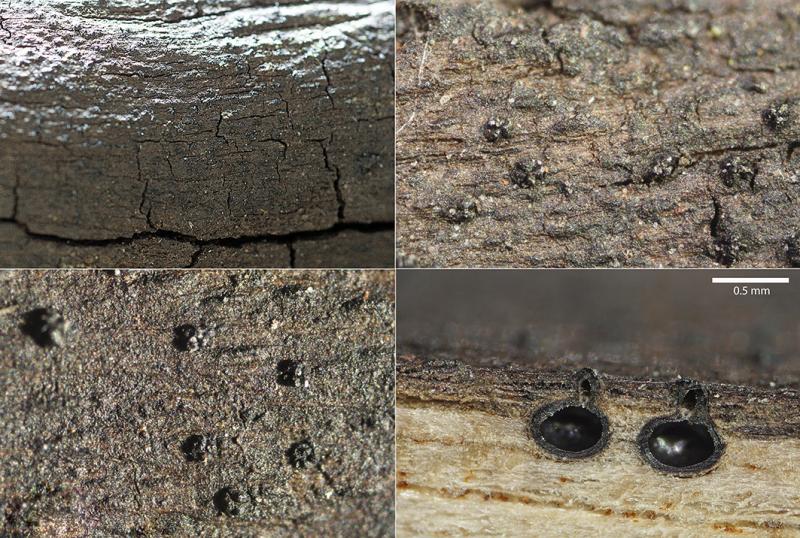
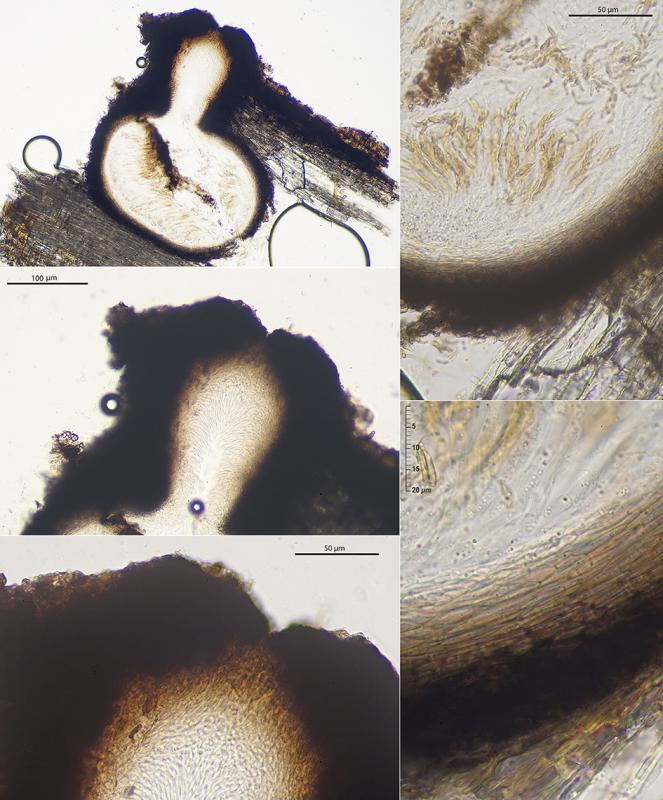
I would like to know your opinion, and in particular that of those who are more specifically dedicated to this type of fungi such as Jacques Fournier or Alain Gardiennet, on this Eutypa growing on the wood of Rhamnus alpina, on dead branches still attached to the tree, and at an altitude of 1700 m. The surface is blackened and the ostioles, which reach 300 microns in diameter, barely protrude and they are conspicually cruciform.
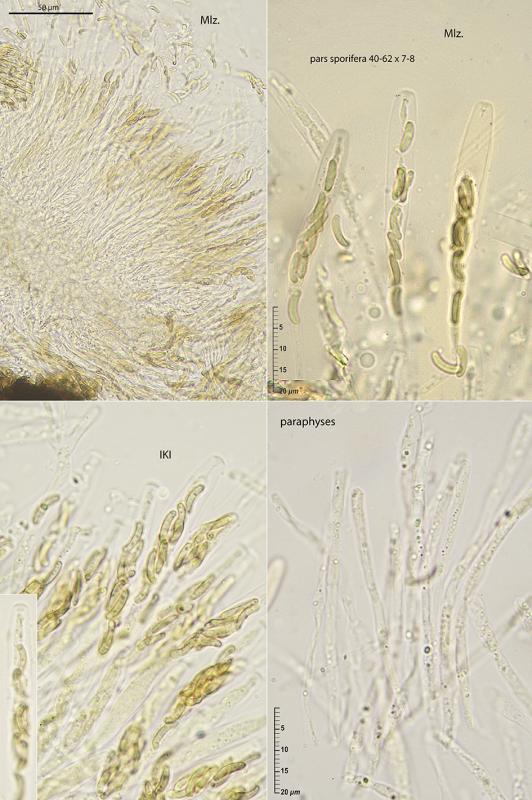
The perithecia are about 500 microns in diameter and the asci have a negative or only very weakly positive subapical ring in both Mlz. and IKI.
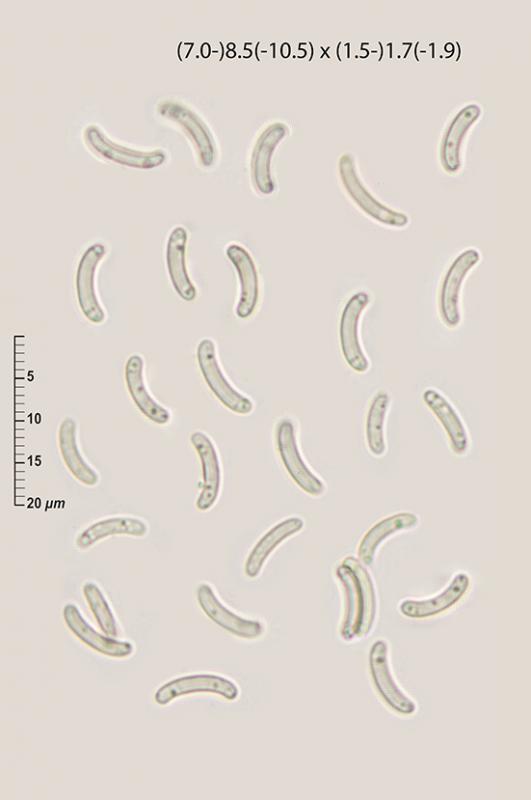
In an unpublished Fournier's key I find an Eutypa rhamnicola, a species that seems not yet formally described, which looks quite similar despite their slightly wider spores.
Many thanks in advance for your help.
Jacques Fournier,
19-01-2025 20:42

Re : Eutypa on Rhamnus
Hola Enrique,
indeed your data fit well what Christian and I called Eutypa rhamnicola. Repeatedly collected on R. alpina over 1000m, just like you.
It remained an unfinished project, like many others, by lack of molecular support and time, and I encourage you to take over. There is still a lot to do on Eutypa.
I found the most diagnostic morphological feature of this species is the long neck in relation with the relatively deeply immersed perithecia. Such a configuration is only encountered in E. maura, otherwise easily distinguished. And I agree the apical ring is very small and amyloid
Let's keep in touch!
Un abrazo,
Jacques
indeed your data fit well what Christian and I called Eutypa rhamnicola. Repeatedly collected on R. alpina over 1000m, just like you.
It remained an unfinished project, like many others, by lack of molecular support and time, and I encourage you to take over. There is still a lot to do on Eutypa.
I found the most diagnostic morphological feature of this species is the long neck in relation with the relatively deeply immersed perithecia. Such a configuration is only encountered in E. maura, otherwise easily distinguished. And I agree the apical ring is very small and amyloid
Let's keep in touch!
Un abrazo,
Jacques
Enrique Rubio,
20-01-2025 19:41
Re : Eutypa on Rhamnus
Thank you once again, Jacques.
I would like to ask you another question: do you really see clearly that the apical apparatus of the asci is amyloid? I have not been as clear as you, neither in Melzer nor in IKI.
Yes, it is very sad that Christian is no longer with us.
I would like to ask you another question: do you really see clearly that the apical apparatus of the asci is amyloid? I have not been as clear as you, neither in Melzer nor in IKI.
Yes, it is very sad that Christian is no longer with us.