
09-06-2026 18:32
Camille MertensSur morceau de roseau immergé 0,5 - 0,7 mm de dia
10-06-2026 12:54
Steve ClementsBonjour encore, Pouvez-vous m'aider, s'il vous pl

10-06-2026 21:16
 François Freléchoux
Bonsoir,Le dernier du jour, en attendant votre avi
10-06-2026 21:07
François Freléchoux
Toutes les tiges de gentianes jaunes de l'an passÃ
10-06-2026 13:41
François Freléchoux
Bonjour à nouveau, Voici une trouvaille d'hier.
10-06-2026 11:53
Steve ClementsBonjour, This disco is abundant on dead stems of
10-06-2026 10:45
François Freléchoux
Bonjour à nouveau, Encore une détermination qui
08-06-2026 10:16
 Spooren Marco
I don`t have a clou about this fungus,it is not in
10-06-2026 09:24
François Freléchoux
Bonjour, J'imagine que cette détermination ne do
Fusicolla?
Dragiša Savic,
27-03-2022 14:46
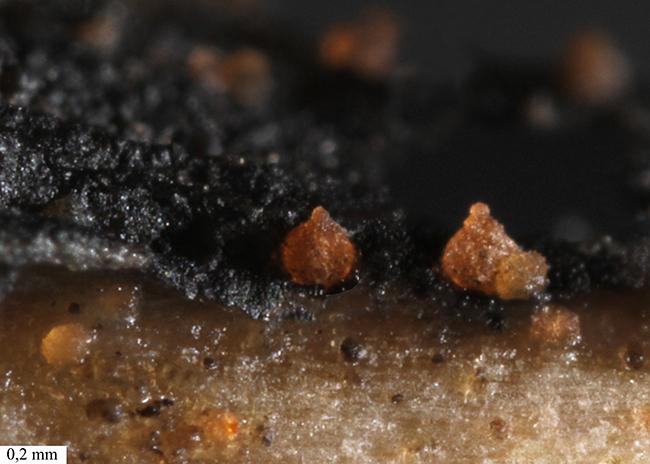
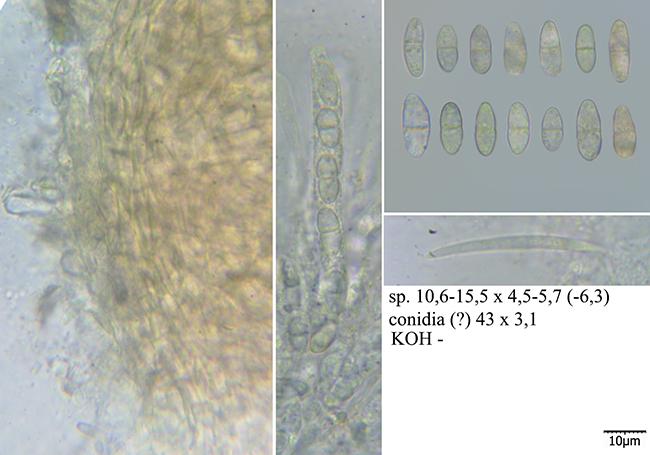
Interesting species on the stem of Ruscus aculeatus (Serbia).
The closest is the genus Fusicolla, if I'm not mistaken. It is somewhat similar to F.ossicola or F.melogrammae but the substrate is different.
Ascomata perithecial, superficial, solitary or in groups, 200–220 um diam, not changing color in KOH. Anamorph not seen, but I found only one Fusarium-like conidia (?).
Nicolas Schwab,
27-03-2022 17:02
Re : Fusicolla?
Compare with Geejayessia ruscicola.
See:
Lechat C. & Fournier J. 2021. Geejayessia ruscicola (Hypocreales, Nectriaceae), a new species on Ruscus aculeatus. Ascomycete.org 13(4): 157-160. DOI: 10.25664/ART-0331
Dragiša Savic,
27-03-2022 17:14
Re : Fusicolla?
Hi Nicolas, G.ruscicola is different. By the way, it is very common in my area, it is easy to find, the first time I found it several years ago, Lechat told me that he was preparing a paper about it. I saw them now as well, but on a different branch.
Nick Aplin,
28-03-2022 00:13
Re : Fusicolla?
Hi Savic,
I'm sure you are right with Fusicolla sp., but I cannot name the species - No collections are known from Ruscus as far as I know....
I found Fussicola ascomata on various substrates in the past (they seem to like it when other other Nectriaceae are present), but often I could not name them, even when I had a good quality ITS sequence.
I guess the situation might be similar to Fusarium species with gibberella-like anamorphs, in that there could be more cryptic species in a wide range of ecological niches (and with overlapping teleomorph morphology) than have been described so far. There are also several species that are only known from their asexual states.
Sorry, I haven't been much help :(
Cheers,
Nick
I'm sure you are right with Fusicolla sp., but I cannot name the species - No collections are known from Ruscus as far as I know....
I found Fussicola ascomata on various substrates in the past (they seem to like it when other other Nectriaceae are present), but often I could not name them, even when I had a good quality ITS sequence.
I guess the situation might be similar to Fusarium species with gibberella-like anamorphs, in that there could be more cryptic species in a wide range of ecological niches (and with overlapping teleomorph morphology) than have been described so far. There are also several species that are only known from their asexual states.
Sorry, I haven't been much help :(
Cheers,
Nick
Dragiša Savic,
28-03-2022 07:31
Re : Fusicolla?
Thanks Nick, you helped a lot, you confirmed what I thought :(