
17-04-2026 19:16
 Enrique Rubio
Hi to everybodyI would appreciate any assistance r
14-04-2026 05:32
Ethan CrensonHi all, A few weeks back a friend pointed out som
17-04-2026 15:14
 Bruno Coué
Bonjour.Récoltes du 16/04/2026, sur feuilles mort
12-04-2026 15:52
Gernot FriebesHi,I'm looking for help with this anamorph collect
14-04-2026 21:52
Gernot FriebesHi,found on dead leaves of Carex elata. Conidia: 4
16-04-2026 22:09
Buckwheat PeteHello, I'd like to ask about this older specimen:
15-04-2026 19:33
Fátima Durán ManzanequeHi!! I need help, I found this Ascomycete but I d
14-04-2026 20:31
Gernot FriebesHi,can this be Psilachnum lateritioalbum on Phragm
12-04-2026 17:56
 Hardware Tony
Found on dead stems in February earlier this year
12-04-2026 12:22
 William Slosse
In a dune grassland in Oostduinkerke (Belgium), on
Boudiera
Zuzana Sochorová (Egertová),
13-10-2020 20:40
 Hello,
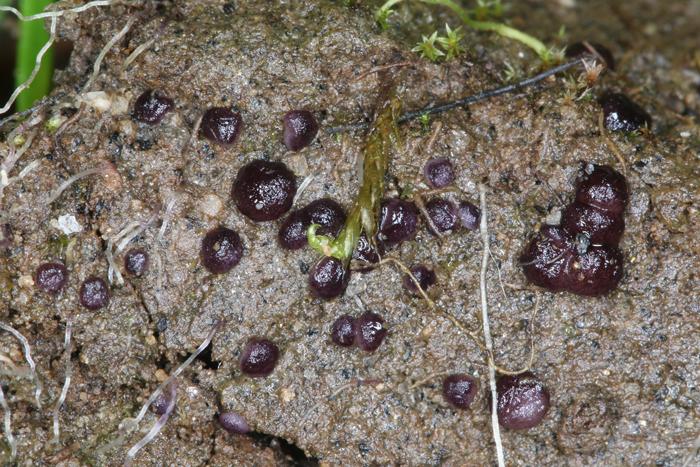
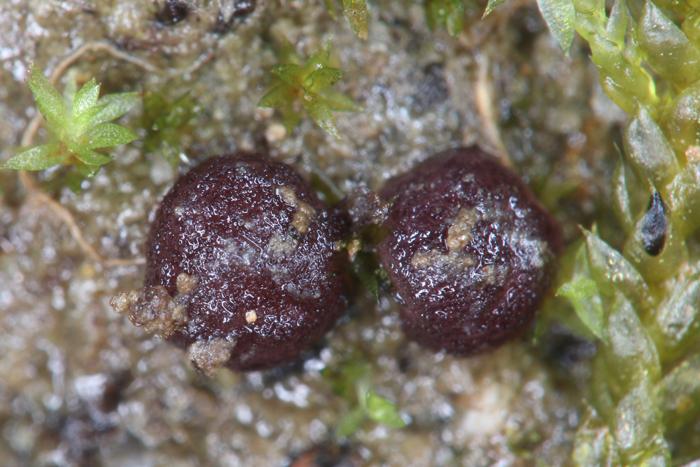
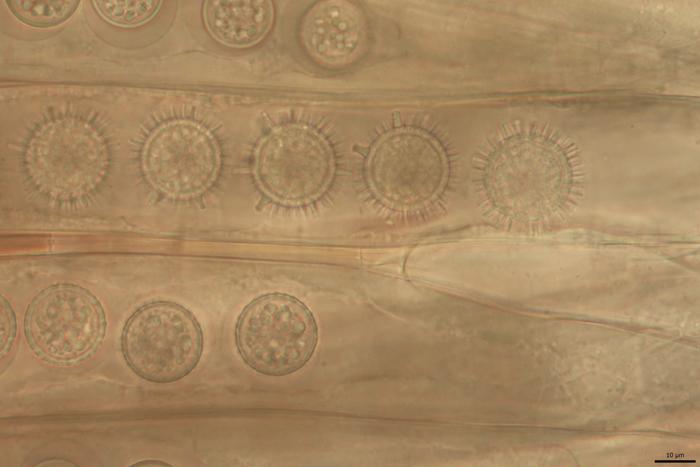
this Boudiera has been collected in South Bohemia, in a meadow with a lot of Hygrocybe species. One group of Boudiera was intermixed with Ramsbottomia macracantha.
Apothecia only to 2.5 mm, pulvinate, purple, sessile.
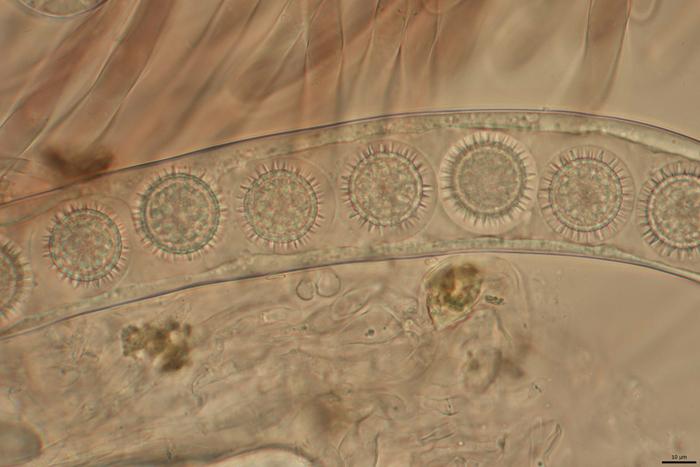
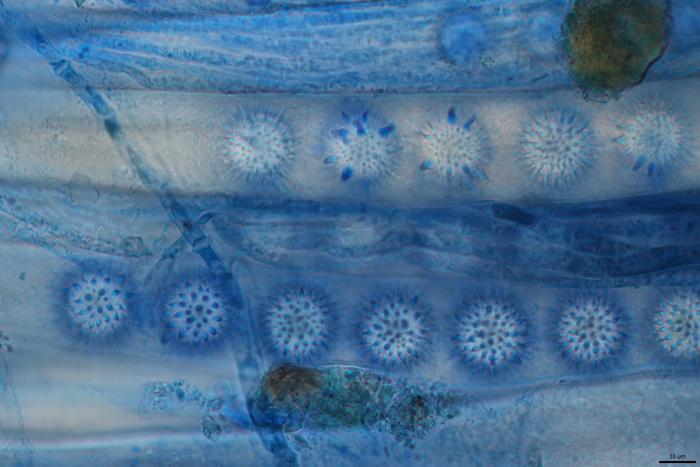
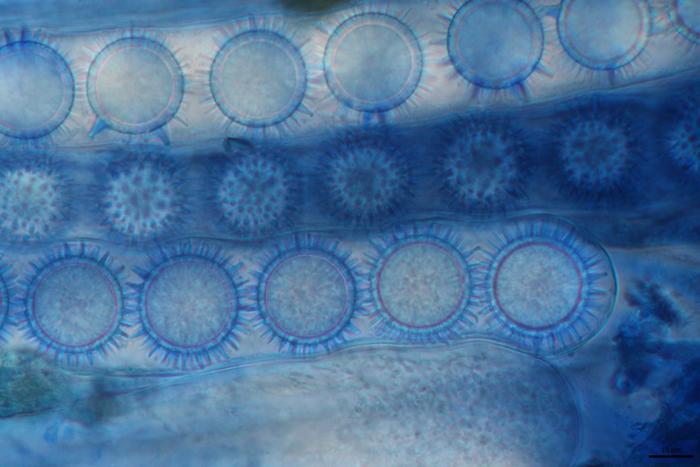
Ascospores without ornament 21.9-24.6 micrometers (average 23.1 micrometers), spines (2.8)3.1-4.4(4.7) micrometers, at base mostly 0.5-1.6 micrometers, inside asci having a gelatinous sheath. However, in some asci ascospores with much wider spines occur, up to 3 micrometers wide at base.
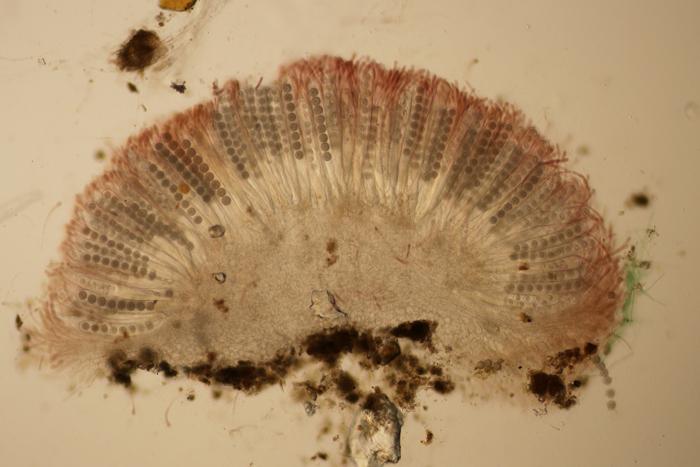
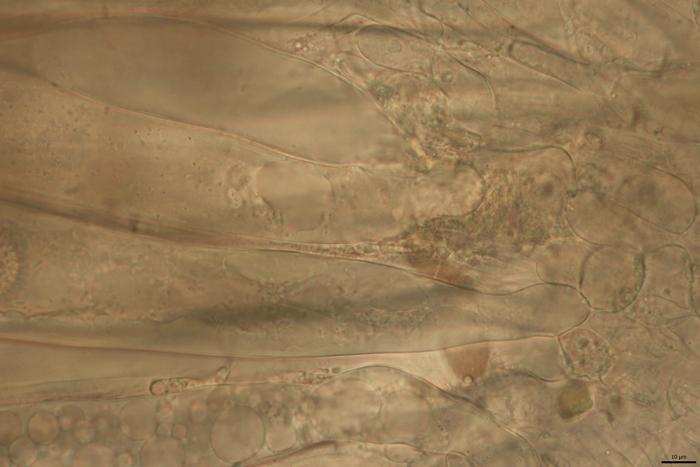
Asci operculate, arising from simple septa, about 390 micrometers long, 38-42 micrometers broad, 8-spored.
Paraphyses 4.2-7.2 micrometers wide, septate, simple, containing purple pigment, apex enlarged, 10.3-12.9 micrometers.
Medulla t. intricata, up to 230 micrometers thick. Ectal excipulum 70-110 micrometers thick, t. angularis-globulosa.
I would determine it as B. tracheia. Do you agree? Have you also observed such a variable ornament in Boudiera?
Thank you, Zuzana
Zuzana Sochorová (Egertová),
13-10-2020 20:43
Re : Boudiera
some more photos
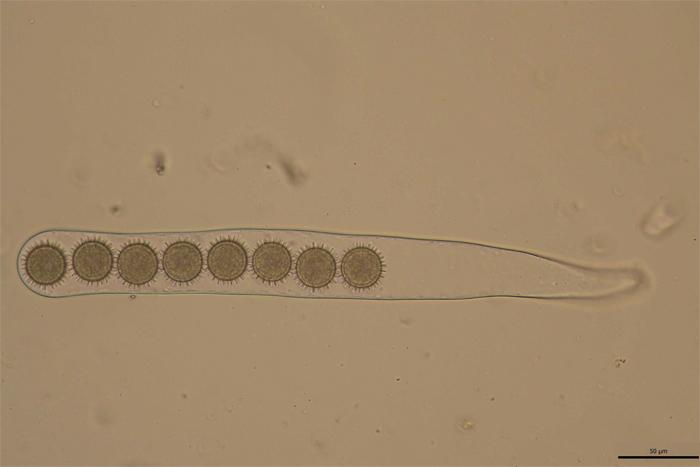
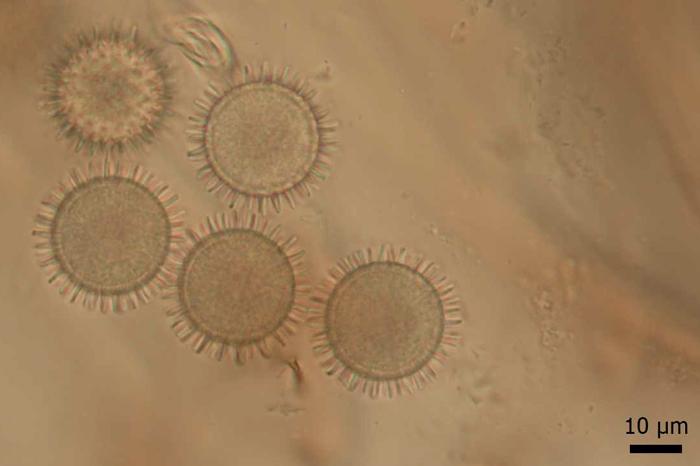
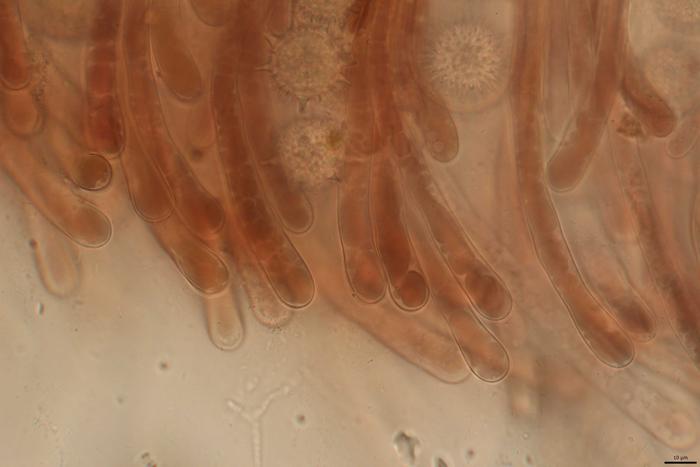
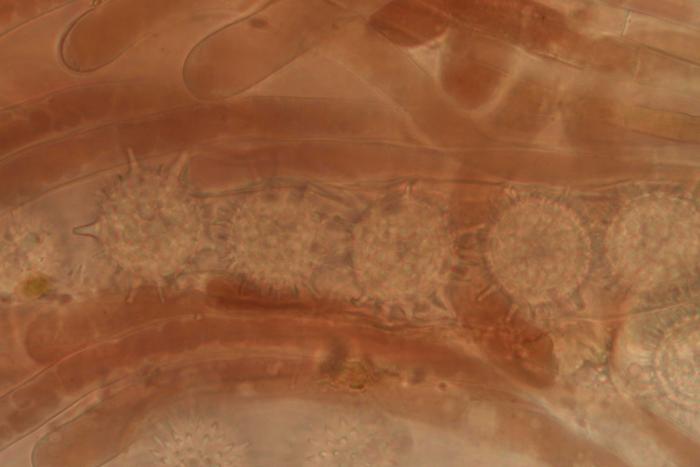
Lothar Krieglsteiner,
13-10-2020 20:44

Re : Boudiera
Hello Zuzana,
if you did not observe free spores (I suggest this because you don`t show them), you cannot conclude how the ripe ornament can be. I remember for instance B. areolata as having very similar spores than yours when unripe, and it becomes ripe quite late.
The common growth with Ramsbottomia shows me that you collected on strongly acid soil. So B. areolata could be a possibility.
But - you should wait until you find enough ripe spores outside the ascus - or look again in your sample in older ascomata.
P.S. Sorry - I did not see your second contribution with free spores. So -... no opinion.
But: yes, I remember very big variation betwenn unripe and fully ripe spore ornaments.
if you did not observe free spores (I suggest this because you don`t show them), you cannot conclude how the ripe ornament can be. I remember for instance B. areolata as having very similar spores than yours when unripe, and it becomes ripe quite late.
The common growth with Ramsbottomia shows me that you collected on strongly acid soil. So B. areolata could be a possibility.
But - you should wait until you find enough ripe spores outside the ascus - or look again in your sample in older ascomata.
P.S. Sorry - I did not see your second contribution with free spores. So -... no opinion.
But: yes, I remember very big variation betwenn unripe and fully ripe spore ornaments.
Zuzana Sochorová (Egertová),
13-10-2020 21:20
Re : Boudiera
Hello Lothar,
in the beginning I really had no free spores, but I let the fungi in a fridge for several days and obtained them. The measurements I give are made on free spores.
I know B. areolata, have collected a rich population in a former kaolin quarry in Moravia.
I have a possibility to sequence the find, but it probably woudn't help, because only minority of the species are in GenBank. Also, there are two specimens of B. dennisii and one of B. tracheia, but this B. tracheia is 100% identical with one of those B. denisii and only 96.77% with the second one. Identity between the two specimens of B.denisii is 96.91% (therefore, at least one collection must be identified wrongly).
Z.
in the beginning I really had no free spores, but I let the fungi in a fridge for several days and obtained them. The measurements I give are made on free spores.
I know B. areolata, have collected a rich population in a former kaolin quarry in Moravia.
I have a possibility to sequence the find, but it probably woudn't help, because only minority of the species are in GenBank. Also, there are two specimens of B. dennisii and one of B. tracheia, but this B. tracheia is 100% identical with one of those B. denisii and only 96.77% with the second one. Identity between the two specimens of B.denisii is 96.91% (therefore, at least one collection must be identified wrongly).
Z.
Lothar Krieglsteiner,
14-10-2020 08:10
Re : Boudiera
Hello Zuzana,
thanks for the information. I only found areolata and acanthospora (on limestone), so I cannot contribute something to your fungus.
Marvellous find(s)!
Yours, Lothar
thanks for the information. I only found areolata and acanthospora (on limestone), so I cannot contribute something to your fungus.
Marvellous find(s)!
Yours, Lothar