
12-04-2026 17:56
 Hardware Tony
Found on dead stems in February earlier this year
19-04-2026 20:46
Steve Clements1 mm diameter approx spherical conidiophores on pl
17-04-2026 19:16
 Enrique Rubio
Hi to everybodyI would appreciate any assistance r
14-04-2026 05:32
Ethan CrensonHi all, A few weeks back a friend pointed out som
17-04-2026 15:14
 Bruno Coué
Bonjour.Récoltes du 16/04/2026, sur feuilles mort
12-04-2026 15:52
Gernot FriebesHi,I'm looking for help with this anamorph collect
14-04-2026 21:52
Gernot FriebesHi,found on dead leaves of Carex elata. Conidia: 4
16-04-2026 22:09
Buckwheat PeteHello, I'd like to ask about this older specimen:
15-04-2026 19:33
Fátima Durán ManzanequeHi!! I need help, I found this Ascomycete but I d
14-04-2026 20:31
Gernot FriebesHi,can this be Psilachnum lateritioalbum on Phragm
Hypocreales on old basidiomata of Trametes hirsuta
Ibai Olariaga Ibarguren,
21-04-2020 15:52
Hi,
I hope eveyone is OK.
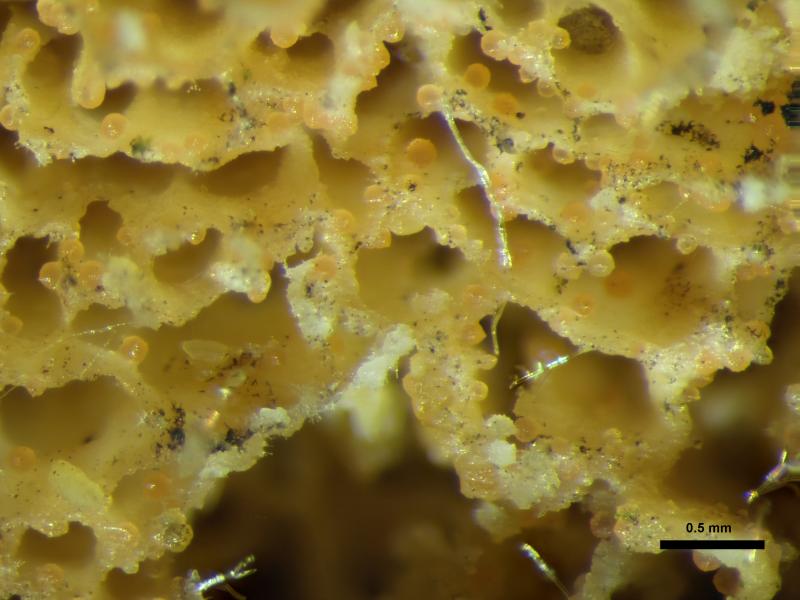
I was wondering is come could provide a hint to be able to identify this fungus that grew on old basidiomata of Trametes hirsuta growing on a large lof of Fagus sylvatica.
The perithecia were more or less globose, growing gregariously, glabrous, initially white and then pale pink, 80-160 µm in diametre.
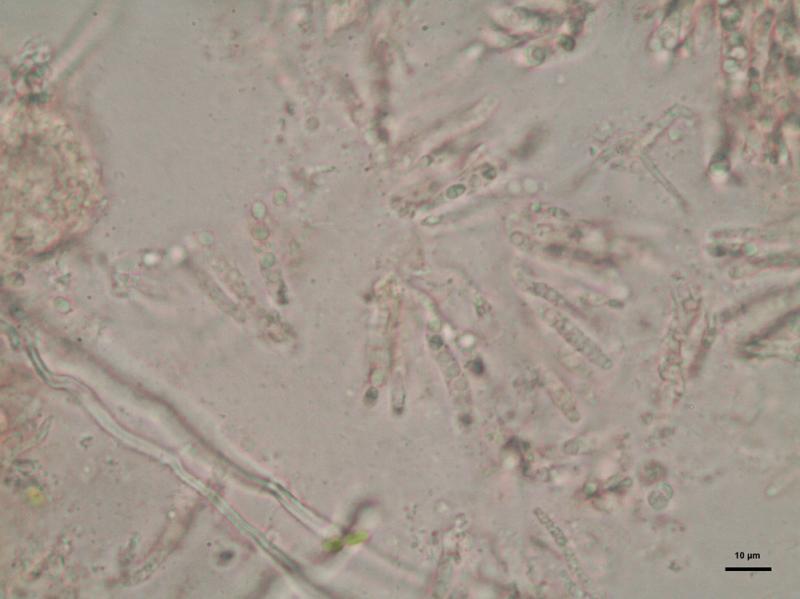
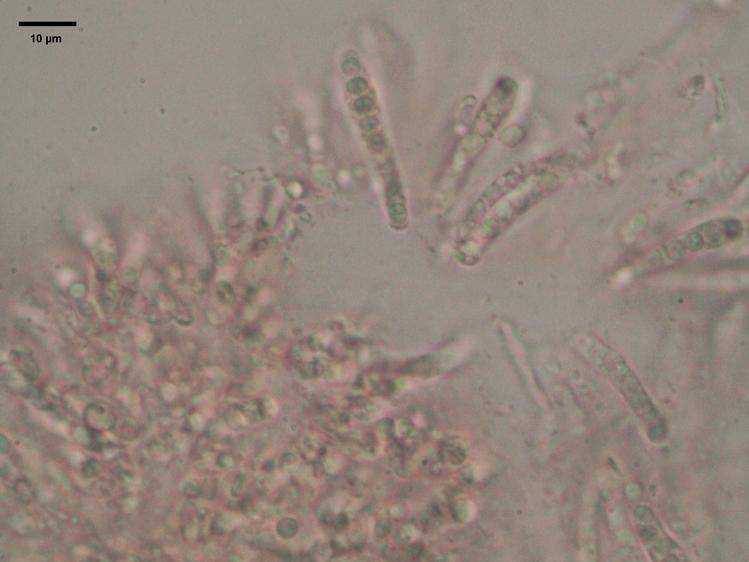
The ascospores are subglobose to broadly ellipsoid, 1-septate, hyaline, thin-walled, 2.7-3.7 x 2.2 µm, not disarticulating. Asci unitunicate, clavate, with 8 uniseriate spores, approx. 21 x 4 µm. I did not see any hairs in peridial cells (if necessary, I can provide photos).
I have been looking in Hypocreales but did not find any species that looks even close. I would appreciate any help.
Thank you in advance and take care.
Cheers,
Ibai.
Salvador Tello,
21-04-2020 22:10
Re : Hypocreales on old basidiomata of Trametes hirsuta
Hola Ibai.
¿Realmente son Peritecios? ¿No podrían ser apotecios muy pequechos?
Tiene pinta de ser Hyalorbilia erythrostigma, que crece en otros hongos muertos.
Saludos.
Salvador.
¿Realmente son Peritecios? ¿No podrían ser apotecios muy pequechos?
Tiene pinta de ser Hyalorbilia erythrostigma, que crece en otros hongos muertos.
Saludos.
Salvador.
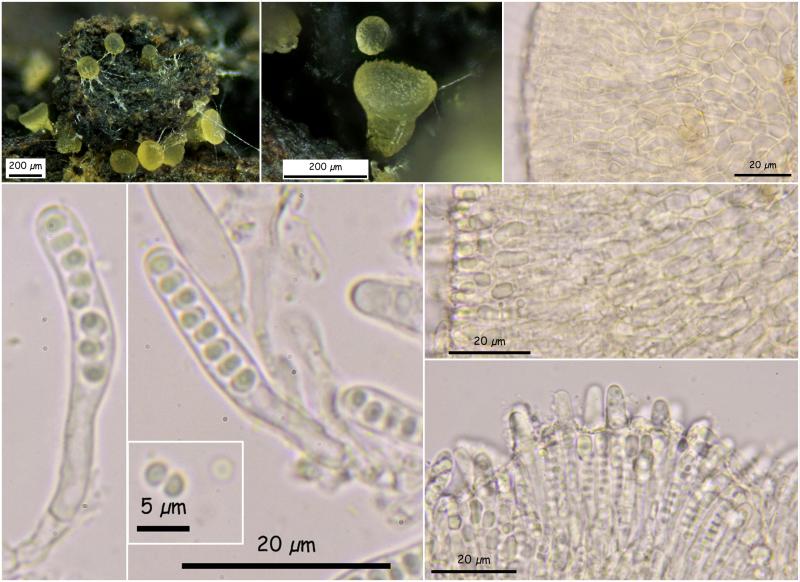
Ibai Olariaga Ibarguren,
22-04-2020 11:45
Re : Hypocreales on old basidiomata of Trametes hirsuta
Hola Salvador,
gracias por tu idea. La verdad es que miré hace tiempo el material. Lo miraré otra vez por si pudieran ser apotecios, pero no lo creo. Al menos algunas esporas eran claramente septadas. Subiré más fotos pronto.
thanks for the idea. To be honest I looked at the material a long time ago. I will take a look at it again to check if they could be apothecia, but I do not think so. At least some spores were clearly septate. I will upload more pictures soon.
Saludos,
Ibai.
Ibai Olariaga Ibarguren,
22-04-2020 17:01
Re : Hypocreales on old basidiomata of Trametes hirsuta
Hi again,
yes, they are definitely perithecia with a clear ostiole.
The asci have a very inconscicuous ascal apparatus, observed as two very small refractive dots at both sides of the apex.
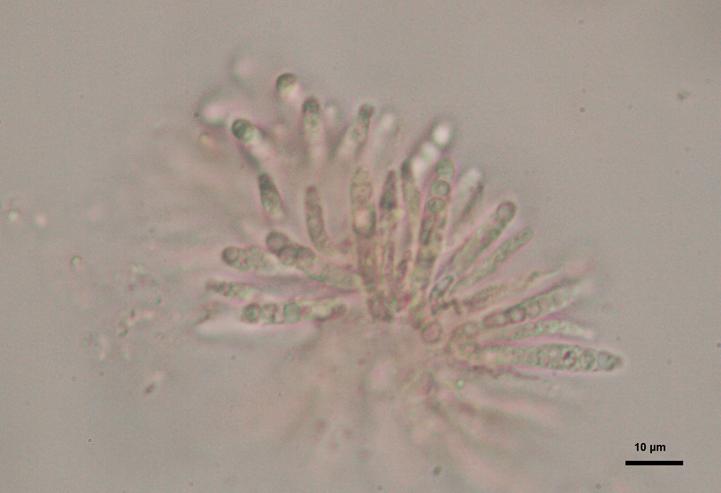
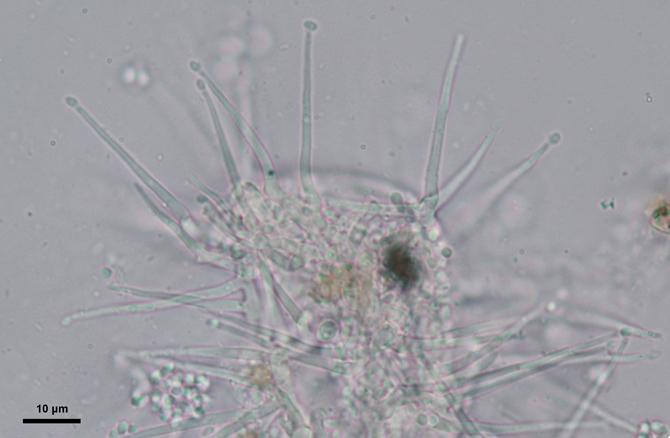
There is an anamorphic state everywhere in my sample, I think it is Acremonium-like.
Any idea? I think it might belong either to Bionectriaceae, but I am not sure.
_____
Hola Salvador,
sí, son peritecios, son ascomas cerrados con un ostiolo apical. Los ascos tienen un aparato ascal muy rudimentario y visible levemente como dos puntos refringentes a cada lado del ápice del asco.
La muestra está completamente colonizada por un anamorfo de tipo Acremonium (creo), que podría ser suyo.
Saludos,
Ibai.
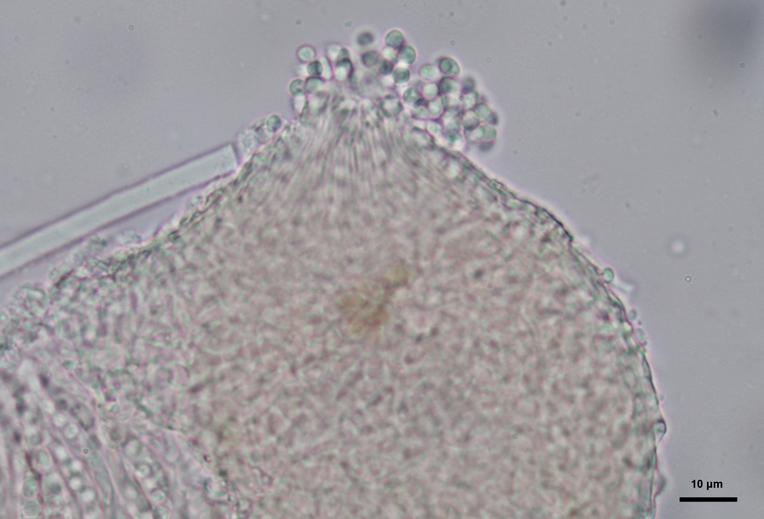
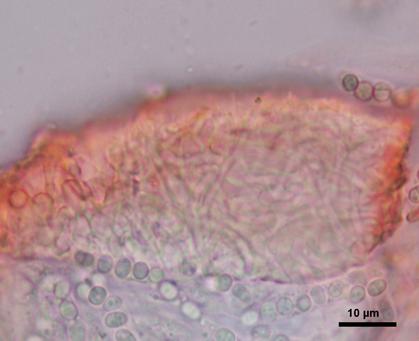
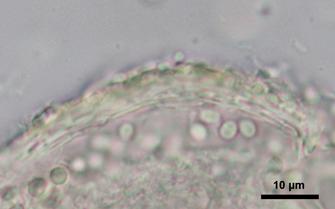
Christian Lechat,
22-04-2020 18:05

Re : Hypocreales on old basidiomata of Trametes hirsuta
Hi to all,
are the hyphal elements covering ascomatal wall smooth or spinulose?
All the best,
Christian
Ibai Olariaga Ibarguren,
22-04-2020 18:10
Re : Hypocreales on old basidiomata of Trametes hirsuta
Hi Christian,
they are completely smooth, 2-3 µm, hyaline to pale yellow.
Thanks in advance.
Ibai.
Salvador Tello,
23-04-2020 14:27
Re : Hypocreales on old basidiomata of Trametes hirsuta
Sí, defintivamente son peritecios.
Solo me había parecido muy similar a Hyalorbilia erythrostigma y como no apreciaba bien los peritecios en la foto pensé que podrías haberte equivocaco. Pensé mal
Saludos.
Salvador.
Solo me había parecido muy similar a Hyalorbilia erythrostigma y como no apreciaba bien los peritecios en la foto pensé que podrías haberte equivocaco. Pensé mal
Saludos.
Salvador.
Ibai Olariaga Ibarguren,
23-04-2020 14:47
Re : Hypocreales on old basidiomata of Trametes hirsuta
Era una propuesta muy razonable, ya que los ascos y las esporas se parecían mucho y la ecología coincidía. Pero tampoco había visto paráfisis.
Gracias por la aportación, no conocía H. erythrostigma, pero ahora ya sí :-)
Saludos,
Ibai.