
29-05-2026 15:35
daniel FERREBonjour à tous,Je voudrais votre aide pour cette
28-05-2026 16:15
James MitchellHello,Does anyone have the original publication of
28-05-2026 11:06
Thomas Læssøehttps://svampe.databasen.org/observations/10596750
23-05-2026 11:44
 Charles Grapinet
Hello, I am having trouble identifying this copro
25-05-2026 16:44
François BartholomeeusenHi forum members,During an excursion organised by
26-05-2026 21:25
Dirk GerstnerHello everyone, I'm completely stumped by this li
26-05-2026 22:44
Ethan CrensonHi all, I think I have Incrucipulum capitatum her
22-05-2026 14:44
 Lothar Krieglsteiner
in unripe condition citrine yellow, then soon fadi
25-05-2026 16:35
 Bernard CLESSE
Bonjour à toutes et tous,J'ai trouvé récemment,
22-05-2026 13:29
Gernot FriebesHi,I am curious to hear your opinion on this mater
Hopefully there is someone here that can help me with this inconspicuous species I collected on the underside of Platanus x hispanica leaves on 24/4/2016:
Apothecia up to 0.4mm, smooth to densely hairy
51.128851°N, -0.152131°W 70 metres above sea level
Ascospores 8.1-10.5 x 2.9-4 µm, smooth, hyaline, aseptate, with few small droplets
Asci with croziers, IKI light blue, possibly with Hymenoscypus type ring (?)
Paraphyses with single elongated, +/- refractive vacuole
Hairs when present clavate, smooth, up to 3-septate, end cell with single vacoule.
I have no idea where this species belongs, so any hints whatsoever would be much appreciated!
Amitiés,
Nick
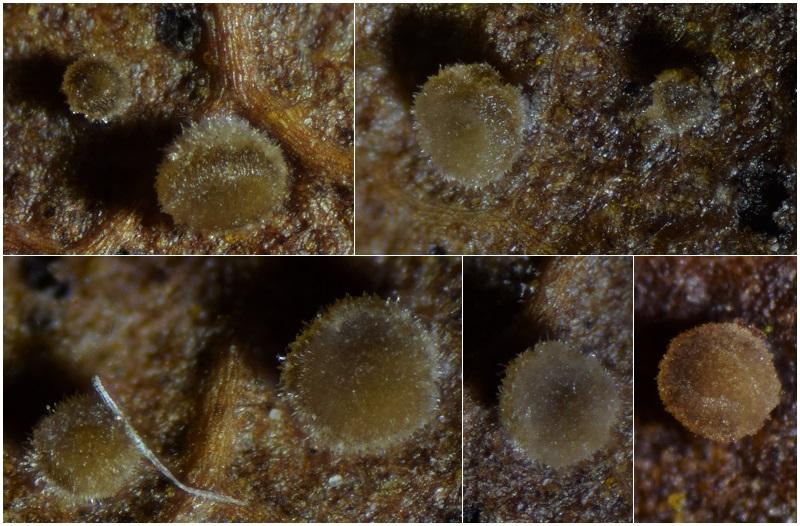
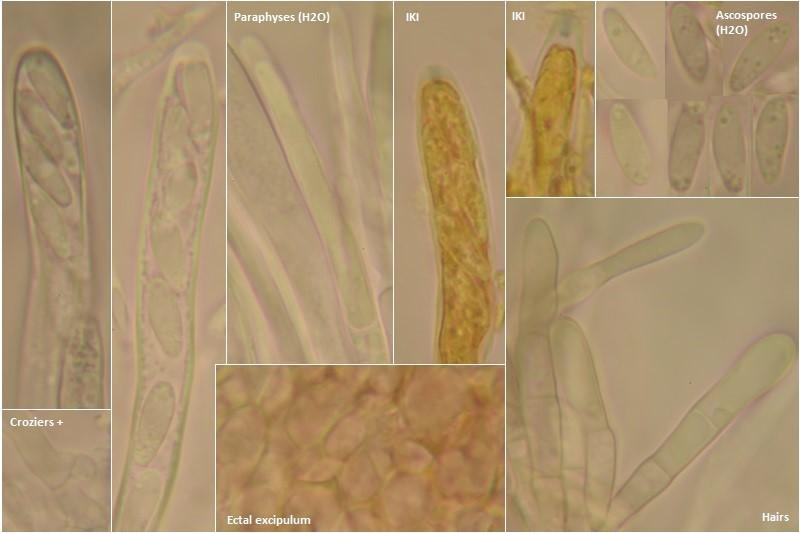

the apical ring looks more Sclerotinaceous to me but about the genus I have currently no idea.
cheers,
Stip

this looks indeed a bit sclerotiniaceous, mainly the basal amyloid protrusion. Could you please characterise the excipulum? Possibly the fungus is related to Moellerodiscus, though being very small and apparently sessile.
Zotto
Thanks for the advice. I had briefly considered Sclerotiniaceae but ended up getting nowhere.
I must admit I haven't grasped the terminology to describe the excipulum, so I'm hoping the picture helps....If not, I can try some more sectioning but I fear I'll end up with less than ten fingers :)
You can see the outside of the apothecium is a rosy-brown colour and which darkens lower down. The point of attachment is black.
Cheers,
Nick
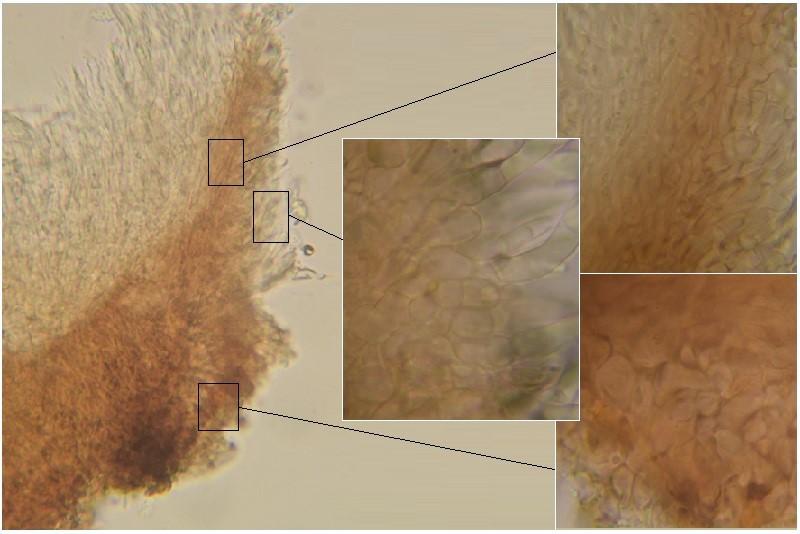
I see there was a similar case of sessile ?Moellerodiscus growing on a twig of Ligustrum which I could study only in the dead state.
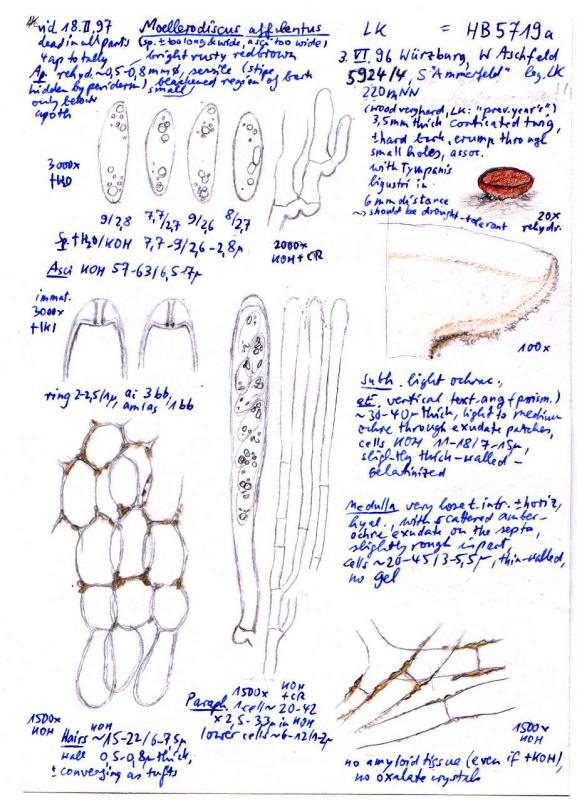
Hi Zotto,
ah - I remember this. I think it grew together with Tympanis ligustri there.
Regards from Lothar