
23-05-2026 11:44
 Charles Grapinet
Hello, I am having trouble identifying this copro
22-05-2026 21:35
Steve ClementsBonjour, I expected this find on old wood on our
22-05-2026 18:12
 Lothar Krieglsteiner
... in moist chamber from Portugal.As the fungus s
22-05-2026 20:08
Ethan CrensonHello all, Yesterday in NYC I was visiting an e
11-01-2022 16:36
 Jason Karakehian
Hi does anyone have a digital copy of Raitviir A (
20-05-2026 17:47
Margot en Geert VullingsWe found this Mollisia on dead Juncus stems mown l
22-05-2026 14:47
Gernot FriebesHi,superficial ascomata collected on bark of a liv
22-05-2026 14:44
Lothar Krieglsteiner
in unripe condition citrine yellow, then soon fadi
22-05-2026 13:29
Gernot FriebesHi,I am curious to hear your opinion on this mater
22-05-2026 10:59
 Nicolas VAN VOOREN
Trouvé sur Phragmites, ce que je pense être un L
 Hello,
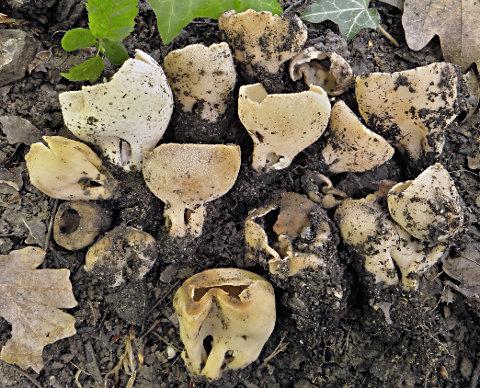
I would like to ask your opinion on this one: Collected in may 2015, warm deciduous forest, basic soil. Apothecia 3-5 cm in diam., all with distinct, big and perforated stipe. Young ascomata semiimmersed in soil, then cupulate, old ones cracking to lobes (Geopora-like). Receptacle lightly pustulate. Many fruibodies are perforated on the bottom of apothecium.
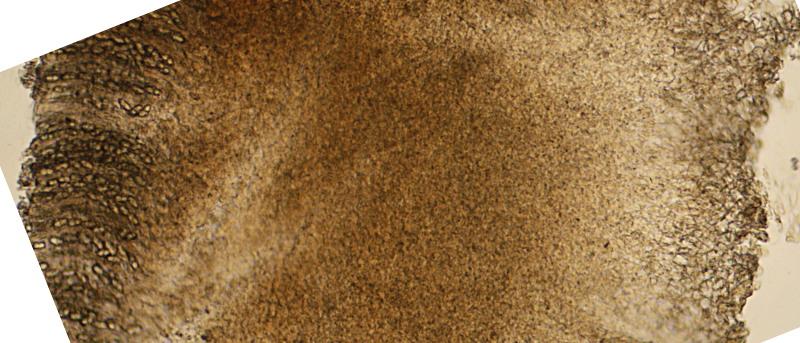
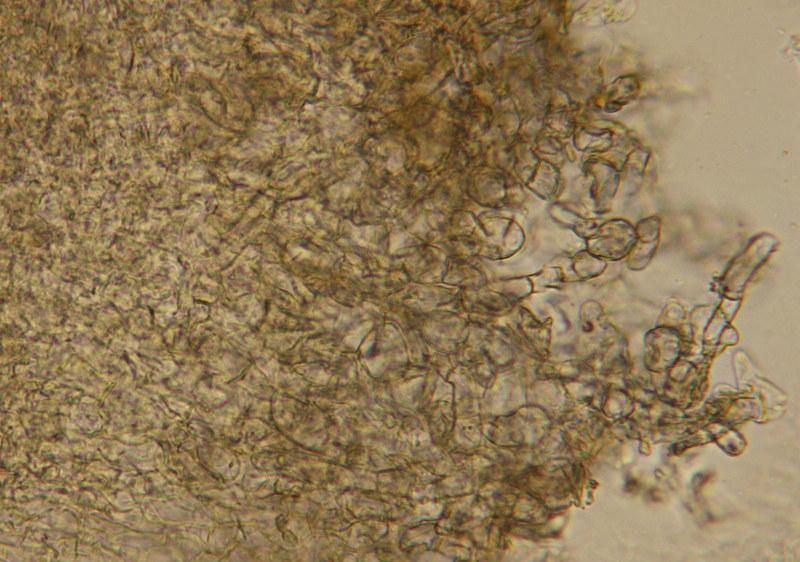
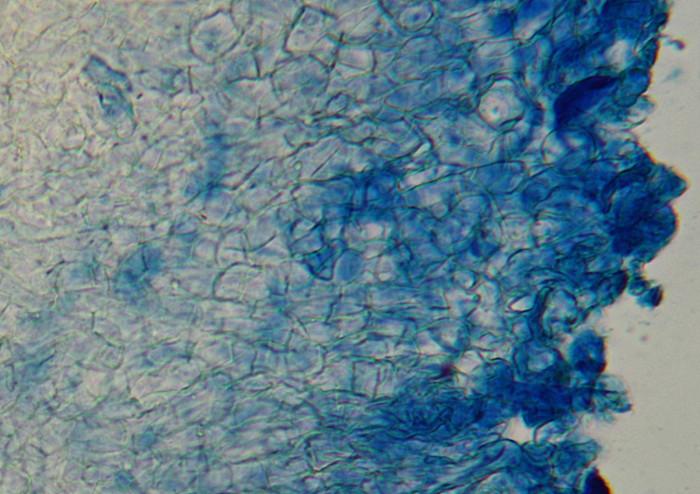
Medúlla of t. intricata, cca 330-370 um, ectal excipulum of t. angularis, up to 140 um, at the surface becoming t. globulosa, covered with sparse hairs. Hairs hyaline or yellowish, flexuous, about 50-135 (190) × 7-10 um, obtuse, 1 um thick walls.
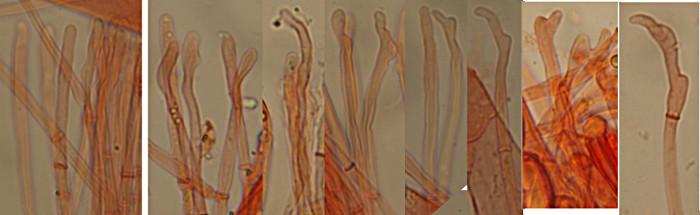
Paraphyses not exceeding asci, straight, branched, most of them are slightly clavate, sometimes more irregularly enlarged or antler-like branched, but not much.
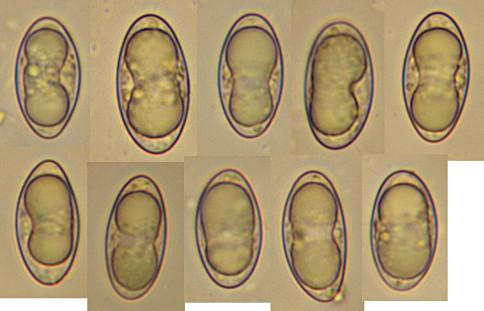
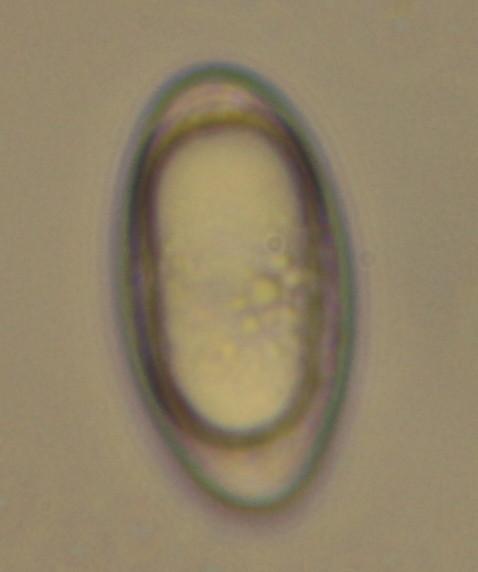
Sp. ellipsoid or fusiform-ellipsoid, most of them with rather pointed poles, (20) 21,1–24,3 (25,5) × (9,8) 11–12,5 (13,3) um, probably with 2 LBs and some small ones when alive, uninucleate, carminophile.
Based on microcharacters I think it is Tarzetta catinus. But I never saw such a distinct, almost Jafnea-like stipe on Tarzetta. Something similar is in this Rubén Martínez Gil's collection: http://ascofrance.fr/search_forum/30049 , but not so much developed. If my determination is correct, is this feature common for T. catinus, or rather result of some environmental conditions?
Genus Helvella should be considered.
Ernestas
So the genus Tarzetta seems the good genus for your collection. Due to the rather large size of apothecia, you should investigate Tarzetta spurcata.
thank you both for answering so quickly.
Ernestas: As far as i know, Helvellas should have only one big LBs, already in living state, and four nuclei in spores - that's why I excluded it. But yes, when searching for a suitable genus, the stipe made me consider Helvella as well.
Mr. Van Vooren: I saw some pustulate ornamentation, but in water only. In LACB or IKI it "disappeared", so I was not sure, if it weren't just the small guttules inside. I'll try to check again.
edit: Häffner (1992) writes he saw tuberculate ornamentation in T. galliardina, catinus, cupularis. But this is not so dense, as he illustrates it.
Tori
The aspect macro is of Tarzetta spurcata
In my opinion the spore size and shape do not fit very well for T. catinus, more in agreement with T. spurcata (see for example the Boudier's plate 337 in his Icones, under the name Pustularia ochracea).
Thank you, Mr. Van Vooren, T. spurcata (= ochracea) sure fits better than Boudier's table of T. catinus. I re-checked the paraphyses' tips and they too point rather to T. spurcata, although they are not so much branched, as in Harmaja's illustration.
So I think you can label your nice collection T. spurcata!