
28-04-2026 20:07
 Lothar Krieglsteiner
... on twig in the air at standing Ceratonia siliq
04-05-2026 18:13
 Stephen Martin Mifsud
ID request for what seems to be a true aquatic fun
04-05-2026 16:39
Stephen Martin Mifsud
ID request: This specimen was collected in Malta o
04-05-2026 09:50
 Castillo Joseba
Me mandan el material seco de Galicia,(España) re
02-05-2026 12:42
Alain BRISSARDBonjour à tousJeuidi 30 avril dernier on m'a remi
02-05-2026 13:06
Pauline. PennaBonjour Please can someone help me with this id
01-05-2026 22:45
 Thierry Blondelle
Bonjour à tous, Une récolte sur bouse séchée d
14-04-2026 05:32
Ethan CrensonHi all, A few weeks back a friend pointed out som
28-04-2026 20:33
Vitus SchäfftleinHello, I found Trochila ilicina on Ilex aquifoliu
Pyrenomycete Resembling Leptosphaeria on Sambucus
Peter Thompson,
14-03-2016 12:48
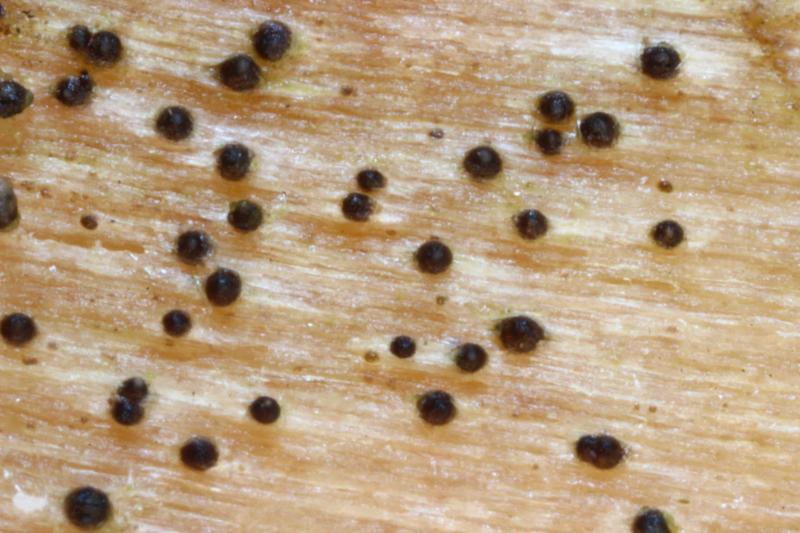
I have a sample of many individual, erumpent, black fruit bodies on a decorticated branch of Sambucus nigra. Macroscopically and microscopically they seem to most closely resemble the genus Leptosphaeria, but hardly any species grow on wood.
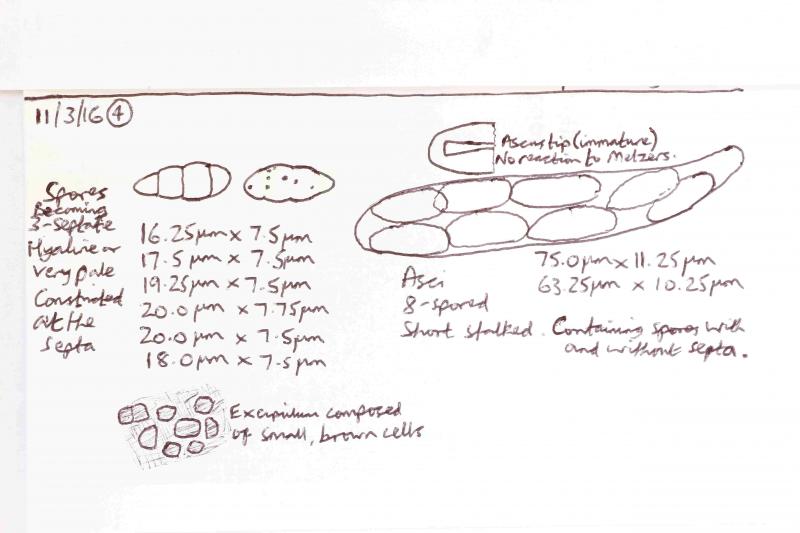
The spores were hyaline or very pale and becoming 3-septate, even in the ascus and constricted at the septa. Less mature spores had only a few small drops and faint septa developing.
There was no reaction at the ascus tip to Melzers.
I have attached a photo of the fruit bodies and a sketch of the microscopy and wonder if anyone has any ideas.
Thank you,
With Best Wishes,
Peter.
Gernot Friebes,
14-03-2016 15:42
Re : Pyrenomycete Resembling Leptosphaeria on Sambucus
Hi Peter,
my initial thought would be Exarmidium, a curious genus that's been discussed many times on this forum.
Best wishes,
Gernot
my initial thought would be Exarmidium, a curious genus that's been discussed many times on this forum.
Best wishes,
Gernot
Peter Thompson,
14-03-2016 15:49
Re : Pyrenomycete Resembling Leptosphaeria on Sambucus
Hello Gernot,
Thank you for that information.
It is a new genus for me, so I will have a look through the previous discussions and any documentation which might be referred to in them.
**** I have now looked into the previous Ascofrance forum postings and Zotto Baral's Cubby data and I am satisfied that my sample is indeed Exarmidium inclusum. There are previous British records for this species in both national databases, unlike most species in the genus.
Thank you,
With Best Wishes,
Peter.
Thank you for that information.
It is a new genus for me, so I will have a look through the previous discussions and any documentation which might be referred to in them.
**** I have now looked into the previous Ascofrance forum postings and Zotto Baral's Cubby data and I am satisfied that my sample is indeed Exarmidium inclusum. There are previous British records for this species in both national databases, unlike most species in the genus.
Thank you,
With Best Wishes,
Peter.