
28-04-2026 20:07
 Lothar Krieglsteiner
... on twig in the air at standing Ceratonia siliq
04-05-2026 18:13
 Stephen Martin Mifsud
ID request for what seems to be a true aquatic fun
04-05-2026 16:39
Stephen Martin Mifsud
ID request: This specimen was collected in Malta o
04-05-2026 09:50
 Castillo Joseba
Me mandan el material seco de Galicia,(España) re
02-05-2026 12:42
Alain BRISSARDBonjour à tousJeuidi 30 avril dernier on m'a remi
02-05-2026 13:06
Pauline. PennaBonjour Please can someone help me with this id
01-05-2026 22:45
 Thierry Blondelle
Bonjour à tous, Une récolte sur bouse séchée d
14-04-2026 05:32
Ethan CrensonHi all, A few weeks back a friend pointed out som
28-04-2026 20:33
Vitus SchäfftleinHello, I found Trochila ilicina on Ilex aquifoliu

Hi forum
We have found these small (up to 1 mm in diam.), scattered, semiinmersed to almost superficial, blackish, areolate, subglobose or broadly pyriform, papillate, not hairy perithecia on wet sandy soil at the SW of Spain.
The 8-spored asci, up to 500 micr. long, seem to have not an apical apparatus and the mature ascospores (dotted?) are brownish black with a septum near one pole. Many trabeculate paraphyses are present among the asci.
Could yo help me with an idea for it?
Thanks again
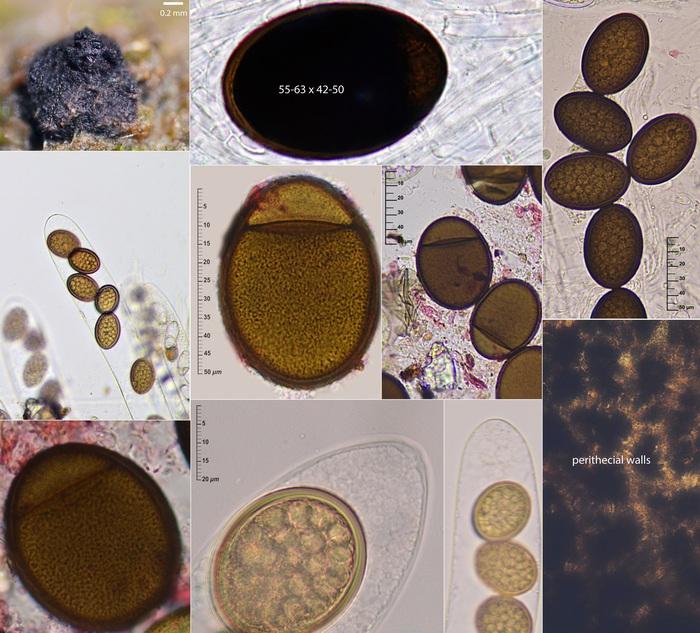

not sure it is a true septum, likely an artefact.
Many Coniochaeta spp. are soil dwellers. Was is on the seaside or near a river?
Sorry I have no better idea.
Jacques

Is it possible the dotted appearance of the ascospores is due to pits in the wall? This might suggest Gelasinospora or, because of the septum, Diplogelasinospora. The habitat on soil would be OK for those genera.
Dave
Hi Jacques
I think is likely a true septum because all the very mature ascospores have it. The perithecia were in a dry place at the south of Spain, only wet by the winter raining days. They grew together with a strange Humaria species.
Thanks a lot for your opinion
Hi David
I tought in Gelasinospora but I think lack the typical pits. The walls are smooth or only finelly dotted, I don't know.
It is curious that just now a friend of mine from the province of Navarra (NNE Spain) have found the same fungus on soil too....!
Thanks

Hi friends,
This fungus remembers me some lichenicolous species (Roselliniella, Roselliniopsis ...)
Some of them grow on lichens on soil. Have you looked at Roselliniella genus ? especially R. cladoniicola that I regularly found on terricolous Cladonia. Ascospores are more roundish but it could be an other idea.
Alain
Hi Alain
My knowledge of these genera is very little, but the ascomata are not cleistothecial and only very few mosses are present on this soil.
Many thanks again!