
15-05-2026 13:33
Sylvie Le GoffBonjour à tousJe serais très reconnaissante enve
16-03-2011 14:31
roman vargas albertoHi. I would like some opinion about this Peziza
14-05-2026 05:36
Ethan CrensonHi all, I haven't paid much attention to Lachnu
10-05-2026 23:17
 Andreas Gminder
Hello,today we found in a moist steep decidous for
11-05-2026 12:32
 Bernard CLESSE
Pourriez-vous m'aider à identifier cette héloti
13-05-2026 15:26
 François Freléchoux
Bonjour,Voici une récolte faite il y a quelques j
12-05-2026 15:41
 Nicolas VAN VOOREN
Dear Ascolovers, especially interested in Pezizale
13-05-2026 12:05
 Thierry Blondelle
Bonjour à tous,J'aimerais avoir confirmation de c
28-04-2026 20:07
 Lothar Krieglsteiner
... on twig in the air at standing Ceratonia siliq
27-04-2026 20:52
Lothar Krieglsteiner
Found on hanging tiwg of Olea europaea in dried-ou
Lachnum with "golden" hairs
Chris Yeates,
06-06-2015 20:04
 Bonsoir tous
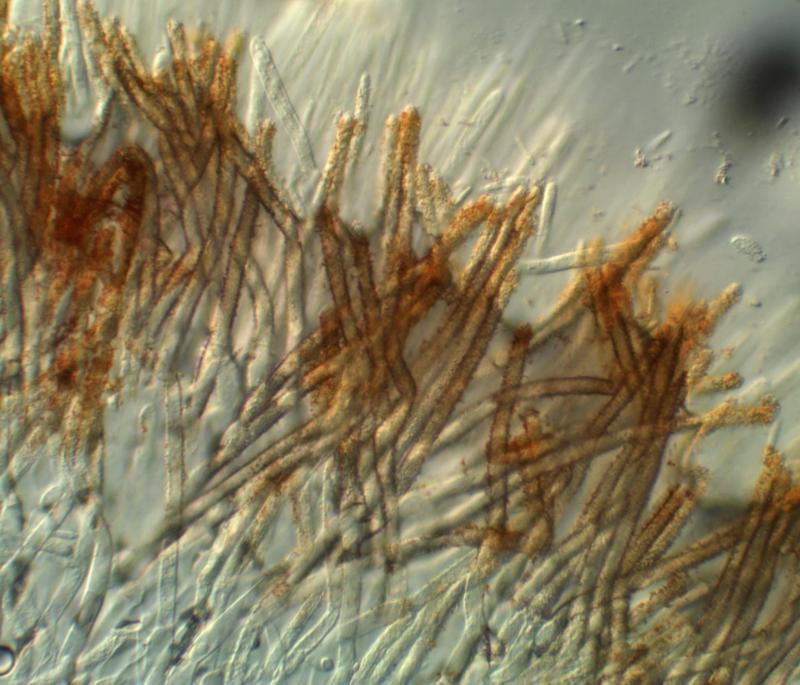
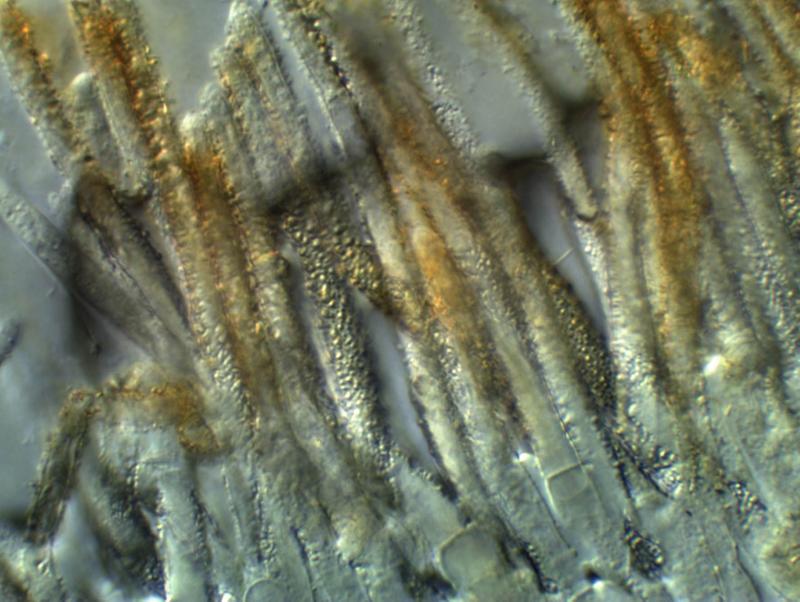
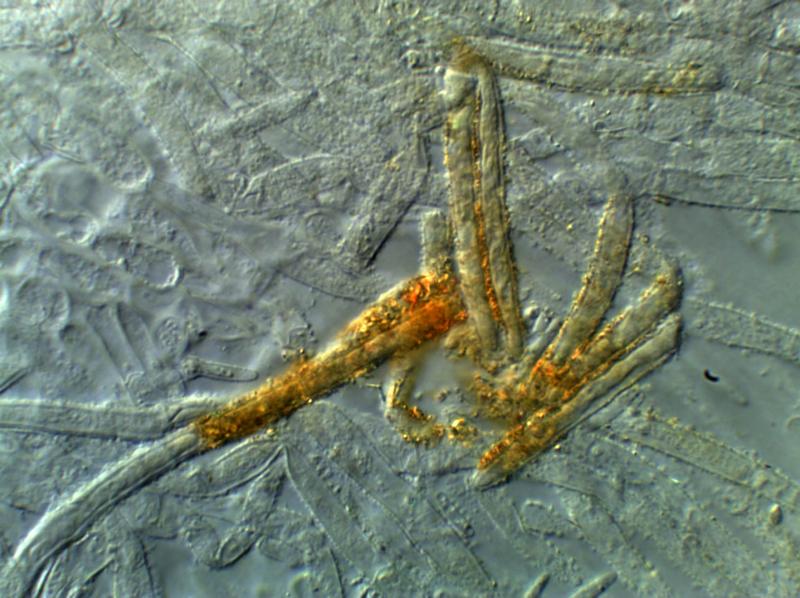
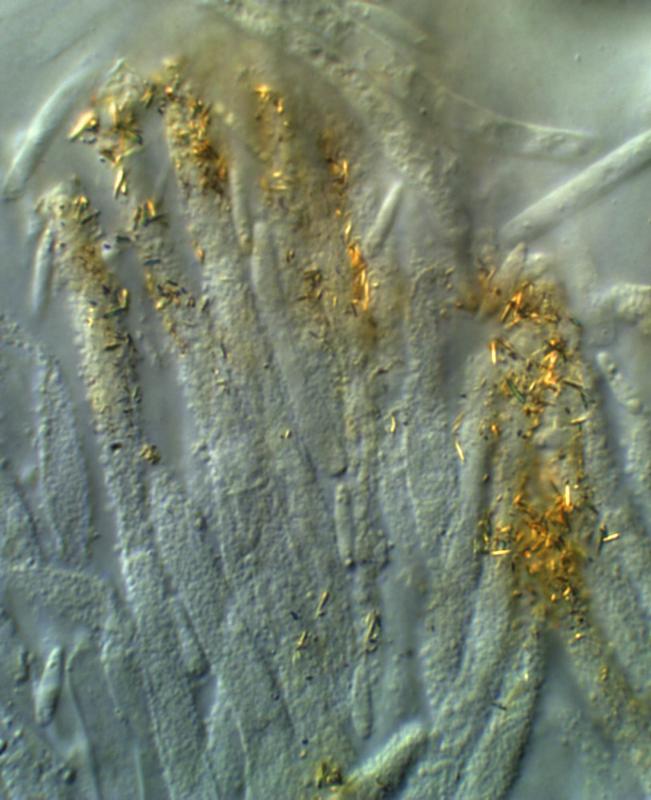
Following my coming across "Psilachnum guttules" in a collection of Lachnum clavigerum on Chamerion angustifolium - http://www.ascofrance.com/search_forum/36237 when I collected a Lachnum on another dead stem of this plant I wanted to see if I could find them again.
To all intents and purposes this second collection was also L. clavigerum: spores right size, asci without croziers, balls of crystals present on tips of hairs. One apothecium had asci with the guttules, another (at a slightly earlier stage of development) apparently did not.
But what surprised me was that a further apothecium I examined showed, in a squash, a perfect ring of golden coloured hairs. I had not noticed any colouration under the stereo microscope, but I wasn't looking for anything other than to remove an apo for examination. Closer observation showed that this colour was produced by numerous golden-coloured acicular crystals covering the distal half of the hairs. Increasing pressure on the coverslip was sufficient for many of them to become free - to start with the hairs were so encrusted as to remind me of an Incrupila. The hairs (ignoring the crystals) were rather more heavily verrucose than the other apo's examined, but otherwise it seemed close to typical L. clavigerum, though there were no globose terminal balls of crystals.
I have struggled to think why a single apothecium should appear so different when in a discrete colony on a single plant stem. I have not examined any more apo's, I am keeping the stem damp to see if any more appear to display this strange appearance.
* All the photographs are of living material mounted in water.
* The yellow colouration of the crystals is not an artefact - I double checked by examination without Nomarski (therefore no polarisation).
* The crystals were definitely only on the hairs and must have been produced there, no other part of the apothecium showed any such presence, nor was there any evidence of external contamination on the stem itself.
* Annoyingly I had treated the squash with IKI to check apex coloration (BB). In retrospect it would have been interesting to see if any reagents reacted to or removed the crystals. I am hoping that I might find another similar apothecium among the dozens on the stem.
I would be interested to know if others have come across something similar.
amitiés
Chris
Hans-Otto Baral,
06-06-2015 21:29

Re : Lachnum with "golden" hairs
Hi Chris
I am not very familia with L. clavigerum. But you can test KOH also to the IKI mount, the IKI colour will disappear and then you see perhaps the persistent crystals - or not.
No idea about this effect. Looks almost like in Trichopeziza.
Zotto
I am not very familia with L. clavigerum. But you can test KOH also to the IKI mount, the IKI colour will disappear and then you see perhaps the persistent crystals - or not.
No idea about this effect. Looks almost like in Trichopeziza.
Zotto