
15-05-2026 13:33
Sylvie Le GoffBonjour à tousJe serais très reconnaissante enve
16-03-2011 14:31
roman vargas albertoHi. I would like some opinion about this Peziza
14-05-2026 05:36
Ethan CrensonHi all, I haven't paid much attention to Lachnu
10-05-2026 23:17
 Andreas Gminder
Hello,today we found in a moist steep decidous for
11-05-2026 12:32
 Bernard CLESSE
Pourriez-vous m'aider à identifier cette héloti
13-05-2026 15:26
 François Freléchoux
Bonjour,Voici une récolte faite il y a quelques j
12-05-2026 15:41
 Nicolas VAN VOOREN
Dear Ascolovers, especially interested in Pezizale
13-05-2026 12:05
 Thierry Blondelle
Bonjour à tous,J'aimerais avoir confirmation de c
28-04-2026 20:07
 Lothar Krieglsteiner
... on twig in the air at standing Ceratonia siliq
27-04-2026 20:52
Lothar Krieglsteiner
Found on hanging tiwg of Olea europaea in dried-ou
 Hi to everybody and specially to J. Fournier, a very good specialist on this genus.
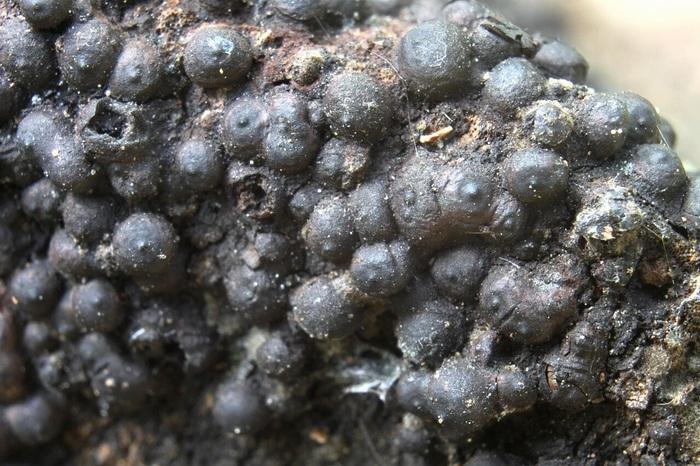
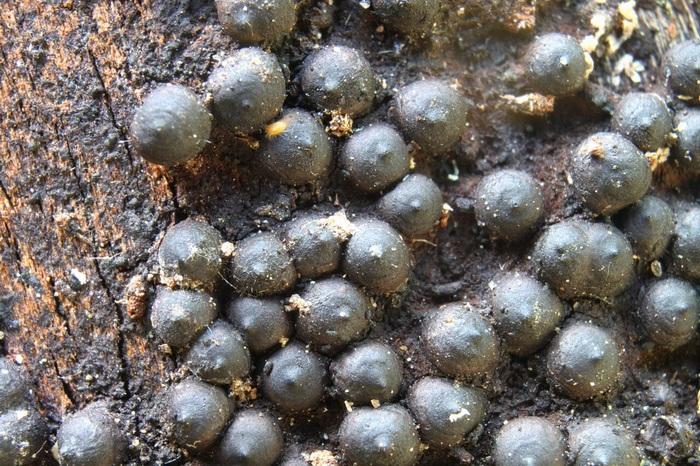
Our common friend P. Zapico has found at his home these gregarious, blackish, roundish, papillate and ostiolate, carbonaceous, perithecia 0.9-1.4 mm in diam. growing over on more or less persistent subiculum on very rotten wood of a cut Salix babylonica.
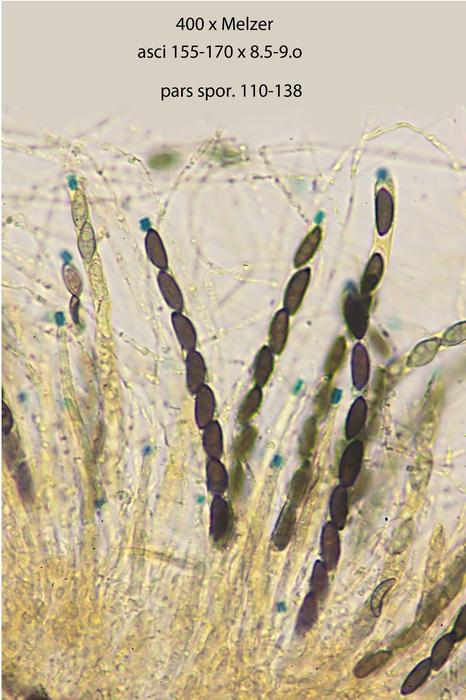
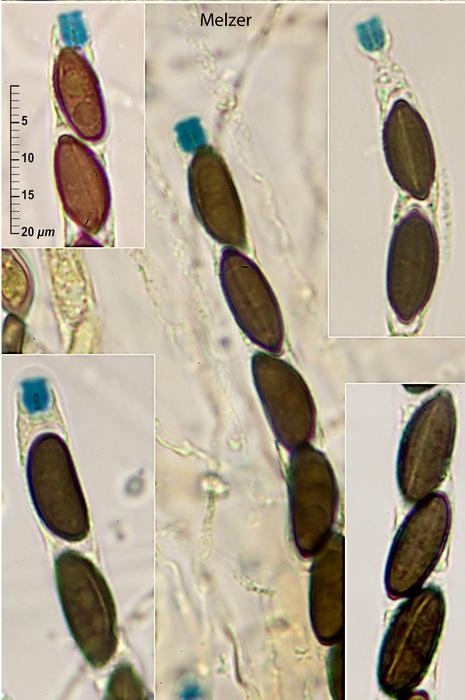
The asci are cylindrical, 8-spored, 155-170 x 8.5-9 microns, pars sporifera 110-138 with a conspicuous apical apparatus Melzer deep blue 5-6 x 4 micr.
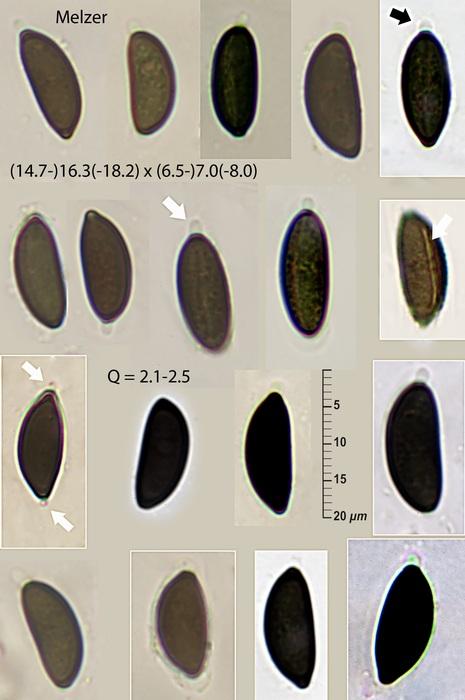
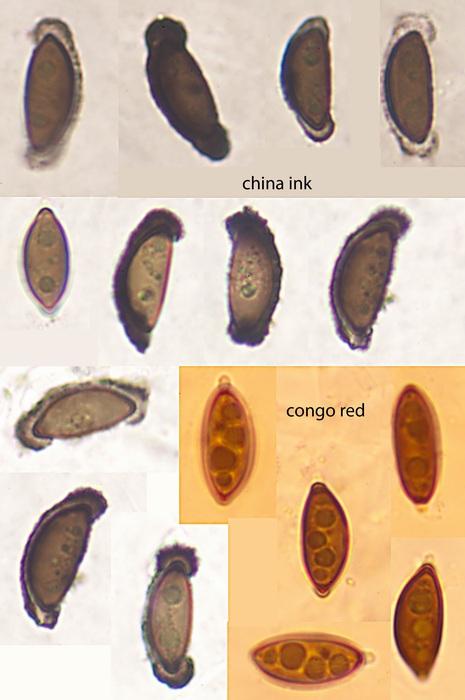
The ascospores are ellipsoid, equilateral, brownish at maturity, with straight germ slit nearly as long as spore, situated on the more convex side, and 1(-2) semiglobose cellular appendage (-s) surrounded by a partial, narrow slimy sheath. (14.7-)16.3(-18.2) x (6.5-)7.0(-8.0); Q = 2.1-2.5
I feel this fungus could be near to Rosellinia akulovii L.E. Petrini but I'd like to know your opinion.
Many thanks in advance for your help

it's good to hear from you and Pedro!
The overall morphology and the ascospores with cellular appendages and germ slit on the convex side clearly set this Rosellinia in the aquila-corticium group. Based on ascospores and apical apparatus dimensions and sheath morphology I would call it R. aquila, even though the ascospores are a bit small. I have seen a wide range of variations in this species, from small-spored collections like yours to large-spored ones grading into R. corticium. They might represent different species but they are difficult to separate based on morphology only.
I do not know R. akulovii for comparison.
Sorry Enrique, I guess you are not going to like my answer!
Cheers,
Jacques
Hi Jacques
No. I like very much your expert opinion on this very difficult genus, at least for me.
Many thanks, Jacques!