
16-03-2011 14:31
roman vargas albertoHi. I would like some opinion about this Peziza
14-05-2026 05:36
Ethan CrensonHi all, I haven't paid much attention to Lachnu
10-05-2026 23:17
 Andreas Gminder
Hello,today we found in a moist steep decidous for
11-05-2026 12:32
 Bernard CLESSE
Pourriez-vous m'aider à identifier cette héloti
13-05-2026 15:26
 François Freléchoux
Bonjour,Voici une récolte faite il y a quelques j
12-05-2026 15:41
 Nicolas VAN VOOREN
Dear Ascolovers, especially interested in Pezizale
13-05-2026 12:05
 Thierry Blondelle
Bonjour à tous,J'aimerais avoir confirmation de c
28-04-2026 20:07
 Lothar Krieglsteiner
... on twig in the air at standing Ceratonia siliq
27-04-2026 20:52
Lothar Krieglsteiner
Found on hanging tiwg of Olea europaea in dried-ou
11-05-2026 20:22
Lothar Krieglsteiner
on attached twig of standing Ficus caricaquite uns
 Hi to all,
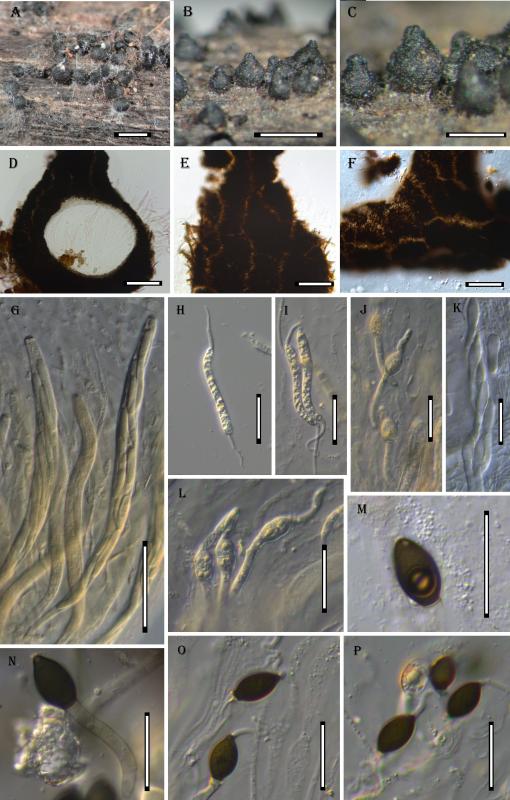
Found this fungus on very rotten twig (unknown). I believe it is a Cercophora species, but I was not able to found a suitable species, because I do not have the necessary literature.
The ectal excipulum called my attention because it is constantly ruptured forming a peculiar pattern.
Perithecia up to 500 microns. Ascospores: upper dark cell 18-20 x 11-12.5, hyaline basal cell 30-45 x 4-6 microns. Asci (young?) up to 200 x 13-18 microns.
Figure Bars: A-B = 1 mm; C = 0.5 mm; D = 100 micra; E-G = 50 micra; H-P = 25 micra
Could somebody help me in this identification.
Thank you very much.
Dartanha
Anyone have a suggestion?
Thanks!

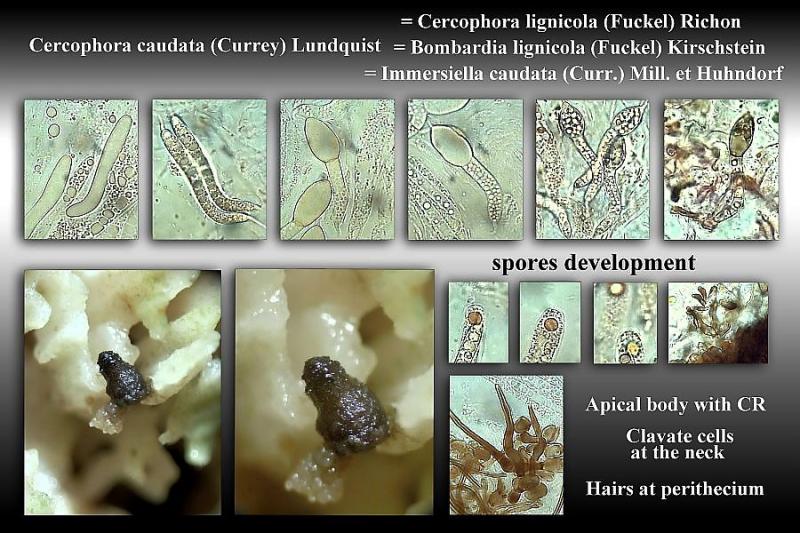
please compare with this species. I found it in rotting Trametes and in Acer wood.
Greetings
Peter.

Michel.
Thank you for your comments.
I have only the Ellis & Ellis description of C. caudata, and I think the description doesn't match, mainly because of the lack of hair in the perithecia neck (however, I dont know if this is a strong characteristic) and also because the ascospores are larger. In fact, based on Ellis & Ellis, the ascospore size (apical dark cell) and filamentous appendage of this specimens seems to fit with C. coprophila (?????).
The filamentous appendages of the young, sigmoid, ascospores are most 20-35, but reached up to 50 microns long (see figures H and I, on the plate). I was unable to obtain the size of such appendage from the mature ascospores because in most cases they vanished.
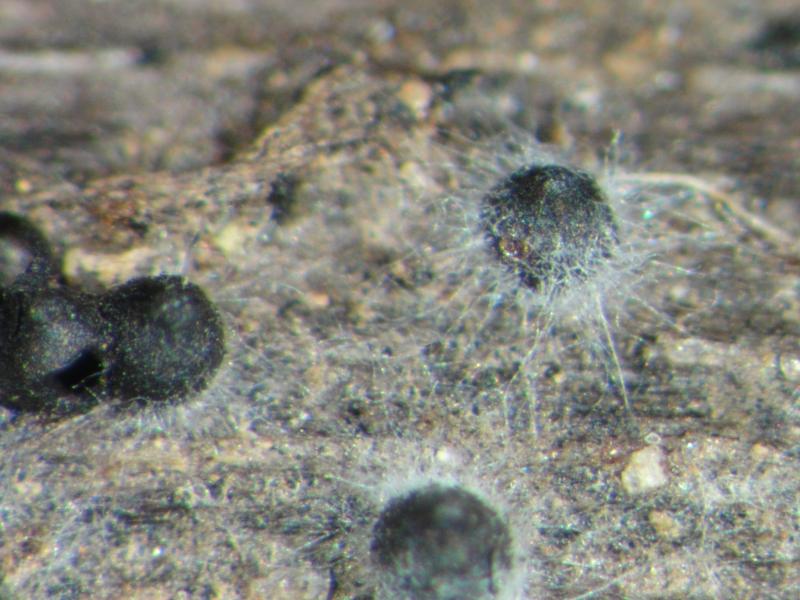
In my new attempts I did not get a good section of the perithecium, but seems to me that it is glabrous, or with flexuous brown hairs (half bottom) (see figure E on the plate). After 12 hours on dew chamber a white tomentum was present (figure attached here).
So, what do you think?
Thanks again,
Dartanha
C.coprophila only grows on dung.
Michel.
one cannot assign the kind only with E. et E. unambiguously. There is literature which makes simpler: HILBER, R. & O. HILBER (1979): Einige Anmerkungen zu der Gattung Cercophora Fuckel (Lasiosphaeriaceae). Zeitschrift für Mykologie 45(2): 209-233. I have this as a PDF, but in German.
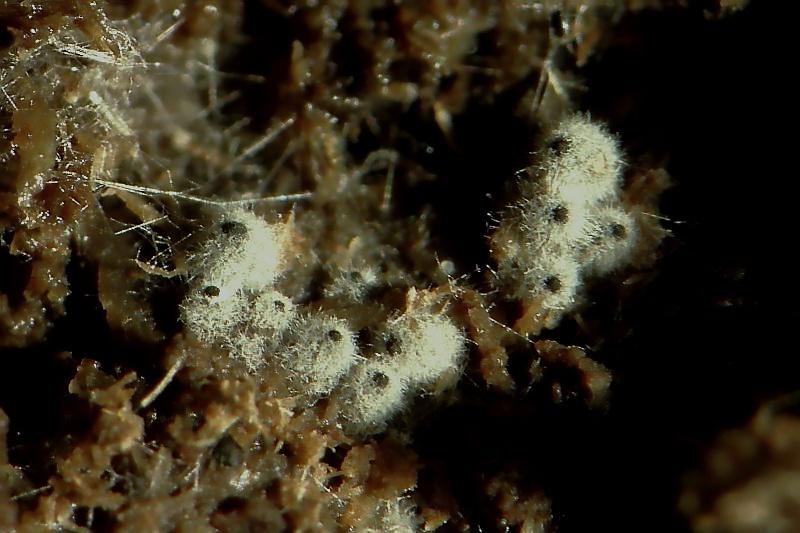
With Your image it is no tomentum, but probably a hyphotrama. The tomentum would have to look in such a way, like to the added photos from Cercophora coprophila.
Greetings
Peter.
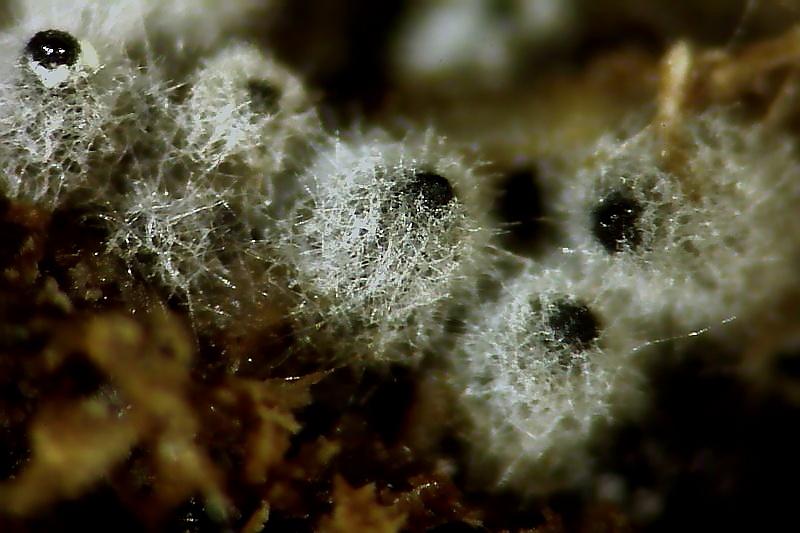
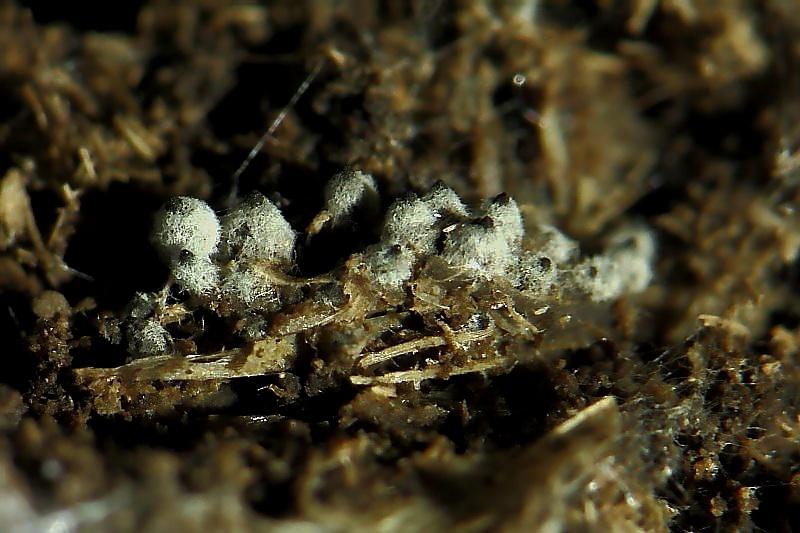
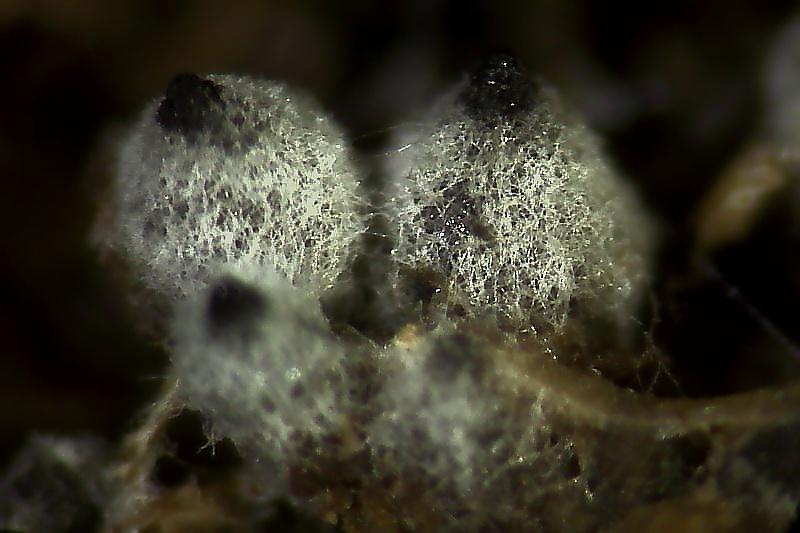
Sorry for the misuse of "globulus". I made an update in the previous post to remove that term, because, in fact, I didn't saw it.
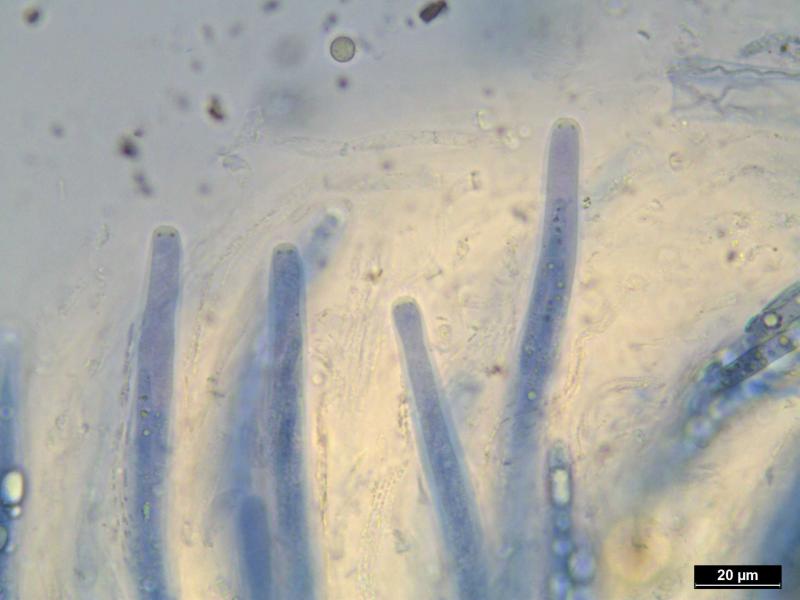
I tried to do new slides to look for the presence of the globulus in the tip of the ascus. I used only water and MLZ, but as before I didn't saw it. Is its presence/absence an important characteristic? I need to use a specific mounting medium?
Definitely the tomentum of C. coprophila is very different from what I saw.
During the last weekend, after read some posts here in the forum about Cercophora, I found the Hilber & Hilber pdf file, but unfortunately my german is null! So, it is probable that this specimen remains as "Cercophora sp.", unless you have another suggestion.
Well, thanks again for your comments, I really appreciated.
Dartanha
I have no translation of the work Hilber, but I send you another paper directly ( Lundqvist ), hoping that it might help you.
Regards.
Michel.
Thanks a lot for the Lundqvist's paper, I pretty sure it will be useful
Merci beaucoup! :@)
Michel, have You the Lundquist- paper for me ?
Thanks in advance.
Peter.
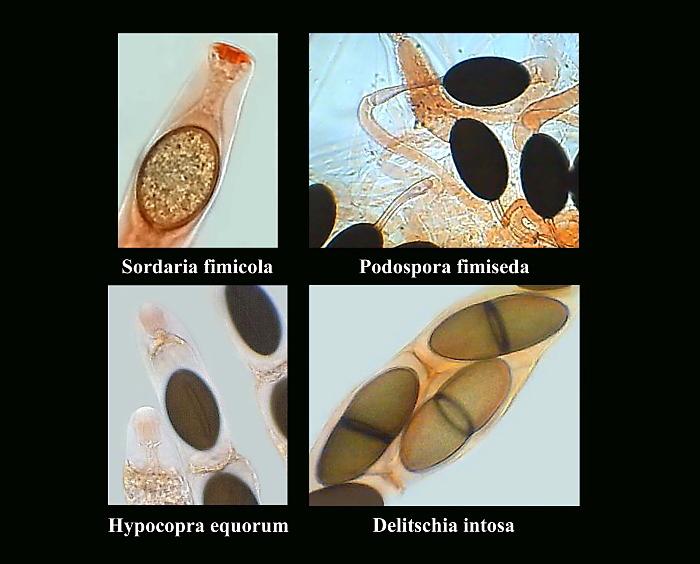
In Lundqvist's description of C. areolata (pag.105) he mentions: "Pedirium ... areolate, cracking in 50-100 u broad polygones when crushed;"
In his comments he says that this trait is present in very few species of the genus, and all species listed, but C. striata, are coprophilous.
I found a full description of C. striata in "Miller, A. N. & S. M. Huhndorf (2001). Neotropical Ascomycetes 10. New and interesting Cercophora species. - Sydowia 53(2): 211-226." and I think that my specimen is close related with C. striata.
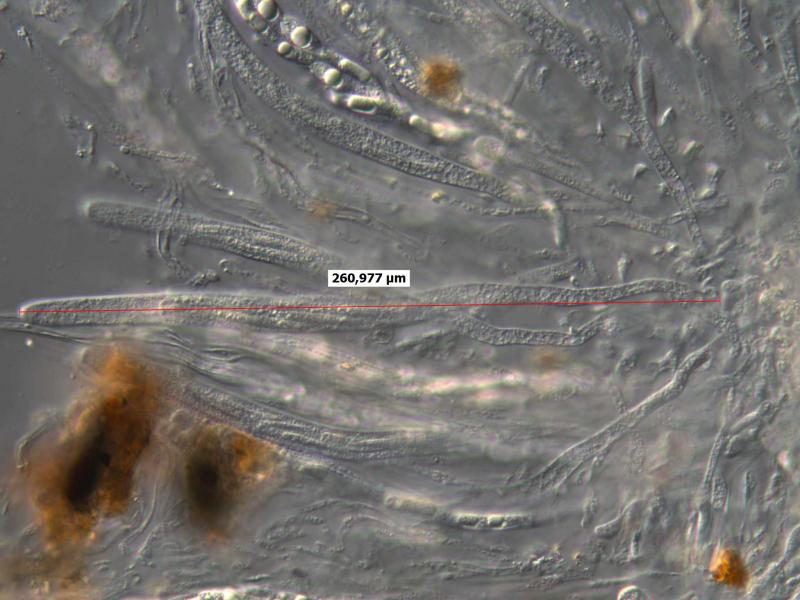
However, I didn't saw the presence of the "white to grayish granules or crystalline flakes below the neck" as illustrated in figures 41 - 43 of Miller & Huhndorf work, and the asci are shorter and wider (up to 260 long x 11-18 wide - see figure attached) when compared with C. striata that has "asci (278-) 305-384 (-413) x 4-9.5".
An additional information not mentioned before is that the sample was collected in Southeast Brazil. I also made an additional slide using cotton blue and the subapical globulus was absent.
So, the absence of the globulus plus the areolate peridium surface, that cracks when crushed, and its habit fits with C. striata. What do you think?
Thanks again,
Dartanha
I do not know the article you speak (if you can send it to me, thank you), but it seems that your fungus is still different from C.striata. I read that some Cercophora of America (C.appalachianensis and C.californica) have cells that have Munk pores. Would you have seen this character on your mushroom? This could be a track for you, at least Andrew is an idea.
Michel.
I sent the article to your email.
No, I didn't saw the Munk pores, I had some difficulties to obtain a good section of the peridium wall. I need to try again.
Dartanha