
23-05-2026 18:57
Sylvie Le GoffBonjour à tousRécolté sur une branchette de Sal
23-05-2026 11:44
 Charles Grapinet
Hello, I am having trouble identifying this copro
22-05-2026 14:44
 Lothar Krieglsteiner
in unripe condition citrine yellow, then soon fadi
22-05-2026 21:35
Steve ClementsBonjour, I expected this find on old wood on our
22-05-2026 18:12
Lothar Krieglsteiner
... in moist chamber from Portugal.As the fungus s
22-05-2026 20:08
Ethan CrensonHello all, Yesterday in NYC I was visiting an e
11-01-2022 16:36
 Jason Karakehian
Hi does anyone have a digital copy of Raitviir A (
20-05-2026 17:47
Margot en Geert VullingsWe found this Mollisia on dead Juncus stems mown l
22-05-2026 14:47
Gernot FriebesHi,superficial ascomata collected on bark of a liv
Peroneutypa sp.
Peter Thompson,
30-01-2015 11:57
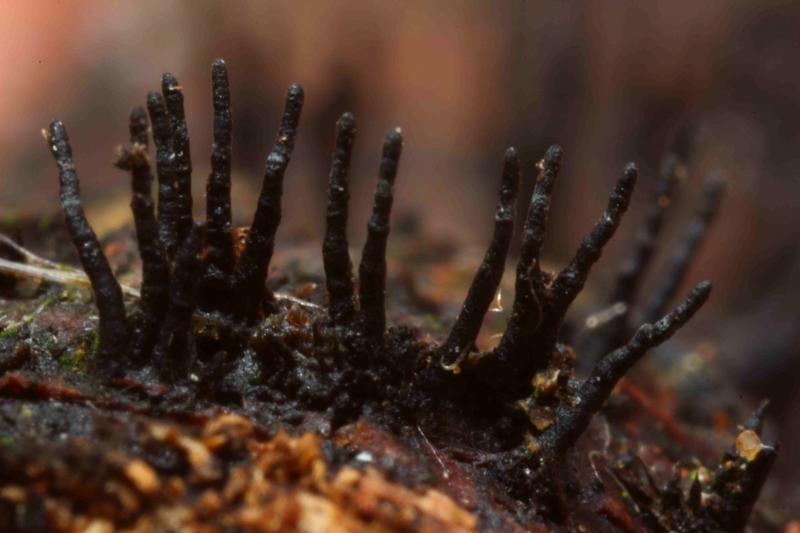
I have found a sample of an ascomycete with long, black ostiolar necks and perithecia immersed in a creamy whitish stroma, growing on Acer pseudoplatanus. A photo is attached.
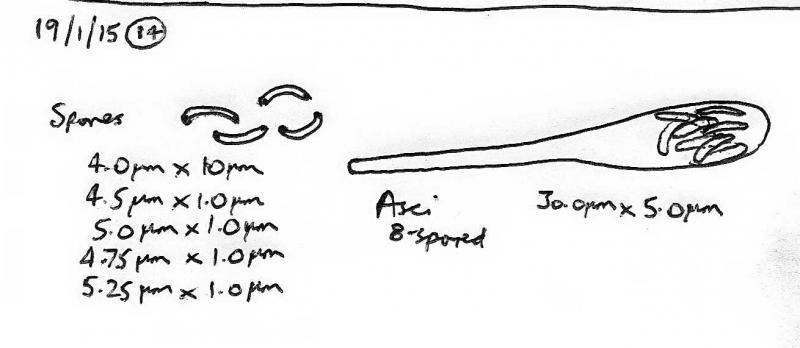
The microscopy (also attached) closely resembles that of Peroneutypa scoparia. The problem which I have is that P. scoparia is accompanied by erect, brown hyphae, which are absent from my sample.
I wonder if these hyphae are not always present, or if I have found another species either from the genus Peroneutypa or a closely related genus?
I would be grateful for some guidance in this matter.
Thank you,
With Best Wishes,
Peter.
Eduard Osieck,
30-01-2015 13:38
Re : Peroneutypa sp.
Apparently they are not always present (cited from Rappaz 1987):
"Elles sont rassemblées sur la base de la taille des asques et des
ascospores, la présence d'un anneau apical amyloÏde bien visible, un
arrangement plus ou moins valsoÏde des périthèces et un stroma d'abord
très discret, puis marqué surtout par une nécrose de la surface du
bois ou de la partie supérieure du parenchyme, nécrose qui entraÎne un
décollement du périderme. Certaines collections montrent encore un
développement stromatique autour du point d'émergence des ostioles,
formant un disque ou un manchon d'hyphes à travers lequel les ostioles
émergent, manchon qui peut se prolonger en fascicules d'hyphes, de 1-2
mm de long, mélangés aux ostioles."
And in the description:
"Ostioles: le plus souvent collectivement émergents, tantôt très peu proéminents et plus
ou moins nettement fendus à cruciformes, tantôt cylindriques, proéminents parfois de 1-2 mm, entiers, fendus à l'apex, ou sur toute la longueur, diam. 100-200 ~m, souvent entourés par un feutre d'hyphes formant un disque duquel émergent des fascicules d'hyphes brun clair à brun-roux.
Do the other mentioned features fit with your collection?
Regards, Eduard
"Elles sont rassemblées sur la base de la taille des asques et des
ascospores, la présence d'un anneau apical amyloÏde bien visible, un
arrangement plus ou moins valsoÏde des périthèces et un stroma d'abord
très discret, puis marqué surtout par une nécrose de la surface du
bois ou de la partie supérieure du parenchyme, nécrose qui entraÎne un
décollement du périderme. Certaines collections montrent encore un
développement stromatique autour du point d'émergence des ostioles,
formant un disque ou un manchon d'hyphes à travers lequel les ostioles
émergent, manchon qui peut se prolonger en fascicules d'hyphes, de 1-2
mm de long, mélangés aux ostioles."
And in the description:
"Ostioles: le plus souvent collectivement émergents, tantôt très peu proéminents et plus
ou moins nettement fendus à cruciformes, tantôt cylindriques, proéminents parfois de 1-2 mm, entiers, fendus à l'apex, ou sur toute la longueur, diam. 100-200 ~m, souvent entourés par un feutre d'hyphes formant un disque duquel émergent des fascicules d'hyphes brun clair à brun-roux.
Do the other mentioned features fit with your collection?
Regards, Eduard
Peter Thompson,
30-01-2015 17:09
Re : Peroneutypa sp.
Hello Eduard,
Thank you for your reply.
From my understanding of the French, some, but not all of the features fit.
There is a black, stromatic line around the small, localised creamy white stroma, viewed from the underside.
I do not see any reaction to Melzers let alone the clearly visible reaction, as mentioned.
Also, I see no cruciform markings radiating from the tapering tips of the ostioles. This using a powerful torch and my dissecting microscope.
My collection consists of some individual fruit bodies, some in pairs and others with between three and seven ostioles emerging from each of the stromata.
Does this help to clarify matters?
With Best Wishes,
Peter.
Thank you for your reply.
From my understanding of the French, some, but not all of the features fit.
There is a black, stromatic line around the small, localised creamy white stroma, viewed from the underside.
I do not see any reaction to Melzers let alone the clearly visible reaction, as mentioned.
Also, I see no cruciform markings radiating from the tapering tips of the ostioles. This using a powerful torch and my dissecting microscope.
My collection consists of some individual fruit bodies, some in pairs and others with between three and seven ostioles emerging from each of the stromata.
Does this help to clarify matters?
With Best Wishes,
Peter.