
04-05-2026 18:13
 Stephen Martin Mifsud
ID request for what seems to be a true aquatic fun
04-05-2026 16:39
Stephen Martin Mifsud
ID request: This specimen was collected in Malta o
04-05-2026 09:50
 Castillo Joseba
Me mandan el material seco de Galicia,(España) re
28-04-2026 20:07
 Lothar Krieglsteiner
... on twig in the air at standing Ceratonia siliq
02-05-2026 12:42
Alain BRISSARDBonjour à tousJeuidi 30 avril dernier on m'a remi
02-05-2026 13:06
Pauline. PennaBonjour Please can someone help me with this id
01-05-2026 22:45
 Thierry Blondelle
Bonjour à tous, Une récolte sur bouse séchée d
14-04-2026 05:32
Ethan CrensonHi all, A few weeks back a friend pointed out som
28-04-2026 20:33
Vitus SchäfftleinHello, I found Trochila ilicina on Ilex aquifoliu
Tubercularia
Bernard Declercq,
10-12-2014 16:33
 Hello,
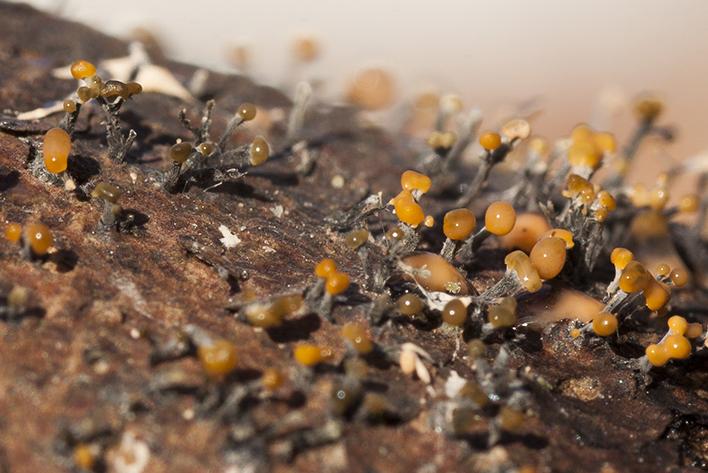
I wonder if this collection on branch of Acer pseudoplatanus is Tubercularia vulgaris.
Data:
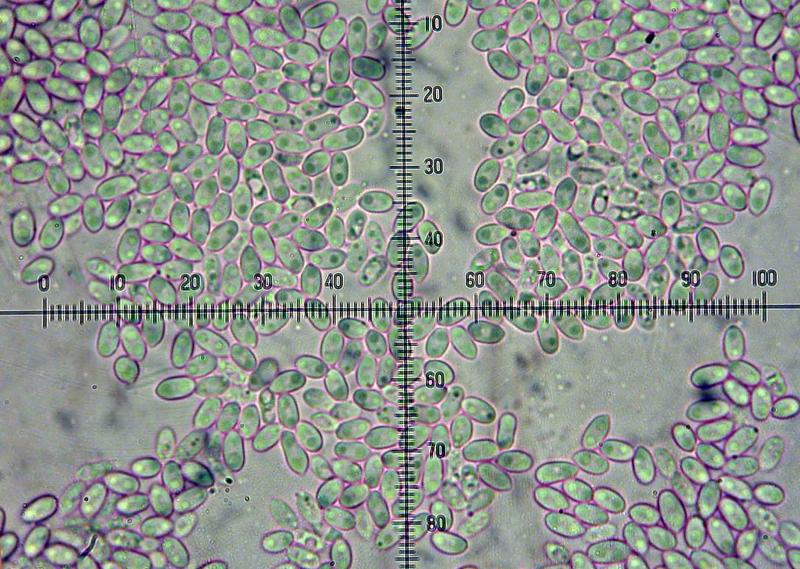
Conidiomata in effuse colonies, long stipitate, 1,3-1,6 mm high, 0,2 mm diam., black with white pruinae, conidia aggregated in an orange subglobose, slimy head of 0,5 mm diam., rarely branched.Conidia oblong-ellipsoid, 4-7x2,5-3 µm, biguttulate, smooth, hyaline, originating from phialides with collarette.
Most Nectria cinnabarina collections collected in out region on Acer have pink sessile to subsessile conidiomata.
Your comments are welcome.
Bernard
Walter Gams,
10-12-2014 17:33

Re : Tubercularia
Cherr Bernard,
This is obviously not T. vulgaris (official name now only Nectria cinnabarina), but a species of Stilbella. You can identify this w ith Seifert, Studies iin Mycology 27, 1985. But you will need some further observations, especially marginal cells of the stipe and conidiogenous cells (in Tubercularia vulgaris these would have a characteristic acro-pleurogenous pattern, i.e. several short lateral branches in the conidiophore producing conidia).
Cheers Walter
This is obviously not T. vulgaris (official name now only Nectria cinnabarina), but a species of Stilbella. You can identify this w ith Seifert, Studies iin Mycology 27, 1985. But you will need some further observations, especially marginal cells of the stipe and conidiogenous cells (in Tubercularia vulgaris these would have a characteristic acro-pleurogenous pattern, i.e. several short lateral branches in the conidiophore producing conidia).
Cheers Walter
Christian Lechat,
10-12-2014 17:38

Re : Tubercularia
Salut Bernard,
ce qui est certain c'est que ce n'est pas N. cinnabarina et ce n'est peut-être pas une Hypocreales
Christian
ce qui est certain c'est que ce n'est pas N. cinnabarina et ce n'est peut-être pas une Hypocreales
Christian
Bernard Declercq,
10-12-2014 19:43
Re : Tubercularia
Dank je wel Walter, voor je reactie; merci Christian pour ta réaction.
Unfortunately I am missing following probably most interesting work:
Seifert, K.A. 1985. A monograph of Stilbella and some allied Hyphomycetes. Studies in Mycology. 27:1-235.
Does anyone have this study for me or is this somewhere available on the internet?
Thanks in advance,
Bernard
Unfortunately I am missing following probably most interesting work:
Seifert, K.A. 1985. A monograph of Stilbella and some allied Hyphomycetes. Studies in Mycology. 27:1-235.
Does anyone have this study for me or is this somewhere available on the internet?
Thanks in advance,
Bernard
Walter Gams,
10-12-2014 20:27
Re : Tubercularia
click on http://www.cbs.knaw.nl/index.php/studies-in-mycology/360-studies-in-mycology-no-27 and then fulll text.
Groetjes Walter
Groetjes Walter
Bernard Declercq,
11-12-2014 11:56
Re : Tubercularia
Great!
I observed a stipe surface composed of blackish textura porrecta covered by hyaline, verrucose to echinulate, clavate to subglobose cells 3-5 µm wide and with walls up to 1 µm thick
According Seifert (1985), this should be (Stilbella clavulata or) the anamorph of Stilbocrea gracilipes (Tul. & C. Tul.) Samuels & Seifert.
Thanks once again, Walter.
Et merci aussi à Christian qui, grace à Ascofrance, rend ces échanges fructueuses possible.
Bernard
I observed a stipe surface composed of blackish textura porrecta covered by hyaline, verrucose to echinulate, clavate to subglobose cells 3-5 µm wide and with walls up to 1 µm thick
According Seifert (1985), this should be (Stilbella clavulata or) the anamorph of Stilbocrea gracilipes (Tul. & C. Tul.) Samuels & Seifert.
Thanks once again, Walter.
Et merci aussi à Christian qui, grace à Ascofrance, rend ces échanges fructueuses possible.
Bernard
Peter Wilberforce,
11-12-2014 15:54
Re : Tubercularia
Hi Bernard,
If you have trouble finding the Siefert paper, please email me as I have the full thing as a pdf
Peter