
03-05-2026 10:57
 Castillo Joseba
Me mandan el material seco de Galicia (España) re
02-05-2026 12:42
Alain BRISSARDBonjour à tousJeuidi 30 avril dernier on m'a remi
02-05-2026 13:06
Pauline. PennaBonjour Please can someone help me with this id
01-05-2026 22:45
 Thierry Blondelle
Bonjour à tous, Une récolte sur bouse séchée d
28-04-2026 20:07
 Lothar Krieglsteiner
... on twig in the air at standing Ceratonia siliq
14-04-2026 05:32
Ethan CrensonHi all, A few weeks back a friend pointed out som
28-04-2026 20:33
Vitus SchäfftleinHello, I found Trochila ilicina on Ilex aquifoliu
30-04-2026 10:28
Rot BojanHello, by appearance I would say that I am dealing
27-04-2026 18:48
Tony MoverleyCollected 23rd April 2026, Norfolk, EnglandSwarms
Myrothecium causing Sphagnum infection
Nina Filippova,
25-10-2014 17:28
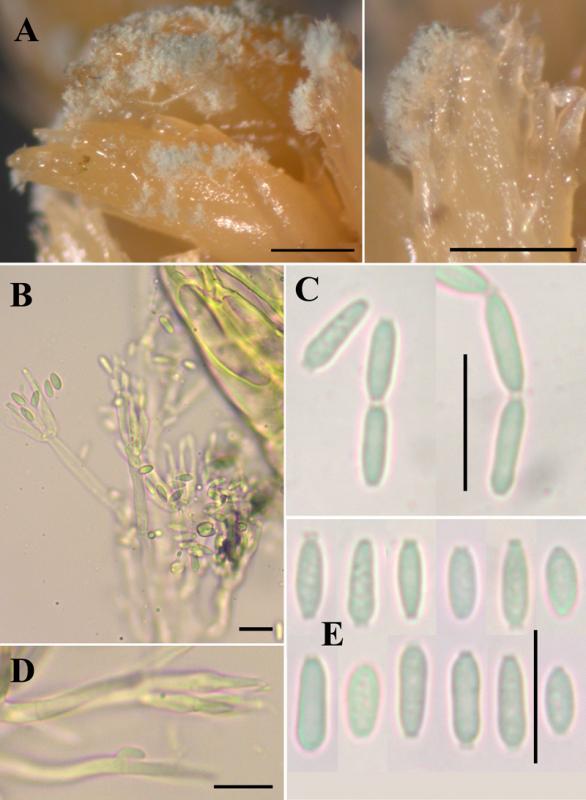
There are not may pathogens of Sphagnum species and therefore it is interesting to find the signs of Sphagnum damage caused by fungal infection. I have found one anamorphic species in my collection which was not recognized before, and i hoping now that it could be assigned at least to its generic position.
Preliminary it was identified as Myrothecium cf. roridum. This taxon is reported from different plant litters and as parasitic on some hosts (but not on Sphagnum) by Domsch (2007). Still, it is common soil saprotroph, and was reported by some authors from peat in peatlands.
12.07.2013, Khanty-Mansiysk town, Western Siberia; 60,89263N 68,67715E
Graminoid-Sphagnum hollows in ombrotrophic bog, on living plats of Sphagnum balticum, S. jensenii, seems parasitizing on these plants. The fungus caused infectious spots 10 and more cm in diameter where Sphagnum looked faded. Such infectious spots were quite regularly met in this year (e.g. not rare event) and the attacked Sphagnum was not weakened by any damage (in natural undisturbed conditions).
Conidiogenous cells bottle-shaped, 4-5 in cluster, mean size 17 x 3 mk; conidia fusoid (upper) to cylindrical (lower in chain), hyaline, in chains, connected by thin constriction, with hyaline appendages, 5.7 (5.1–7.3) x 1.8 (1.5–2) mk (n=13).
Could you direct me to the close morphologically genera and species there could be? I could not find also the key (Tulloch, M. Genus Myrothecium Tode ex FR Mycol. Pap. 130. 1972).
There are some not very detailed photos below. Nina.
Walter Gams,
25-10-2014 17:47

Re : Myrothecium causing Sphagnum infection
Dear Nina, You may ssend me a culture to my home address at Molenweg 15, 3743 CK Baarn, Netherlands. I shall look at it microscopically and deposit the strain at CBS, where a molecular analysis will be made. But this may take several weeks.
Best wishes Walter Gams
Best wishes Walter Gams
Nina Filippova,
25-10-2014 17:52
Re : Myrothecium causing Sphagnum infection
Thanks Walter, i will answer you in private.