
28-05-2026 16:15
James MitchellHello,Does anyone have the original publication of
28-05-2026 11:06
Thomas Læssøehttps://svampe.databasen.org/observations/10596750
23-05-2026 11:44
 Charles Grapinet
Hello, I am having trouble identifying this copro
25-05-2026 16:44
François BartholomeeusenHi forum members,During an excursion organised by
26-05-2026 21:25
Dirk GerstnerHello everyone, I'm completely stumped by this li
26-05-2026 22:44
Ethan CrensonHi all, I think I have Incrucipulum capitatum her
22-05-2026 14:44
 Lothar Krieglsteiner
in unripe condition citrine yellow, then soon fadi
25-05-2026 16:35
 Bernard CLESSE
Bonjour à toutes et tous,J'ai trouvé récemment,
22-05-2026 13:29
Gernot FriebesHi,I am curious to hear your opinion on this mater
23-05-2026 18:57
Sylvie Le GoffBonjour à tousRécolté sur une branchette de Sal

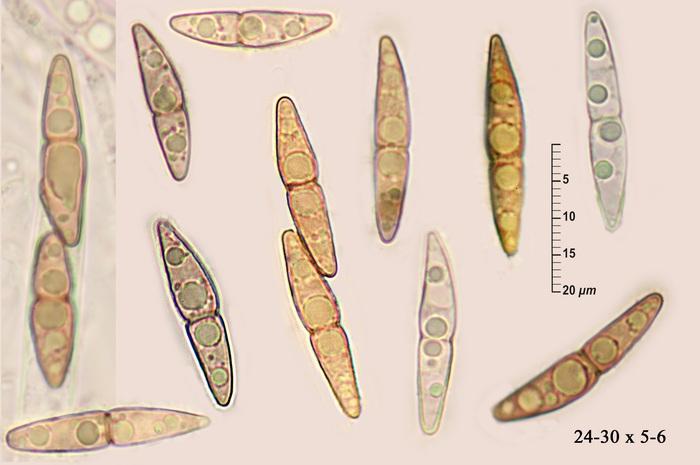
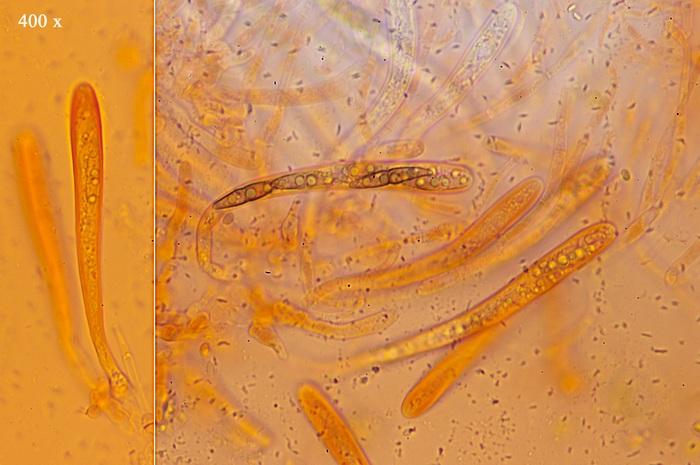
Does anyone have an idea about these small (up to 0.5 mm), gregarious, ostiolate, globose, superficial, never inmersed, black, rough walled but glabrous pseudothecia growing on corticated roots (Prunus spinosa?) near the freshwater of a stream at the hill level?
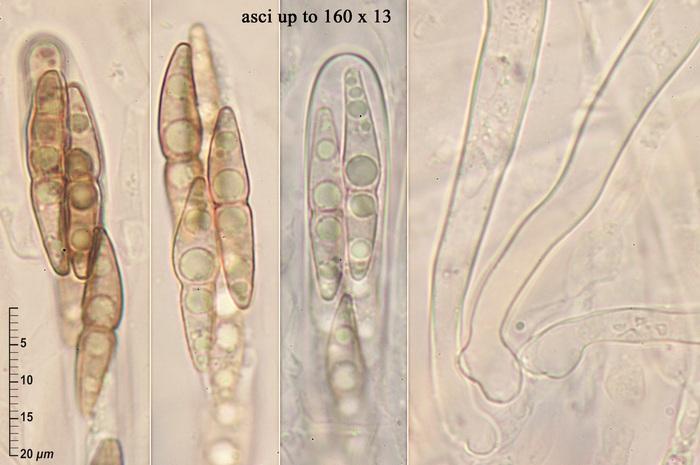
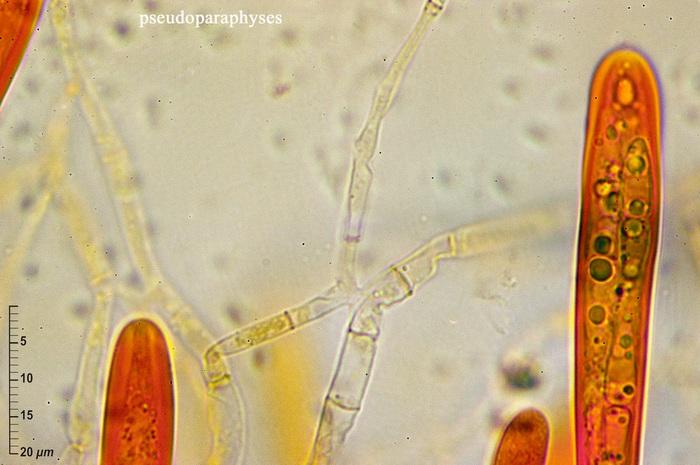
The ascospores are hyaline, later greyish and finally greyish-brown and they seem to have smooth walls. The asci are bitunicate, 8-spored, narrowly clavate and they arise from croziers. The trabeculate peseudoparaphyses heve many anastomoses. Pseudothecial walls angularis.
Have you some idea for this fungus?
Thanks again




Hi Enrique,
Really no subiculum ?
Ascospores seem to be very slightly striated, aren't they ?
Alain
Hi Alain
Yes. You are right because they are some rest of a subiculum not well visible when the ascomata are wet, but yes when dried. And it's possible the ascospores are very fienelly striate, but very difficult to observe it with my optica.
What's your idea?
Thanks again!
My idea was Byssosphaeria schiedermayeriana, even if we can't see the usual apex.
In wet conditions, it can be hardly recognizable.
You can check it, it's just an idea, perhaps I'm wrong.
Alain
PS : ascospores are perhaps not striate
HI Alain
Perhaps Byssosphaeria is a good genus for my fungus but I think it's not schiedermayeriana because any ascomata has the typical periostiolar color and morphology. By the way I read Barr's paper on Herpotrichia and its allies, and I have not seen a Byssosphaeria species that matches with this fungus.
Thanks, Alain

In that genus the asci are fairly long-stipitate, is it the case here?
Saludos,
Jacques
HI Jacques
Yes. The asci are long stipitate
Thanks for your replay