
25-05-2026 16:44
François BartholomeeusenHi forum members,During an excursion organised by
26-05-2026 21:25
Dirk GerstnerHello everyone, I'm completely stumped by this li
26-05-2026 22:44
Ethan CrensonHi all, I think I have Incrucipulum capitatum her
22-05-2026 14:44
 Lothar Krieglsteiner
in unripe condition citrine yellow, then soon fadi
23-05-2026 11:44
 Charles Grapinet
Hello, I am having trouble identifying this copro
25-05-2026 16:35
 Bernard CLESSE
Bonjour à toutes et tous,J'ai trouvé récemment,
22-05-2026 13:29
Gernot FriebesHi,I am curious to hear your opinion on this mater
23-05-2026 18:57
Sylvie Le GoffBonjour à tousRécolté sur une branchette de Sal
22-05-2026 21:35
Steve ClementsBonjour, I expected this find on old wood on our
this species was found on a dead, wet (but not submerged) culm of some reed-like grass in Styria, Austria (Central Europe). The ascomata seem to be seated on a blackish layer reminding of a subiculum but it's hard to say if that's just a coincidence or there's indeed a correlation. The same is true for the conidia that I found around the ascomata... in any case I wasn't able to find a helicosporous anamorph.
Ascospores measure about 80-127 x 3-3.5(3.8) µm, they are slightly sinuous and have obtuse, slightly swollen ends. I didn't count the number of septa of a whole ascospore but there are definitely >30 of them. Hairs are typically blunt, brown, and multi-septate. Accompanying conidia measure 32-38 x 7-9 or ca. 26.5 x 12 µm.
I have looked for a fitting species in the Tubeufiaceae but couldn't find anything so any suggestions are welcome!
Best wishes,
Gernot
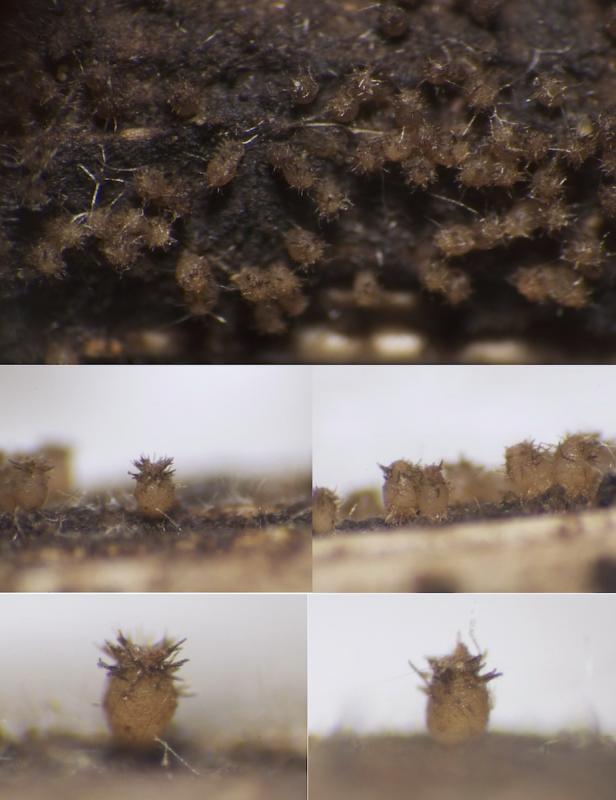
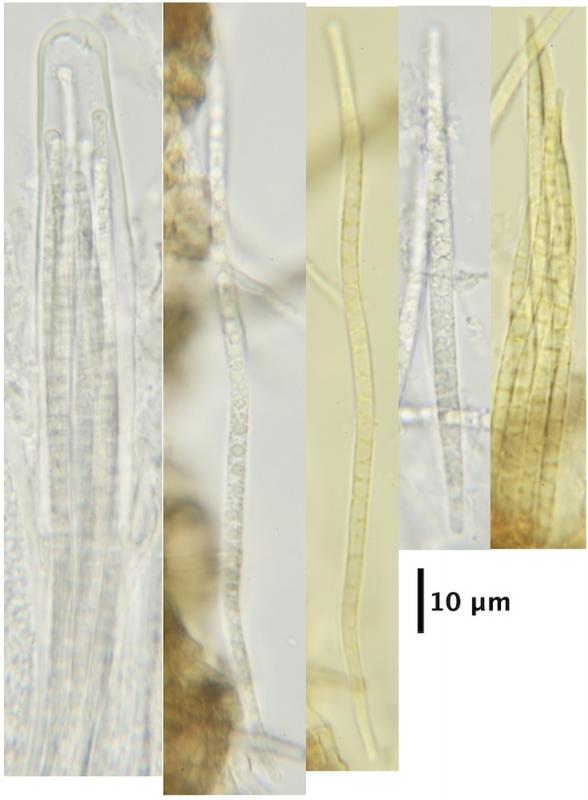
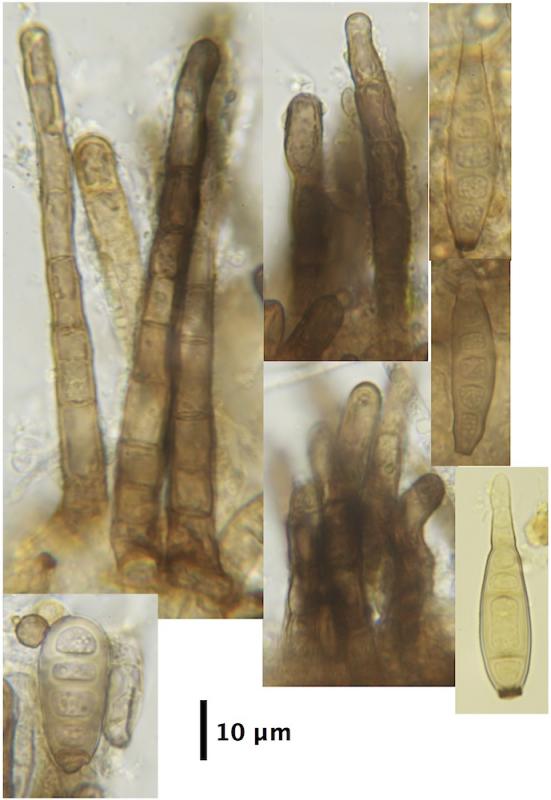

the conidia observed remind me on Pseudospriropes simplex. Thus the "blackish layer" is possibly produced by a fungus like Strossmayeria basitricha.
I have no experience how ascomata of Tubeufia paludosa will mature (darker and with hairs?). But I see similarities with my find: http://www.ascofrance.fr/search_forum/12985
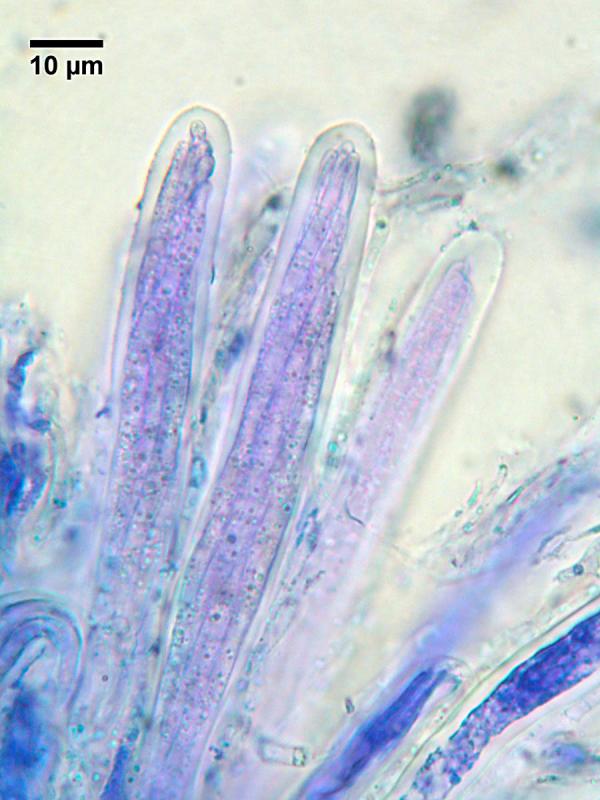
Attached another picture of this specimen, asci in BKB.
Best regards
Martin

I suspect the conidia are not directly connected to the teleomorph, Corynespora or one of the several similar genera possibly. Except the conidium at bottom left which looks like the very common Sporodesmiella hyalosperma - see: http://www.ascofrance.com/forum/25987/unknwn-asco-update
corialement
Chris
I agree, T. paludosa seems to come closest to this find. But the conspicuous hairs and very thin ascospores (according to Barr (1980), Rossman (1987) and Kodsueb et al. (2004) ascospores of T. paludosa are (2)3.5-7(8) µm wide!) leave me doubting. The width of the ascospores given in Samuels et al. (1979) for T. paludosa comes closer (3-5(5) µm) but that species described by Samuels et al. is certainly not the same as my collection... difficult group.
Hi Chris,
thanks for your suggestions regarding the anamorphs!
Best wishes,
Gernot