
28-04-2026 20:07
 Lothar Krieglsteiner
... on twig in the air at standing Ceratonia siliq
11-05-2026 12:32
 Bernard CLESSE
Pourriez-vous m'aider à identifier cette héloti
11-05-2026 20:22
Lothar Krieglsteiner
on attached twig of standing Ficus caricaquite uns
29-04-2026 10:44
Lothar Krieglsteiner
growing at moist, drying-out soil at the side of a
05-04-2026 22:46
Lothar Krieglsteiner
on wood of Ceratonia, Algarve, 3.4.2026.The color
10-05-2026 16:18
brigitte vignotbonjour trouvée en Ariège sur bois une petite
10-05-2026 23:17
 Andreas Gminder
Hello,today we found in a moist steep decidous for
27-04-2026 17:16
Lothar Krieglsteiner
.. Algarve, moist lying.The conidiomata look like
Mycosphaerangium tetrasporum ?
Arold Lavoie,
27-04-2014 06:48
 Bonjour,
J'aimerrais savoir si selon vous, il s'agit bien de Mycosphaerangium tetrasporum? Voici mes observations :
Apothécie : érumpante dans le bois; disque brun orangé à noir; environ 1 mm de largeur
Asque : 4 spores. Après KOH et solution de Lugol, les asques deviennent rouges entre les spores.
Spores : subglobuleuse, granuleuses, hyalines lorsque jeunes, devenant brun foncé à maturité; 26,2 - 29,8 um de long.
Habitat et substrat : Branche de feuillu au sol. Érablière à hêtre et à chêne rouge. Montérégie, Québec.
Bien que Seaver (1951) rapporte des spores entre 20 et 25 um de long, Cash (1940) mentionne plutôt 22 – 28,5 um de long, ce qui le rapproche de mes mesures.
Voici les liens vers mes photos :
https://www.flickr.com/photos/gnomediscret/14028500055/
https://www.flickr.com/photos/gnomediscret/14025311071/
https://www.flickr.com/photos/gnomediscret/14028948084/
https://www.flickr.com/photos/gnomediscret/14005391336/
https://www.flickr.com/photos/gnomediscret/14025303382/
https://www.flickr.com/photos/gnomediscret/14028513015/
https://www.flickr.com/photos/gnomediscret/14028939934/
Je vous remercie!
Arold Lavoie,
27-04-2014 08:20
Re : Mycosphaerangium tetrasporum ?
Et quelqu'un aurait ce document svp?
Verkley, G.J.M. 1999. A monograph of the genus Pezicula and its anamorphs. Studies in mycology. Vol. 44. 180 p.
Metci!
Verkley, G.J.M. 1999. A monograph of the genus Pezicula and its anamorphs. Studies in mycology. Vol. 44. 180 p.
Metci!
Hans-Otto Baral,
27-04-2014 10:06

Re : Mycosphaerangium tetrasporum ?
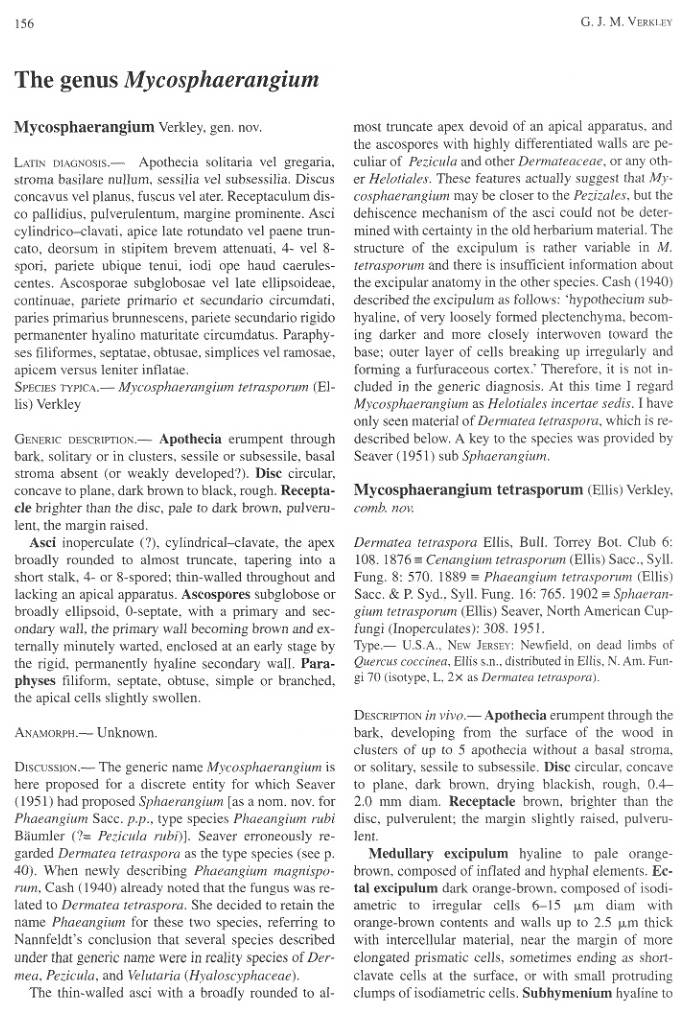
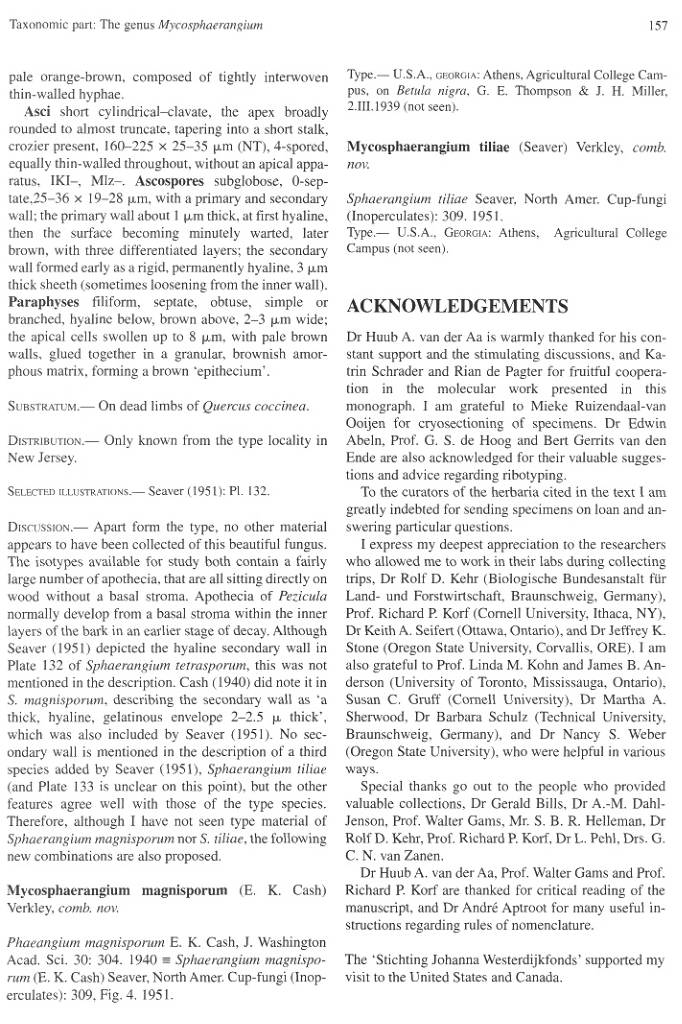
Very interesting collection! I see strong similarities to Hymenobolus agaves, a species we had here in the forum. Maybe both are congeneric?
I think it is this species, but I did not compare the other two transferred there by Verkley.
Zotto
I think it is this species, but I did not compare the other two transferred there by Verkley.
Zotto

 Mycosphaerangium-Verkley-1999-1-0001.jpg
 Mycosphaerangium-Verkley-1999-2-0001.jpg
Arold Lavoie,
27-04-2014 17:25
Re : Mycosphaerangium tetrasporum ?
Dear Zotto!
I read the description in Verkley (thanks for sharing!) and it confirms the identification. The only difference I see is that he wrote that the asci are IKI-. The asci on my specimen are clearly IKI+ red, but I've made a pre-treatment with KOH...
Thank you vey much!
I read the description in Verkley (thanks for sharing!) and it confirms the identification. The only difference I see is that he wrote that the asci are IKI-. The asci on my specimen are clearly IKI+ red, but I've made a pre-treatment with KOH...
Thank you vey much!
Hans-Otto Baral,
27-04-2014 20:47
Re : Mycosphaerangium tetrasporum ?
No, they are IKI-. The iodine reaction of asci refers always to the wall, not the ascoplasm. In your case the ascoplasm reacts red, which indicates the presence of glycogen.
You say that there is Quercus and Fagus around, Didi you look at the broken wood? The distinction is very easy: only Quercus is ring-pored (rapidly visible with a hand lens).
Zotto
You say that there is Quercus and Fagus around, Didi you look at the broken wood? The distinction is very easy: only Quercus is ring-pored (rapidly visible with a hand lens).
Zotto
Arold Lavoie,
27-04-2014 22:59
Re : Mycosphaerangium tetrasporum ?
I identified the substrate this afternoon. It's a broken branch of Northern red oak (Quercus rubra), a species close to Q. coccinea (on which Ellis made his collect in 1875).
Thanks for the information about the red asci!
Thanks for the information about the red asci!