
28-04-2026 20:07
 Lothar Krieglsteiner
... on twig in the air at standing Ceratonia siliq
11-05-2026 12:32
 Bernard CLESSE
Pourriez-vous m'aider à identifier cette héloti
29-04-2026 10:44
Lothar Krieglsteiner
growing at moist, drying-out soil at the side of a
05-04-2026 22:46
Lothar Krieglsteiner
on wood of Ceratonia, Algarve, 3.4.2026.The color
10-05-2026 16:18
brigitte vignotbonjour trouvée en Ariège sur bois une petite
10-05-2026 23:17
 Andreas Gminder
Hello,today we found in a moist steep decidous for
27-04-2026 17:16
Lothar Krieglsteiner
.. Algarve, moist lying.The conidiomata look like
10-05-2026 09:02
Buckwheat PeteHello everybody, ould this be Lachnum subvirgineu
Helvella juniperi ???
Vasileios Kaounas,
23-01-2014 09:46
 Found 22-01-14, in Attica Greece, in sandy soil, in coastal forest with Pinus and Quercus coccifera. Asci 315-383 x 18-21. Ascospores 18-19,5 x 11,5-12,5. Paraphyses thickness 6-7,3.
 Helvella-lacunosa-0001.pdf
Nicolas VAN VOOREN,
23-01-2014 10:38

Re : Helvella lacunosa ???
Hello.
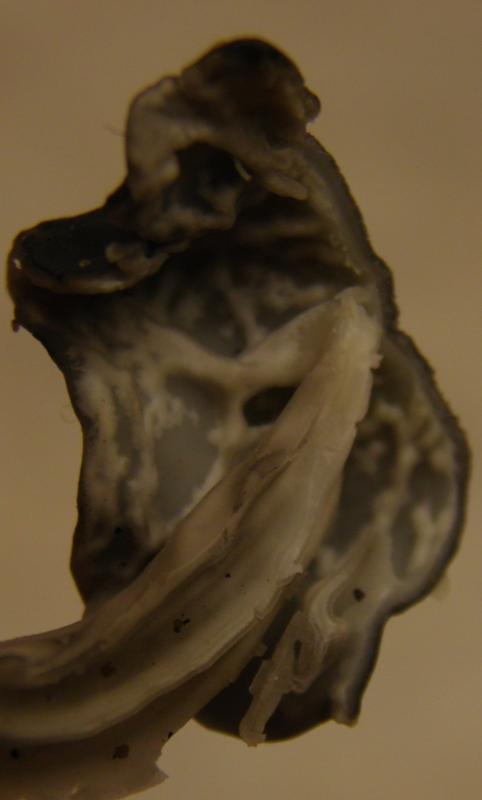
It would be interesting to see the outer surface.
It would be interesting to see the outer surface.
Vasileios Kaounas,
23-01-2014 11:00
Re : Helvella lacunosa ???
I was looking for juniperi but the spores do not reach these dimensions.
Nicolas VAN VOOREN,
23-01-2014 16:51
Re : Helvella lacunosa ???
Is there some veins on the outer surface?
Vasileios Kaounas,
23-01-2014 20:54
Re : Helvella lacunosa ???
Nicolas, you mean these neuroses ?
Mario Filippa,
24-01-2014 09:42
Re : Helvella lacunosa ???
It really looks like Helvella juniperi, it seems strange that the spores are so short. Vasileios, the two specimens are rather young, maybe it's better to wait some days and try to measure again. Always mount in water!
If the ascoma is young you should choose only the "ripe" spores to be measured. Ripe spores in Helvella have a single large oil drop (small droplets at the poles are always possible), the walls are smooth and rather thick (you should see a double line all around the spore in optical section, i.e. you see the thickness of the wall).
If some spores with pustules occur, these are constantly narrower.
The ectal excipulum also can be similar to H. juniperi, but you should made a little step forward in preparing your mounts: the excipulum should be seen in a section taken perpendicularly to the surfaces (hymenial or abhymenial). In your photos it seems rather viewed "from the outside". So only the terminal cells are clearly seen, but the most important are the deeper ones.
Ciao
Mario
If the ascoma is young you should choose only the "ripe" spores to be measured. Ripe spores in Helvella have a single large oil drop (small droplets at the poles are always possible), the walls are smooth and rather thick (you should see a double line all around the spore in optical section, i.e. you see the thickness of the wall).
If some spores with pustules occur, these are constantly narrower.
The ectal excipulum also can be similar to H. juniperi, but you should made a little step forward in preparing your mounts: the excipulum should be seen in a section taken perpendicularly to the surfaces (hymenial or abhymenial). In your photos it seems rather viewed "from the outside". So only the terminal cells are clearly seen, but the most important are the deeper ones.
Ciao
Mario
Vasileios Kaounas,
28-01-2014 13:42
Re : Helvella lacunosa ???
I put the sample on wet paper and took measurements again, and if I tried, I dont found spores longer than 21.
Vasileios Kaounas,
28-01-2014 14:28
Re : Helvella lacunosa ???
that day I found another collection of Helvella and I looked today. Spores 19-22,5 x 11-12,5.
Mario Filippa,
28-01-2014 22:39
Re : Helvella juniperi ???
Vasileios,
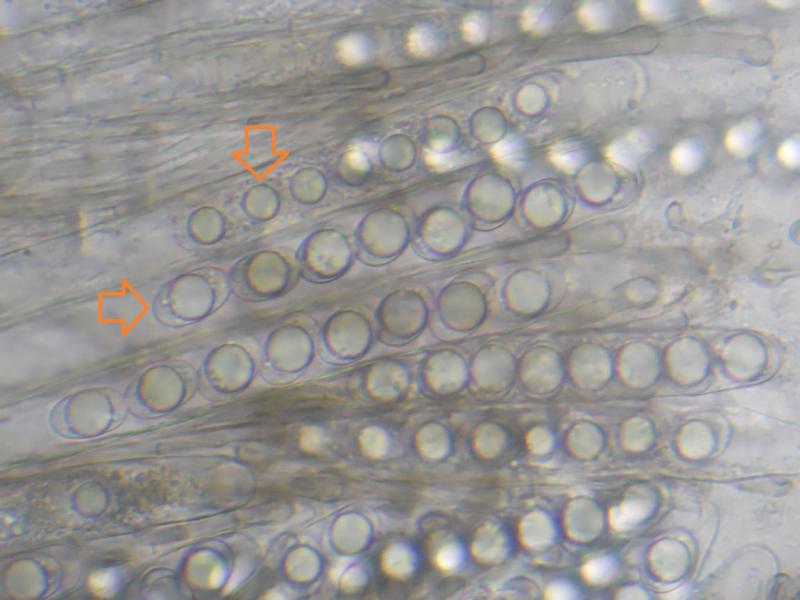
for the first collection I think the ascoma is still not fully mature, look in the photo I join (your image): near the upper arrow, an ascus with unripe and small spores, look at the difference with the spore pointed by the lower arrow. It's difficult to have a reliable measurement when the ascoma is collected too young, even if you wait until it's rotten, the spores should never reach the "normal" length.
The second collection seem rather typical for H. juniperi, once again the ascoma is not completely mature but you can see several oblong spores, look at those two into the ascus in the first image with the maximum enlargement. However none of all seem to have the look of the ripe spores, with the usual double-lined wall.
Regards
Mario
for the first collection I think the ascoma is still not fully mature, look in the photo I join (your image): near the upper arrow, an ascus with unripe and small spores, look at the difference with the spore pointed by the lower arrow. It's difficult to have a reliable measurement when the ascoma is collected too young, even if you wait until it's rotten, the spores should never reach the "normal" length.
The second collection seem rather typical for H. juniperi, once again the ascoma is not completely mature but you can see several oblong spores, look at those two into the ascus in the first image with the maximum enlargement. However none of all seem to have the look of the ripe spores, with the usual double-lined wall.
Regards
Mario
Vasileios Kaounas,
28-01-2014 22:58
Re : Helvella juniperi ???
Thank you very much Mario, for your time !!!!