
29-04-2026 10:44
 Lothar Krieglsteiner
growing at moist, drying-out soil at the side of a
28-04-2026 20:07
Lothar Krieglsteiner
... on twig in the air at standing Ceratonia siliq
11-05-2026 12:32
 Bernard CLESSE
Pourriez-vous m'aider à identifier cette héloti
05-04-2026 22:46
Lothar Krieglsteiner
on wood of Ceratonia, Algarve, 3.4.2026.The color
10-05-2026 16:18
brigitte vignotbonjour trouvée en Ariège sur bois une petite
10-05-2026 23:17
 Andreas Gminder
Hello,today we found in a moist steep decidous for
27-04-2026 17:16
Lothar Krieglsteiner
.. Algarve, moist lying.The conidiomata look like
10-05-2026 09:02
Buckwheat PeteHello everybody, ould this be Lachnum subvirgineu
08-05-2026 11:55
Gernot FriebesHi,found on a decorticated Picea abies branch stil
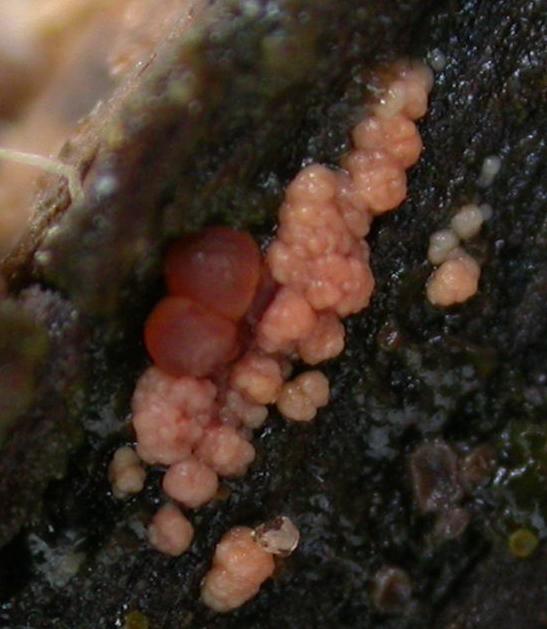
I found this Ascocoryne on decayed Quercus in Japan.
I think it's typical A. cylichnium, ascospores multiguttulate, 24-32 x 4.5-6 microns, finally 5 septate, producing conidia directly.
Associated conidiomata, small cerebriform, 1-2mm, somewhat gelatinous, conidia 3.5-4.5 × 1microns, allantoid.
I couldn't find such anamorph of A. cylichnium in literature.
Is it true A. cylichnium and its anamorph?
regards,
Kutsuna
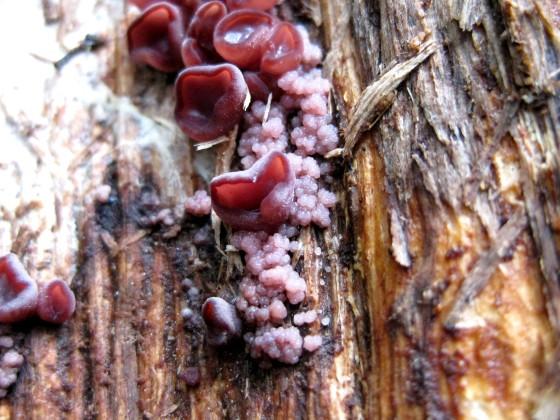
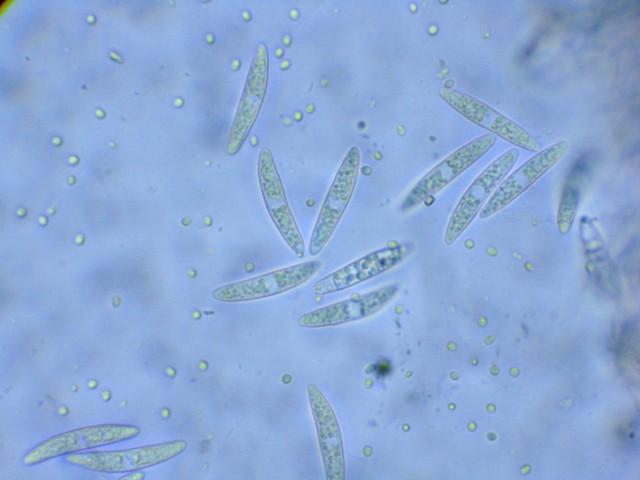
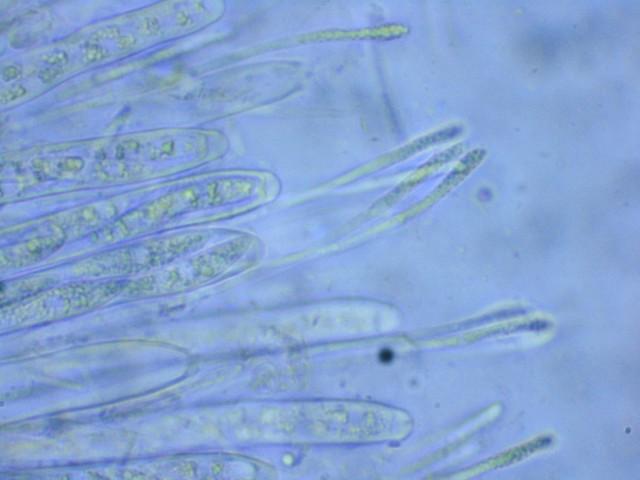
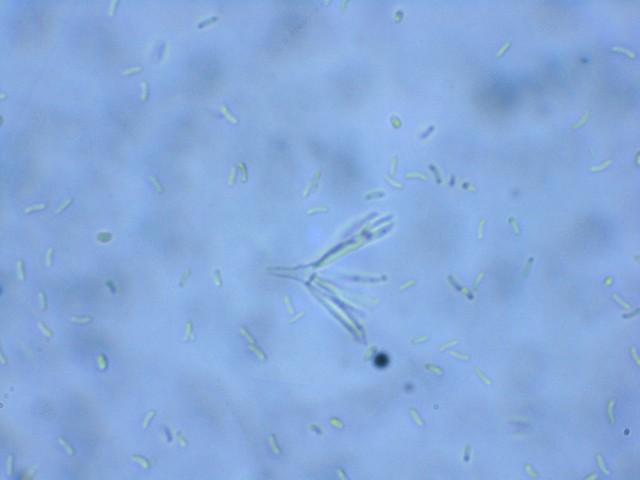

it looks very much like the anamorph of Ascocoryne inflata Wilson, the teleomorph however is probably very young, it lacks the inflated paraphyses (or it represents a different species). if you keep the collection moist for a few days you should be able to find germinating spores with globulose conidia-chains
regards,
Stip
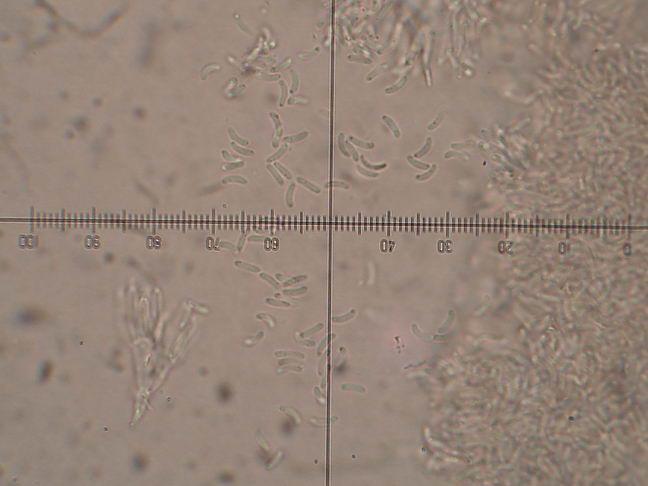
Thank you for your prompt reply.
As you say, it looks like anamorph of A. inflata.
Immature paraphyses of A. inflata are clavate and multiguttulate as my photos?
Maybe, it is teleomorph of A. cylichnium with anamorph of A. inflata?
Kutsuna
no anamorph of cylichnium is known by me but if you keep your collection alive for a few days, cylichnium will produce conidia inside living asci.
Stip
OK, I'll give it a try.
Thank you.
Kutsuna

I only wanted to ask whether the name Ascocoryne inflata Wilson is actually valid ?
I found it several times in Brittany.
Amitiés
Michel

I must correct Stip: A. cylichnium forms conidia inside dead asci or on free spores.
And your fungus cannot be A. inflata. It looks mature and the difference to A. inflata is in the absence of the two large oil drops in the living spores. Your multiguttulate spores fully match A. cylichnium, also I see one septate spore, from which these subglobose conidia are formed that swim around.
Now Stip is right in the fact that we have never seen an anamorph in A. cylichnium. In fact, this anamorph strongly resembles that of A. inflata.
Also the contents of the paraphyses with the guttules inside fully match cylichnium (see below).
Now I suggest to make a section of the undoubtedly mature apothecia. Look for the medullary hyphae: A. inflata and sarcoides have very narrow hyphae with ample gel between, while cylchnium has broad hyphae with few gel. Also there occur druses of crystals in the medulla in A. cylichnium but not in the others.
Zotto
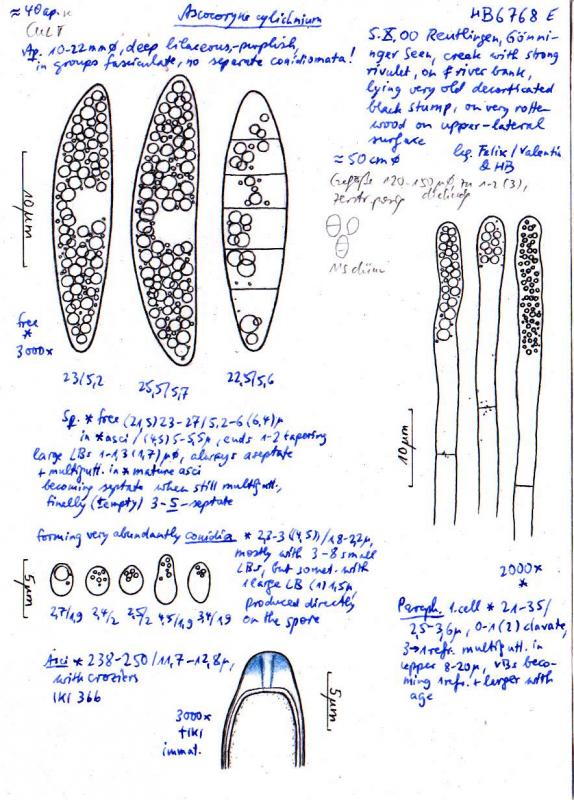
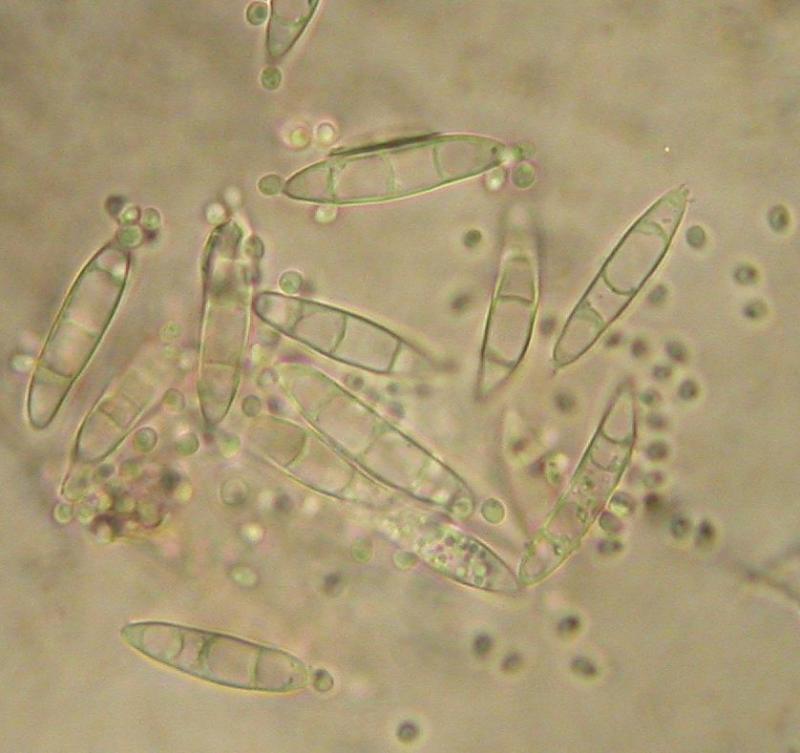
I am not sure if A. inflata is validly published. It is not published in a journal but in a dissertation, the validity depends on the fact if it is printed and if so on the quantity and distribution, see Mycotaxon 13 187-190. These facts are unfortunately unknown to me.
cheers,
Stipc
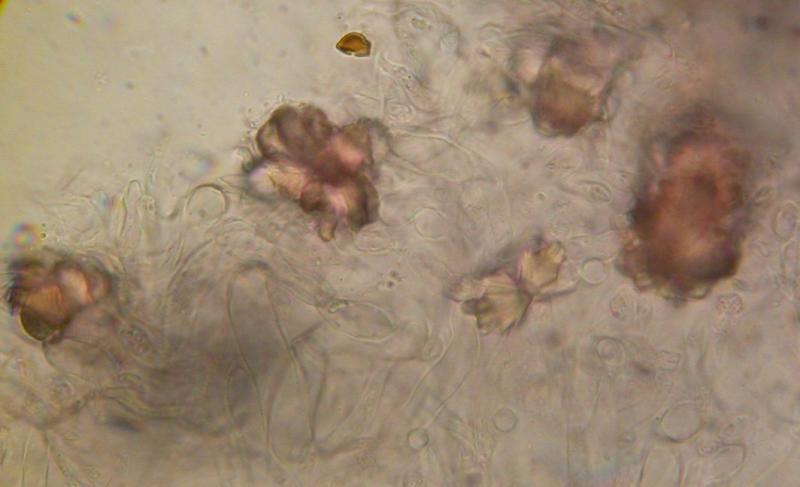
My fungus have broad hyphae (about 10 microns wide) and crystals.
So, I think, it is A. cylichnium and anamorph of A. inflata growing nearby.
Thank you.
Kutsuna
I assume that inflata is invalid as the dissertation probably exists only as a few copies.

Regards
Martin
Update: found it!