
05-05-2026 22:40
Gernot FriebesHi,I believe this is a Plagiostoma growing on a Sa
04-05-2026 18:13
 Stephen Martin Mifsud
ID request for what seems to be a true aquatic fun
04-05-2026 16:39
Stephen Martin Mifsud
ID request: This specimen was collected in Malta o
28-07-2011 18:31
 Alex Akulov
Dear FriendsToday I made the pdf file of Velenovsk
28-04-2026 20:07
 Lothar Krieglsteiner
... on twig in the air at standing Ceratonia siliq
04-05-2026 09:50
 Castillo Joseba
Me mandan el material seco de Galicia,(España) re
02-05-2026 12:42
Alain BRISSARDBonjour à tousJeuidi 30 avril dernier on m'a remi
02-05-2026 13:06
Pauline. PennaBonjour Please can someone help me with this id
01-05-2026 22:45
 Thierry Blondelle
Bonjour à tous, Une récolte sur bouse séchée d
Dear friends,Today my wife find a Discomycete sample, which looks interesting. Its apothecia are formed on thin twigs of unknown deciduous tree with signs of discoloration in red. Young apothecia are yellow, but soon stay red as the wood .
Asci are 8 - sporous, very small, in average of 14 x 4.2 micrometers. Asci are both monostichous and distichous, but more frequently 6 spores at the top of ascus are placed in two rows, and the two spores near the ascus leg are placed in one row. The size of ascospores: 3.1-3.3 x 1.7-2.2 micrometer.
Please, tell me what is this species and whether it is the cause of red staining of wood or vice versa it absorbs red pigment from the wood.
Thanks in advance ,
Alex
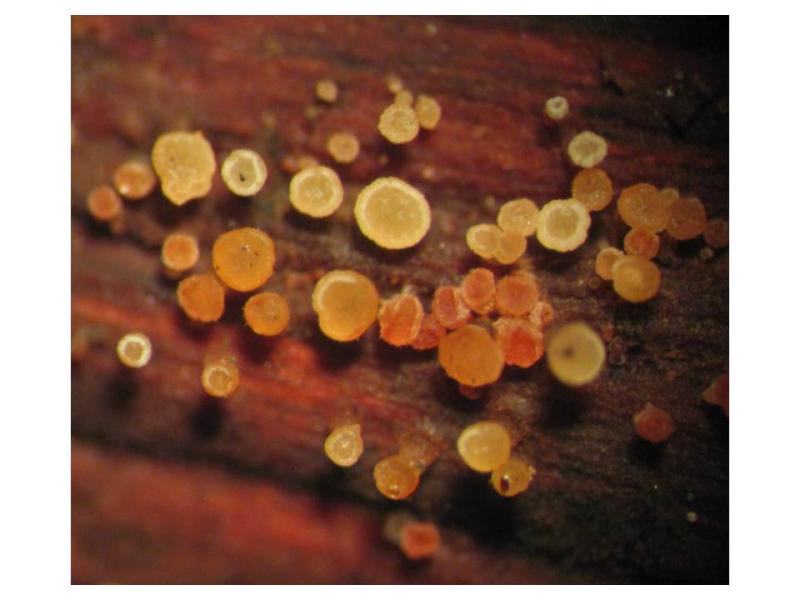
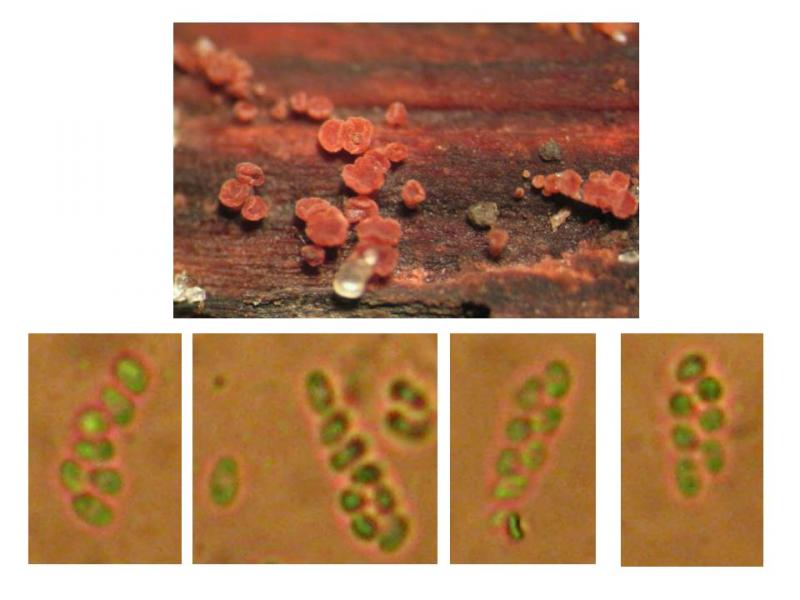

it might be a Hyphodiscus, but to clarify you should lok for marginal hairs, and whether it has a gelatinized excipulum.
H. hymenipohilus is known to stain the wood in red by its anamorph.
Do you have a photo of an ascus? is it amyloid?
Zotto
Thanks for your advice! In the Lugol reagent apical apparatus of asci colored in blue. Most of the asci in my sample are immature, but as a whole the morphology of asci, spores and marginal hairs are very similar to those shown on the site: http://asco-sonneberg.de/pages/gallery/hyphodiscus-hymeniophilus-091227-mcol-0115551.php?group_id=15511&position=2
The legs of asci are enough long and their overall size, even in an immature state is 37 x 4.3 micrometer.
Probably I'm dealing with a young specimen of Hyphodiscus hymeniophilus.
Alex