
22-05-2026 21:35
Steve ClementsBonjour, I expected this find on old wood on our
22-05-2026 18:12
 Lothar Krieglsteiner
... in moist chamber from Portugal.As the fungus s
22-05-2026 20:08
Ethan CrensonHello all, Yesterday in NYC I was visiting an e
11-01-2022 16:36
 Jason Karakehian
Hi does anyone have a digital copy of Raitviir A (
20-05-2026 17:47
Margot en Geert VullingsWe found this Mollisia on dead Juncus stems mown l
22-05-2026 14:47
Gernot FriebesHi,superficial ascomata collected on bark of a liv
22-05-2026 14:44
Lothar Krieglsteiner
in unripe condition citrine yellow, then soon fadi
22-05-2026 13:29
Gernot FriebesHi,I am curious to hear your opinion on this mater
22-05-2026 10:59
 Nicolas VAN VOOREN
Trouvé sur Phragmites, ce que je pense être un L
20-05-2026 21:49
Margot en Geert VullingsWe found this Lachnum on Juncus stems mown last ye
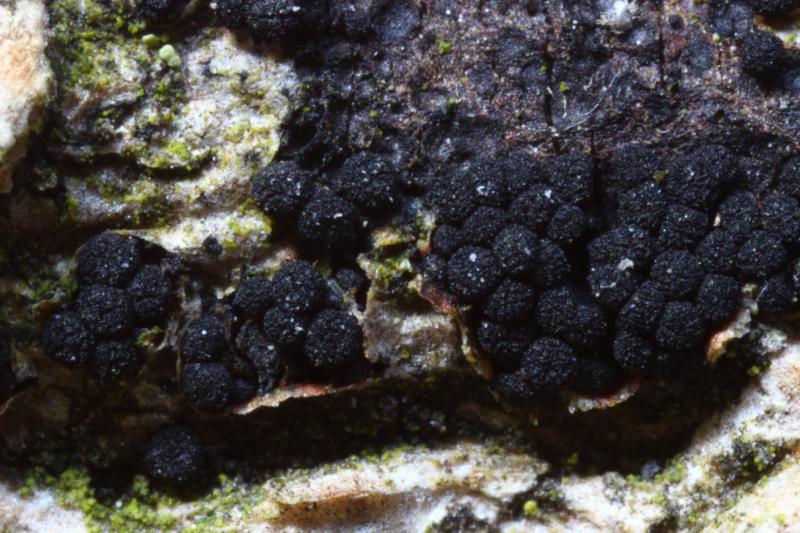
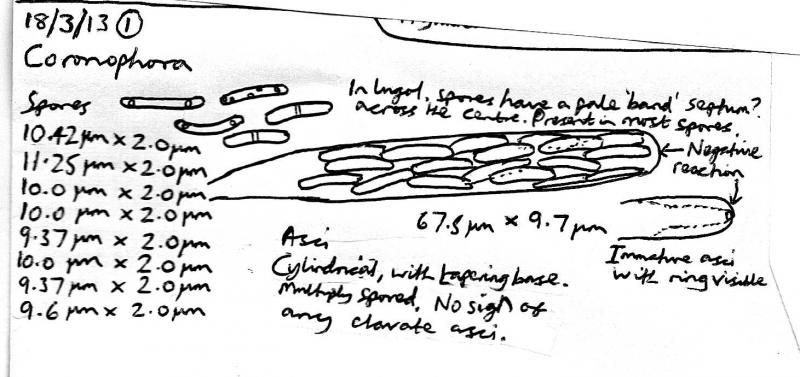
I have received a sample with perithecia resembling those of the genus Nitschkia. The asci are many spored and cylindrical rather than clavate in the upper part. The spores are sausage shaped and mostly curved, with the majority measuring between 9.5 and 10um long.
I wonder if there is another genus within the Nitschkiaceae which applies to my sample. Alternatively, is it possible in the genus Coronophora that asci can be cylindrical rather than clavate?
Any help would be much appreciated.
Thank you,
Peter.

Zotto
Thank you for your reply.
I certainly thought that the fruit bodies strongly resembled those of a non collapsing Nitschkia, but I was unaware of any species with many spored asci.
There are two entries in the Ascofrance database under the synonym Fracchiaea broomeana and their microscopy very closely resembles that for my sample.
Best wishes,
Peter.

regards
Chris

Contribución al conocimiento de cinco géneros de la familia Nitschkiaceae (Hymenoascomycetes: Sordariales). Acta Botanica Mexicana: 36. 43-52. 1996.

Alain
Thank you for the references to the literature about this species and the other related genera. I shall have a look at them both.
Best wishes,
Peter.
Thank you for your confirmation of the identification.
I was surprised to find that there was a Nitschkia species with polysporous asci. N. broomeana appears only to have been found twice before in Britain.
Best wishes,
Peter.