
26-05-2026 22:44
Ethan CrensonHi all, I think I have Incrucipulum capitatum her
26-05-2026 21:25
Dirk GerstnerHello everyone, I'm completely stumped by this li
22-05-2026 14:44
 Lothar Krieglsteiner
in unripe condition citrine yellow, then soon fadi
25-05-2026 16:44
François BartholomeeusenHi forum members,During an excursion organised by
23-05-2026 11:44
 Charles Grapinet
Hello, I am having trouble identifying this copro
25-05-2026 16:35
 Bernard CLESSE
Bonjour à toutes et tous,J'ai trouvé récemment,
22-05-2026 13:29
Gernot FriebesHi,I am curious to hear your opinion on this mater
23-05-2026 18:57
Sylvie Le GoffBonjour à tousRécolté sur une branchette de Sal
22-05-2026 21:35
Steve ClementsBonjour, I expected this find on old wood on our
Hysterium?
Garcia Susana,
25-02-2013 09:08
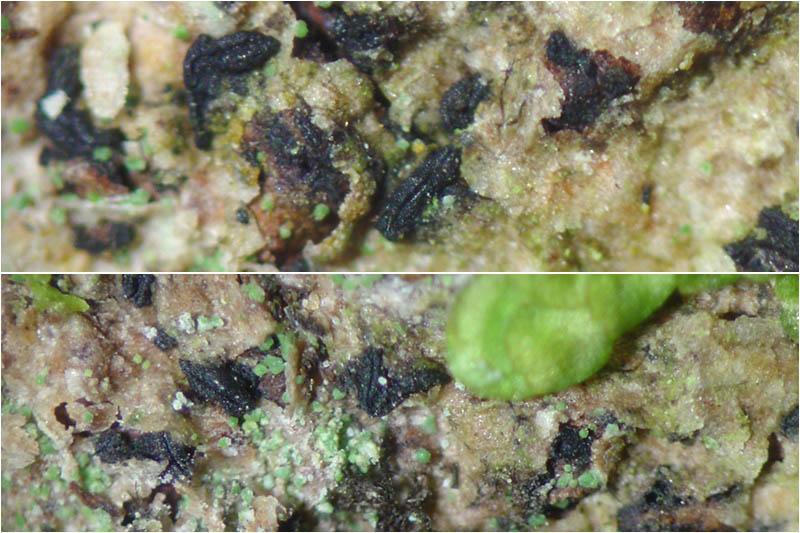
Especie que crece de forma gregaria sobre corteza de arce colonizada por liquenes.
Tamaño de los ascomas, en torno a 0.5mm.
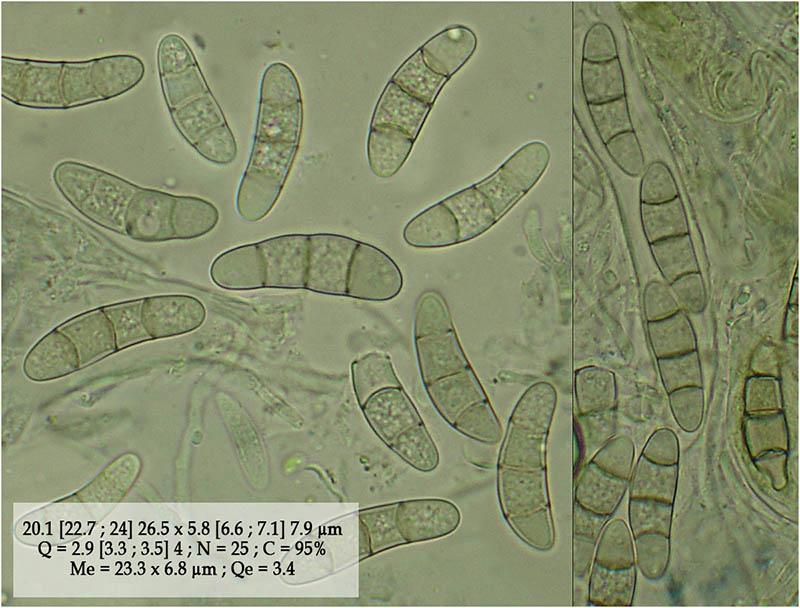
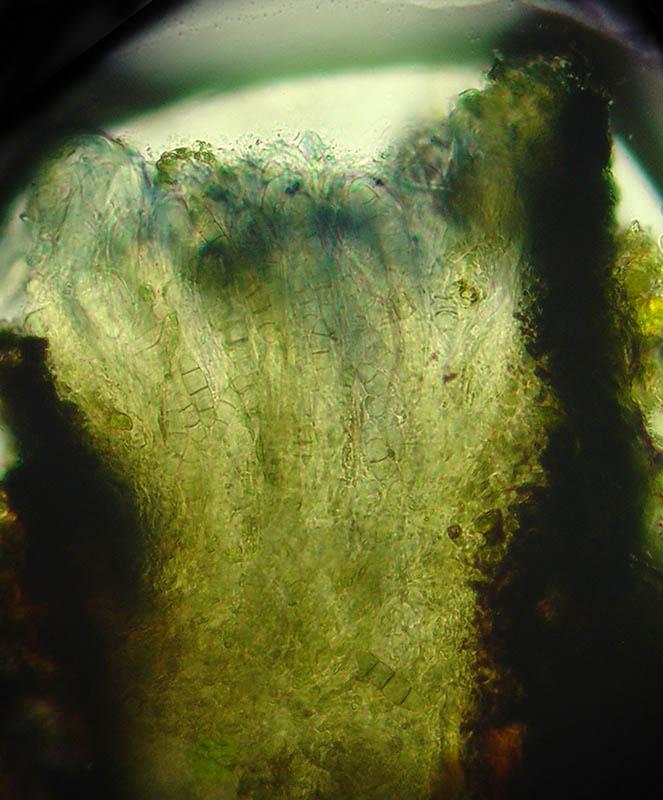
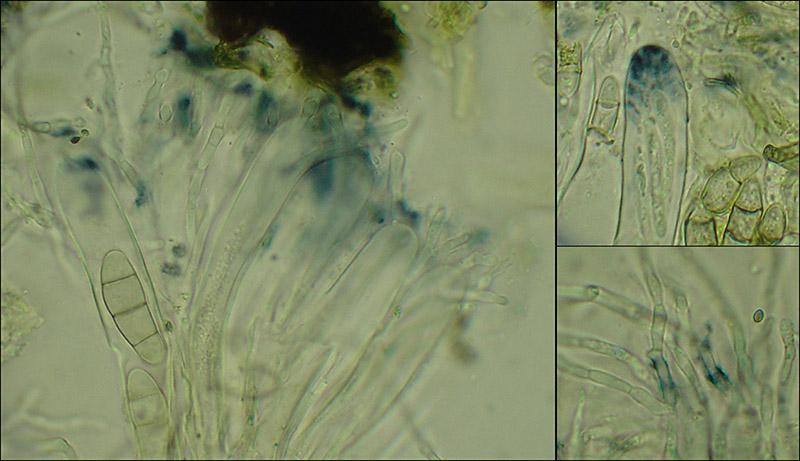
Microscopicamente se observa gran cantidad de pigmento azul en la zona apical del himenio. La mayoria de las muestras observadas estaban en un estadío inmaduro, por lo que puede que las esporas mostradas no estén totalmente maduras, es posible que hayan salido de las ascas al preparar la muestra.
Pienso que podría pertenecer a la familia Hysteraceae y dentro de ésta al genero Hysterium.
¿Que opinais?
Gracias.
Susana
Hello:
Species that grows gregariously on Acer bark colonized by lichens.
Ascomata size, around 0.5mm.
Observed microscopically lot of blue pigment in the apical region of the hymenium. Most of the samples were observed in an immature stage, so that the spores can not be displayed fully mature, you may have left the asci during sample preparation.
I think it might belong to the family Hysteraceae and within it the genre Hysterium.
What do you think?
Thank you.?
Susana

Hans-Otto Baral,
25-02-2013 09:53

Re : Hysterium?
Hi Susanna
I agree with Hysterium though Hysteropatella is difficult to separate.
Are your macros in dry or moist state? hysteropatella then will display an open hymenium.
I observed such blue pigment in Patellaria aff. atrata (I call it "crassispora").
Zotto
I agree with Hysterium though Hysteropatella is difficult to separate.
Are your macros in dry or moist state? hysteropatella then will display an open hymenium.
I observed such blue pigment in Patellaria aff. atrata (I call it "crassispora").
Zotto
Björn Wergen,
25-02-2013 19:30

Re : Hysterium?
Hi Zotto,
Yesterday I have also observed those plue pigments in Patellaria atrata growing on herbaceous stems (perhaps Angelica) with spores about 36-45x6-7µm. I do not think this to be crassispora.
I can send you the material via email when I am ready with the photos.
regards,
björn
Yesterday I have also observed those plue pigments in Patellaria atrata growing on herbaceous stems (perhaps Angelica) with spores about 36-45x6-7µm. I do not think this to be crassispora.
I can send you the material via email when I am ready with the photos.
regards,
björn
Garcia Susana,
25-02-2013 20:16
Re : Hysterium?
Hola
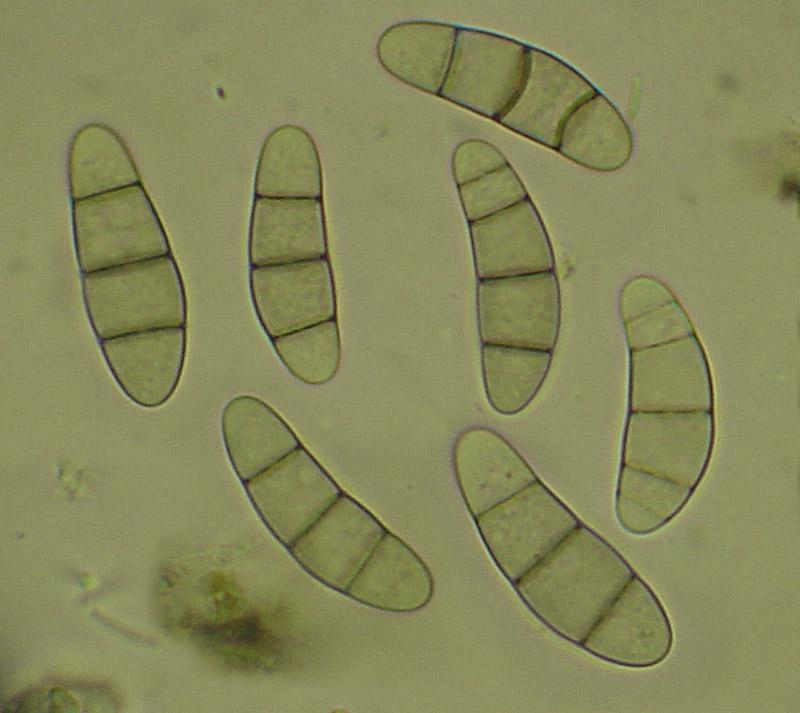
Las imagenes son en estado seco. Pero he revisado la recolecta y he encontrado ascomas aplanados que se corresponden con la misma especie. En la micro observo que las esporas estan más maduras y su tamaño es de 24-26 x 7-8um. Casi todas con tres septos, pero alguna espora con 4 y 5.
¿Se trataría de hysteropatella? No tengo informacion de ese genero.
Respecto a Patellaria crassispora creo que las esporas son diferentes.
Saludos
Susana
?
Hello
Images are in the dry state. But I reviewed the collection and found flattened ascomata that correspond to the same species. In the micro observed that spores are more mature and its size is 24-26 x 7-8um. Almost all three septa, but some spore with 4 and 5.
Would it be hysteropatella? I have no information of that genre.
Regarding Patellaria crassispora think spores are different.
regards
Susana
Las imagenes son en estado seco. Pero he revisado la recolecta y he encontrado ascomas aplanados que se corresponden con la misma especie. En la micro observo que las esporas estan más maduras y su tamaño es de 24-26 x 7-8um. Casi todas con tres septos, pero alguna espora con 4 y 5.
¿Se trataría de hysteropatella? No tengo informacion de ese genero.
Respecto a Patellaria crassispora creo que las esporas son diferentes.
Saludos
Susana
?
Hello
Images are in the dry state. But I reviewed the collection and found flattened ascomata that correspond to the same species. In the micro observed that spores are more mature and its size is 24-26 x 7-8um. Almost all three septa, but some spore with 4 and 5.
Would it be hysteropatella? I have no information of that genre.
Regarding Patellaria crassispora think spores are different.
regards
Susana


Hans-Otto Baral,
25-02-2013 22:31
Re : Hysterium?
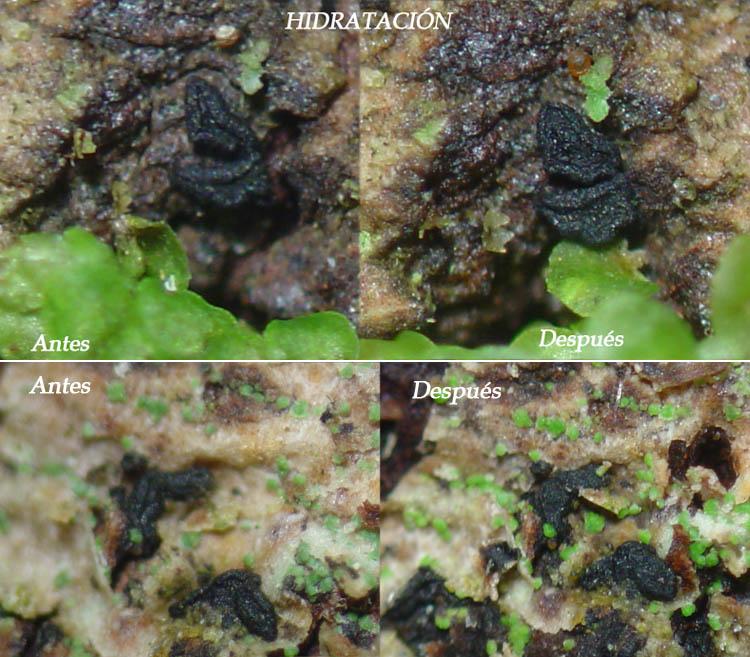
It would be good to compare the dry and rewettened state. Hysteropatella thereby opens its hymenium rather strongly, while Hysterium does not.
I know mainly two species in Hysteropatella: H. elliptica on Salix bark, and H. prostii on Malus bark. The two species are very similar but they seem to be host-specific, because we never saw them on other hosts within Europe. Now, that on Salix has such a blue pigment while that on Malus hasn't. How sure are you with Acer? Is Salix impossible? Does your collection come from Spain?
Your spore size fits quite well H. elliptica, I measured for instance *19-26 x 6.3-8.5 µm.
Zotto
I know mainly two species in Hysteropatella: H. elliptica on Salix bark, and H. prostii on Malus bark. The two species are very similar but they seem to be host-specific, because we never saw them on other hosts within Europe. Now, that on Salix has such a blue pigment while that on Malus hasn't. How sure are you with Acer? Is Salix impossible? Does your collection come from Spain?
Your spore size fits quite well H. elliptica, I measured for instance *19-26 x 6.3-8.5 µm.
Zotto
Paul LEROY,
25-02-2013 23:14
Re : Hysterium?
Bonjour Suzana,
Ici ce qui me déroute un peu c'est l'absence de pigmentation dans les 2 cellules centrales,
sinon ceci me fait penser à Hysrerium pulicare
Paul
Ici ce qui me déroute un peu c'est l'absence de pigmentation dans les 2 cellules centrales,
sinon ceci me fait penser à Hysrerium pulicare
Paul
Garcia Susana,
25-02-2013 23:47
Re : Hysterium?
Hola Zotto
He hecho la prueba de la rehidratacion y yo considero que es positiva (Adjunto imagen). Por tanto, se trata de Hysteropatella, ¿no?
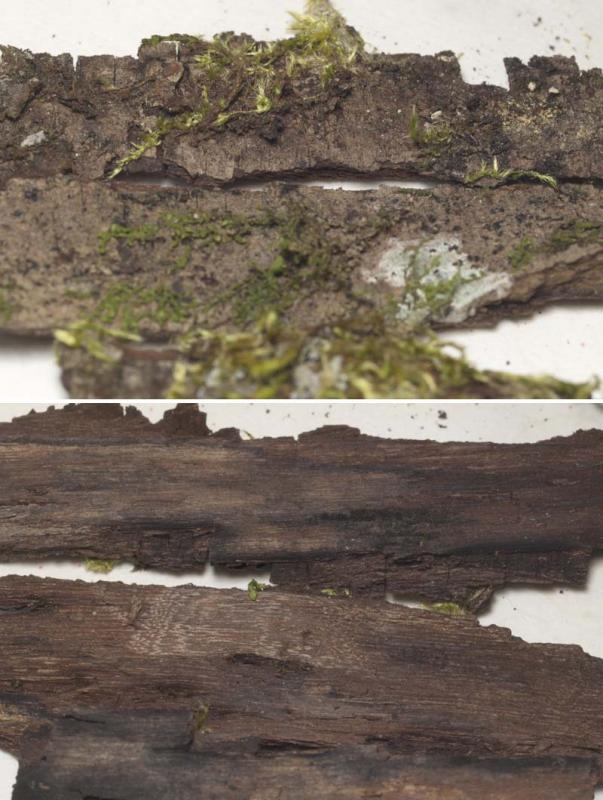
Respecto al sustrato, no tengo seguridad de que fuera Acer, se trataba de una zona de regata donde abundan arces, avellanos, y sauces. (Adjunto imagen por si alguien es capaz de identificar a traves de la corteza).
Saludos
Susana?
Hi Zotto
I have been tested for rehydration and I think it is positive (image attached). Therefore, it is Hysteropatella, right?
Respect to the substrate, I have no assurance that Acer was, it was a racing area with abundant maples, and willow trees. in Spain (Navarra) (Attached picture if someone is able to identify through the bark).
regards
Susana?
He hecho la prueba de la rehidratacion y yo considero que es positiva (Adjunto imagen). Por tanto, se trata de Hysteropatella, ¿no?
Respecto al sustrato, no tengo seguridad de que fuera Acer, se trataba de una zona de regata donde abundan arces, avellanos, y sauces. (Adjunto imagen por si alguien es capaz de identificar a traves de la corteza).
Saludos
Susana?
Hi Zotto
I have been tested for rehydration and I think it is positive (image attached). Therefore, it is Hysteropatella, right?
Respect to the substrate, I have no assurance that Acer was, it was a racing area with abundant maples, and willow trees. in Spain (Navarra) (Attached picture if someone is able to identify through the bark).
regards
Susana?
Hans-Otto Baral,
26-02-2013 08:17
Re : Hysterium?
Yes, that is what I wished to see. For me clearly Hysteropatella.
For the bark I am not sure. Could be Acer indeed. You do not have a piece of wood also? A crossbreak would easily allow distinction. Acer with rather thick radial rays, Salix with very thin, one-layered radial rays.
Zotto
For the bark I am not sure. Could be Acer indeed. You do not have a piece of wood also? A crossbreak would easily allow distinction. Acer with rather thick radial rays, Salix with very thin, one-layered radial rays.
Zotto
Garcia Susana,
26-02-2013 09:26
Re : Hysterium?
Hola de nuevo
No tengo en este momento madera del arbol , pero puedo volver al sitio e intentar identificar correctamente el arbol. Cuando lo haya hecho te lo hare saber.
Gracias, un saludo
Susana
Hello again
At this time I have no tree wood, but I can return to the site and try to correctly identify the tree. When you are done you will know.
Thanks, greetings
Susana
No tengo en este momento madera del arbol , pero puedo volver al sitio e intentar identificar correctamente el arbol. Cuando lo haya hecho te lo hare saber.
Gracias, un saludo
Susana
Hello again
At this time I have no tree wood, but I can return to the site and try to correctly identify the tree. When you are done you will know.
Thanks, greetings
Susana