
28-04-2026 20:07
 Lothar Krieglsteiner
... on twig in the air at standing Ceratonia siliq
04-05-2026 18:13
 Stephen Martin Mifsud
ID request for what seems to be a true aquatic fun
04-05-2026 16:39
Stephen Martin Mifsud
ID request: This specimen was collected in Malta o
04-05-2026 09:50
 Castillo Joseba
Me mandan el material seco de Galicia,(España) re
02-05-2026 12:42
Alain BRISSARDBonjour à tousJeuidi 30 avril dernier on m'a remi
02-05-2026 13:06
Pauline. PennaBonjour Please can someone help me with this id
01-05-2026 22:45
 Thierry Blondelle
Bonjour à tous, Une récolte sur bouse séchée d
14-04-2026 05:32
Ethan CrensonHi all, A few weeks back a friend pointed out som
28-04-2026 20:33
Vitus SchäfftleinHello, I found Trochila ilicina on Ilex aquifoliu
trichophaea-article
DirkW,
30-10-2012 01:31
 salut a tous!
does anyone has this article?:
Moyne, G. 2005. Aleuria cestrica et Trichophaea pseudogregaria récoltés en Franche-Comté. Bull. mycol. bot. Dauphiné-Savoie, 176, p. 31-36.
i have two quite different collections of t. cf. gregaria here, which are mixing characteristica of gregaria and pseudogregaria in a very confusing way. so i have to learn more about pseudogregaria ;-)
thanks a lot!
dirk
Beñat Jeannerot,
30-10-2012 06:24

Re : trichophaea-article
Adio Dirk,
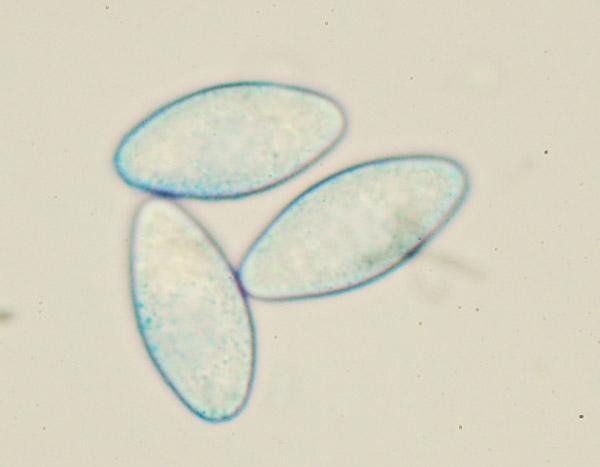
It exist a sort of complex in T. gregaria. Some collections with smooth spores, some finely verrucose and some with little warts in the middle of fine ponctuation. This last seems to correspond to T. gregaria var. intermedia (Le Gal - 1937).
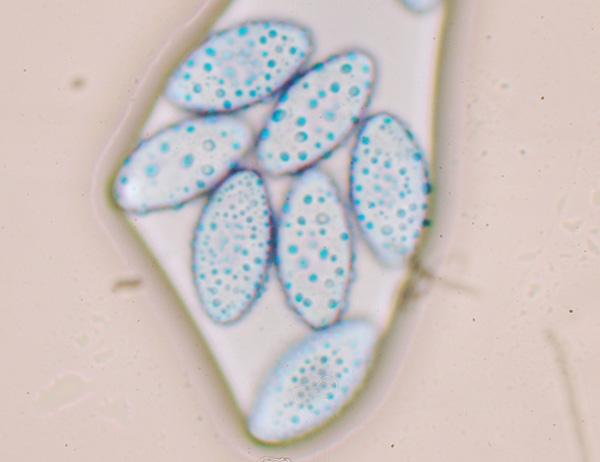
And T. pseudogregaria is a species with an ornementation with warts, distinctly rounded and spores larger than T. gregaria.
Until someone sends you article, I attach here two photos of sporogram : T. gregaria (finely ponctuate) and T. pseudogregaria (distinct warts) of personal collections.
It's just my opinion, based on Bronckers article. It's difficult to make more without study of typus and overview of opinions of the primary authors.
Perhaps more information with others...
Beñat
It exist a sort of complex in T. gregaria. Some collections with smooth spores, some finely verrucose and some with little warts in the middle of fine ponctuation. This last seems to correspond to T. gregaria var. intermedia (Le Gal - 1937).
And T. pseudogregaria is a species with an ornementation with warts, distinctly rounded and spores larger than T. gregaria.
Until someone sends you article, I attach here two photos of sporogram : T. gregaria (finely ponctuate) and T. pseudogregaria (distinct warts) of personal collections.
It's just my opinion, based on Bronckers article. It's difficult to make more without study of typus and overview of opinions of the primary authors.
Perhaps more information with others...
Beñat
Gilbert MOYNE,
30-10-2012 09:23
Re : trichophaea-article
Voici un pDF de l'article demandé.
Amitiés
gilbert
Amitiés
gilbert
 Aleuria-cestrica--0001.pdf
Gernot Friebes,
30-10-2012 11:30
Re : trichophaea-article
Hi,
I've never had problems to identify my collections as either T. gregaria (ascospores smooth or delicately rough) or T. pseudogregaria (ascospores with more distinct, rounded warts). Beñat's photos show the differences quite nicely. Dirk, do you maybe have photos of your intermediate collections?
T. pseudogregaria loses the ornamentation of the ascospores in KOH which makes it quite difficult to distinguish this species from T. gregaria when not examined in water.
Best wishes,
Gernot
I've never had problems to identify my collections as either T. gregaria (ascospores smooth or delicately rough) or T. pseudogregaria (ascospores with more distinct, rounded warts). Beñat's photos show the differences quite nicely. Dirk, do you maybe have photos of your intermediate collections?
T. pseudogregaria loses the ornamentation of the ascospores in KOH which makes it quite difficult to distinguish this species from T. gregaria when not examined in water.
Best wishes,
Gernot
DirkW,
30-10-2012 15:37
Re : trichophaea-article
dear gilbert,
now i have a clearer opinion on t. pseudogregaria!
merci beaucoup!!
dirk
now i have a clearer opinion on t. pseudogregaria!
merci beaucoup!!
dirk
DirkW,
30-10-2012 16:03
Re : trichophaea-article
salut benat, hallo gernot,
merci pour les spores-ornamentation, benat!
now i can say my second collection is not pseudogregaria, because it is also very fine-warted (comparable to the ornamentation of peziza arvernensis f.ex.), like gregaria has to be, often nearly not to see. my problem with the collection are three aspects:
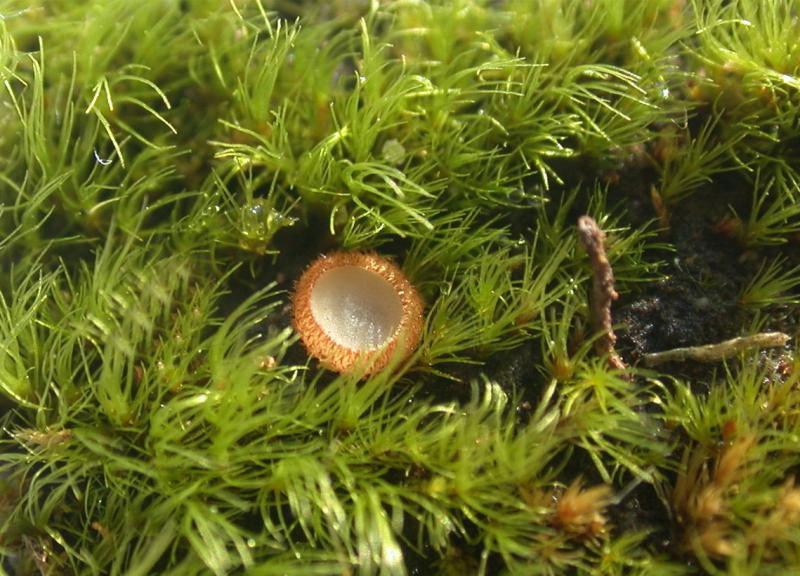
1. the hairs are light-brown (not dark-purplish-brown as i know from typically t. gregaria). 160-250 long.
2. the spores are subfusoid-elliptical (22 x 10-11 (12)) and fit from size and form very good to that what bronckers describes and draws for pseudogregaria. but the ornamentation is much too weak in my collection
3. nearby to this collection i found typically dark-haired t. gregaria with really different, narrow and fusoid spores (24-25 (26) x 12)
at first i thought, this could be paratrichophaea boudieri, but the spores are full of little oil-drops at maturity and with two medium-sized drops when young.
here is a picture: should this be in the variation of t. gregaria? that seems courious to me ...
best
dirk
merci pour les spores-ornamentation, benat!
now i can say my second collection is not pseudogregaria, because it is also very fine-warted (comparable to the ornamentation of peziza arvernensis f.ex.), like gregaria has to be, often nearly not to see. my problem with the collection are three aspects:
1. the hairs are light-brown (not dark-purplish-brown as i know from typically t. gregaria). 160-250 long.
2. the spores are subfusoid-elliptical (22 x 10-11 (12)) and fit from size and form very good to that what bronckers describes and draws for pseudogregaria. but the ornamentation is much too weak in my collection
3. nearby to this collection i found typically dark-haired t. gregaria with really different, narrow and fusoid spores (24-25 (26) x 12)
at first i thought, this could be paratrichophaea boudieri, but the spores are full of little oil-drops at maturity and with two medium-sized drops when young.
here is a picture: should this be in the variation of t. gregaria? that seems courious to me ...
best
dirk
Daniel Ghyselinck,
01-11-2012 11:30
Re : trichophaea-article
Voici également un article avec une description de T. pseudogregaria, paru dans le numéro 5 de la revue de l'AMFB (association des mycologues francophones de Belgique) de 2012.
Amitiés,
Daniel
Amitiés,
Daniel