12-04-2026 15:52
Gernot FriebesHi,I'm looking for help with this anamorph collect
14-04-2026 21:52
Gernot FriebesHi,found on dead leaves of Carex elata. Conidia: 4
16-04-2026 22:09
Buckwheat PeteHello, I'd like to ask about this older specimen:
14-04-2026 05:32
Ethan CrensonHi all, A few weeks back a friend pointed out som
15-04-2026 19:33
Fátima Durán ManzanequeHi!! I need help, I found this Ascomycete but I d
14-04-2026 20:31
Gernot FriebesHi,can this be Psilachnum lateritioalbum on Phragm
12-04-2026 17:56
 Hardware Tony
Found on dead stems in February earlier this year
12-04-2026 12:22
 William Slosse
In a dune grassland in Oostduinkerke (Belgium), on
11-04-2026 15:45
 Zuzana Sochorová (Egertová)
Please, could anyone send me this paper?Moyne G.,
11-04-2026 13:34
Artem PtukhaHello, I am seeking assistance with the identific
Hymenoscyphus on wood
Martin Bemmann,
05-07-2010 23:57
 Hi all,
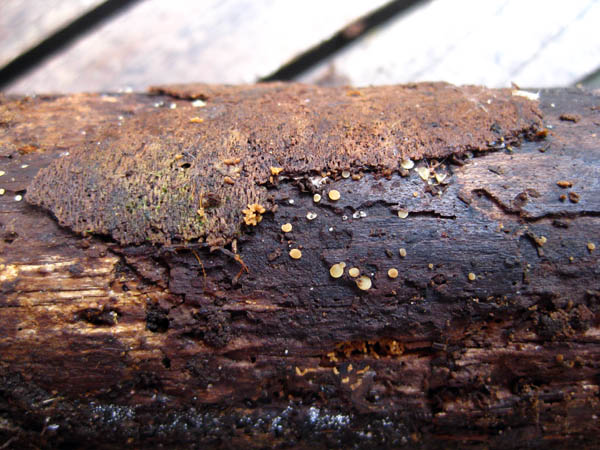
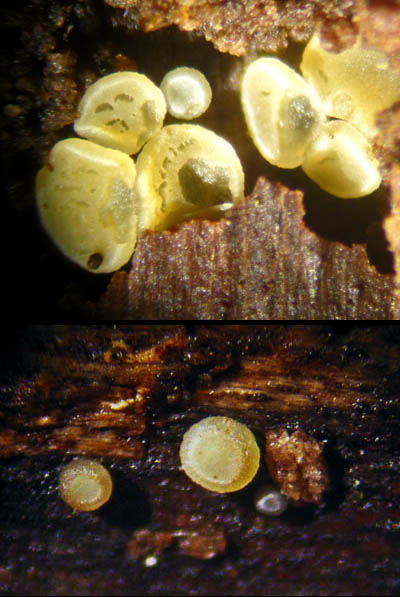
this one puzzels me lacking clear features. The apothecia grow with a short stipe on a soaked dead and mostly decorticated twig of a broadleave tree. Their colour is cream to yellowish.
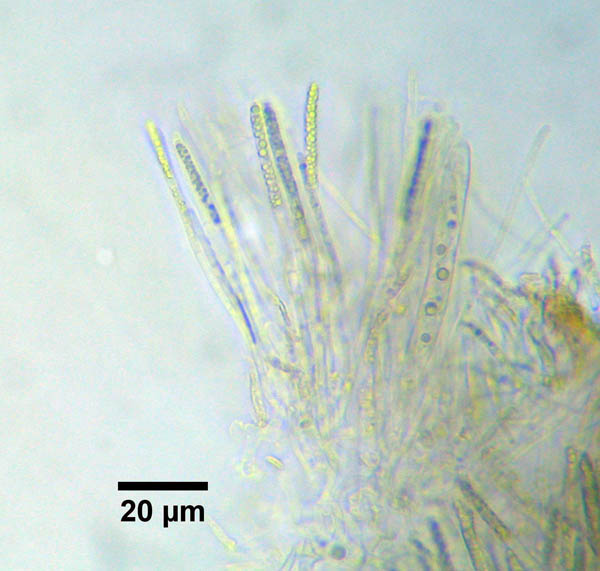
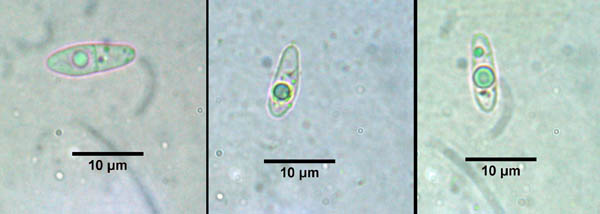
I found hundreds of paraphyses (septated and with refractive bodies in the upper segment) but only few asci (c. 75 x 5 µm). No chance to check whether they arise from croziers or not (I made several preparations...). With IKI I could observe a faint blue reaction of the apical apparatus. The few spores I found are scutuloide, 1-septate when mature and filled with 1 big and some smaller oildrops (10,1-12,5 x 3,2-4,2 µm).
My hope is that the overall appearence will remind some of you on a group of species I should look after.
Best regards,
Martin
Martin Bemmann,
05-07-2010 23:58
Re:Hymenoscyphus on wood
closer view:
Martin Bemmann,
05-07-2010 23:58
Re:Hymenoscyphus on wood
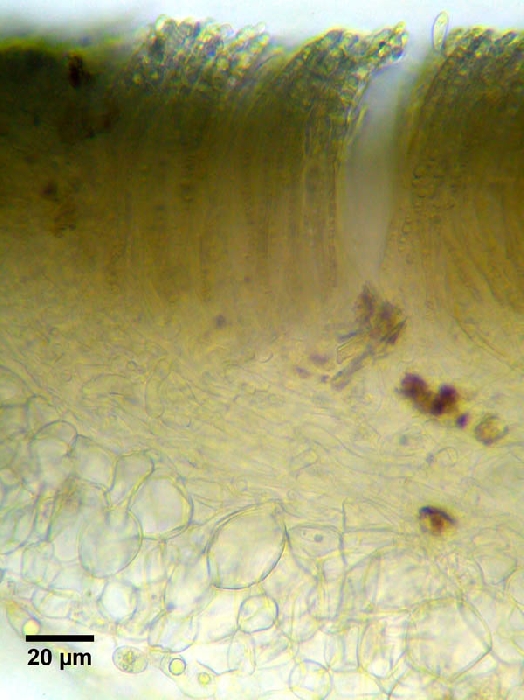
a section showing the texturae of the different layers:
Martin Bemmann,
05-07-2010 23:59
Re:Hymenoscyphus on wood
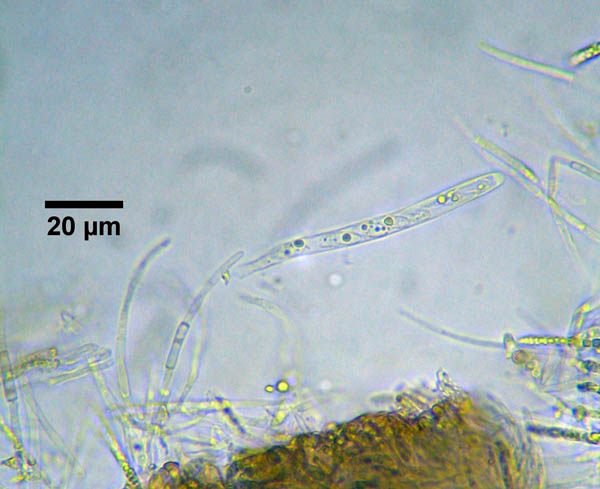
an immature ascus:
Martin Bemmann,
05-07-2010 23:59
Re:Hymenoscyphus on wood
ascus with IKI:

Martin Bemmann,
06-07-2010 00:00
Re:Hymenoscyphus on wood
paraphyses:
Martin Bemmann,
06-07-2010 00:00
Re:Hymenoscyphus on wood
and spores:
Marja Pennanen,
06-07-2010 01:18
Re:Hymenoscyphus on wood
Hello Martin,
this looks like Hymenoscyphus vernus, which I've found on wet wood.
Except that the spores were not septate and I've not mentioned too many papaphyses ;)
Anyway the paraphyses had many droplets and were a little longer than asci.
But my determinations may not always be rock solid ;)
Greetings:Marja
this looks like Hymenoscyphus vernus, which I've found on wet wood.
Except that the spores were not septate and I've not mentioned too many papaphyses ;)
Anyway the paraphyses had many droplets and were a little longer than asci.
But my determinations may not always be rock solid ;)
Greetings:Marja
Hans-Otto Baral,
06-07-2010 08:31

Re:Hymenoscyphus on wood
Hi Martin & Marja
good to see that you try idetification yourself, Marja! I think it is the close H. kathiae. H. vernus has often a longer stipe (but must not), and the spores not so much oil. Septa often occur in overmature stages in many species.
Important would be the ascus base (H- in vernus, H+ in kathiae and imberbis). With KOH+CR I usually easily see whether there are croziers or not. Or in the living state in a section without squashing.
Zotto
good to see that you try idetification yourself, Marja! I think it is the close H. kathiae. H. vernus has often a longer stipe (but must not), and the spores not so much oil. Septa often occur in overmature stages in many species.
Important would be the ascus base (H- in vernus, H+ in kathiae and imberbis). With KOH+CR I usually easily see whether there are croziers or not. Or in the living state in a section without squashing.
Zotto
Martin Bemmann,
06-07-2010 15:07
Re:Hymenoscyphus on wood
Thank you Marja and Zotto!
I tried to find croziers and I am pretty sure there are. I could see them better while focusing, then I could photograph them.
Well, H. kathiae! The data on the DVD are fitting well, too. Thank you again.
Best regards,
Martin
I tried to find croziers and I am pretty sure there are. I could see them better while focusing, then I could photograph them.
Well, H. kathiae! The data on the DVD are fitting well, too. Thank you again.
Best regards,
Martin