
11-05-2026 12:32
 Bernard CLESSE
Pourriez-vous m'aider à identifier cette héloti
11-05-2026 20:22
 Lothar Krieglsteiner
on attached twig of standing Ficus caricaquite uns
28-04-2026 20:07
Lothar Krieglsteiner
... on twig in the air at standing Ceratonia siliq
29-04-2026 10:44
Lothar Krieglsteiner
growing at moist, drying-out soil at the side of a
05-04-2026 22:46
Lothar Krieglsteiner
on wood of Ceratonia, Algarve, 3.4.2026.The color
10-05-2026 16:18
brigitte vignotbonjour trouvée en Ariège sur bois une petite
10-05-2026 23:17
 Andreas Gminder
Hello,today we found in a moist steep decidous for
27-04-2026 17:16
Lothar Krieglsteiner
.. Algarve, moist lying.The conidiomata look like
50293 - Disco inconnu
Roland Labbé,
09-05-2010 18:44
Voici un autre disco inconnu de Québec.
Votre aide est très précieuse pour nous.
Amitiés !
Roland
Détails :
Date de récolte: 04 / 05 / 2010
Habitat : forêt mixte
Substrat : branche morte décortiquée de peuplier faux-tremble
Sporée blanc grisâtre
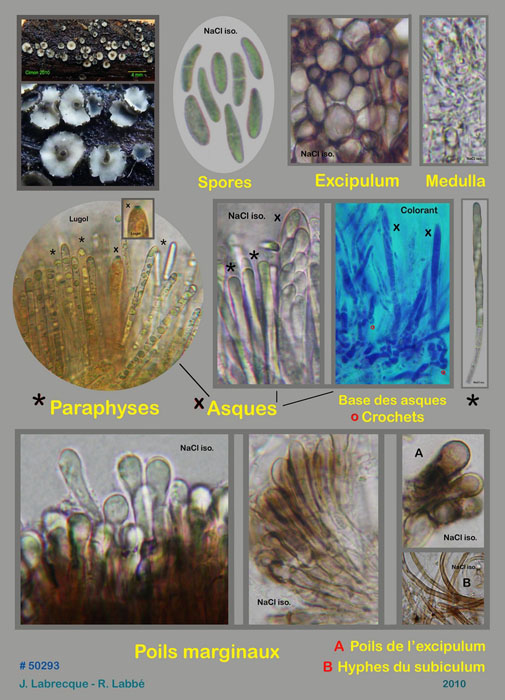
Spores ellipsoïdes à subnaviculaires allongées, lisses, à 1 septum, à contenu huileux uniforme, de dimension variable, 6-12 x 2-4 µm, 9,4 x 2,8 µm en moyenne (20 spores), Q = 3,36
Asques plutôt dispersées parmi les paraphyses, à 8 spores bisériées, à contenu dextrinoïde, avec crochet à la base et avec appareil apical amyloïde, 42-58 x 4,5-6 µm (10 asques), dépassant parfois les paraphyses( ?)
Paraphyses cylindriques, lisses, à 1 septum basal, non ramifiées, à contenu huileux homogène à 95% en NaCl iso., à nombreuses grosses bulles en Lugol, 55-77 x 2-4 µm (8 paraphyses)
Poils marginaux en palissade, cylindriques, septés, moyennement arrondis à l'apex, jusqu'à 6 µm de diam.
Excipulum en textura globulosa, à globuleuses à clavées, brun foncé, jusqu'à 15 µm de largeur
Face externe formée d'hyphes rarement ramifiées et septées, à paroi légèrement épaisse, brun ochracé à brun foncé, jusqu'à 4 µm de diam.
Roland Labbé,
11-05-2010 02:26
Re:50293 - Disco inconnu
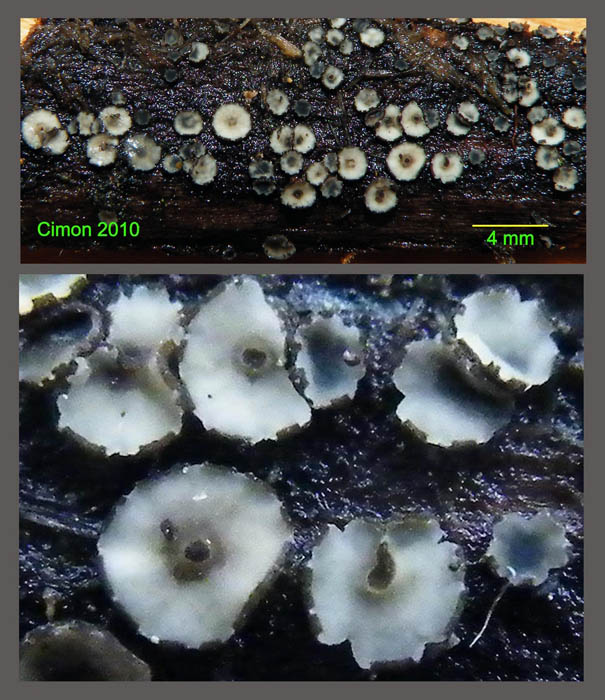
Voici la photo orignale.
Roland
Roland
Roland Labbé,
11-05-2010 02:26
Re:50293 - Disco inconnu
Voici la photo orignale.
Roland
Roland
Hans-Otto Baral,
24-05-2010 20:39

Re:50293 - Disco inconnu
Clearly a Mollisia. It seems that you studied this specimen in the fresh state? Only the living paraphyses contain these refractive contents which are not oleaginous which you can confirm by its dissolution in KOH. KOH is also necessary to apply whether a transient yellow colour appears from these VBs (seen already under the bino).
See Andreas Gimder's key. (ww.mollisia.de). If you have living asci (you recognize them when you add KOH, they will strongly shrink and retract below the paraphyses), please try to find out whether the spores inside are aseptate or septate. This is very important to indetify the species.
Zotto
See Andreas Gimder's key. (ww.mollisia.de). If you have living asci (you recognize them when you add KOH, they will strongly shrink and retract below the paraphyses), please try to find out whether the spores inside are aseptate or septate. This is very important to indetify the species.
Zotto