
16-03-2011 14:31
roman vargas albertoHi. I would like some opinion about this Peziza
14-05-2026 05:36
Ethan CrensonHi all, I haven't paid much attention to Lachnu
10-05-2026 23:17
 Andreas Gminder
Hello,today we found in a moist steep decidous for
11-05-2026 12:32
 Bernard CLESSE
Pourriez-vous m'aider à identifier cette héloti
13-05-2026 15:26
 François Freléchoux
Bonjour,Voici une récolte faite il y a quelques j
12-05-2026 15:41
 Nicolas VAN VOOREN
Dear Ascolovers, especially interested in Pezizale
13-05-2026 12:05
 Thierry Blondelle
Bonjour à tous,J'aimerais avoir confirmation de c
28-04-2026 20:07
 Lothar Krieglsteiner
... on twig in the air at standing Ceratonia siliq
27-04-2026 20:52
Lothar Krieglsteiner
Found on hanging tiwg of Olea europaea in dried-ou
11-05-2026 20:22
Lothar Krieglsteiner
on attached twig of standing Ficus caricaquite uns
Nectria
Martin Bemmann,
12-04-2010 23:18
 Dear all,
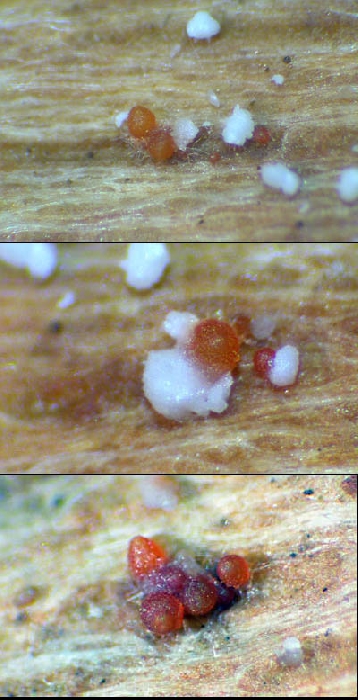
I have here a Nectria, unmature (no asci, no spores), fruiting on a decorticated twig of a decidous tree.
Maybe the white lumps are a hint which taxa can be expected?
Best regards,
Martin
Martin Bemmann,
12-04-2010 23:18
Re:Nectria
a close view:
Christian Lechat,
13-04-2010 05:15

Re:Nectria
Hi Martin,
your fungus resembles to the genus "Cosmospora" and the white sporodochia are maybe a Fusarium.
Would you have some microscopical illustrations?
Regards,
Christian
your fungus resembles to the genus "Cosmospora" and the white sporodochia are maybe a Fusarium.
Would you have some microscopical illustrations?
Regards,
Christian
Martin Bemmann,
14-04-2010 13:00
Re:Nectria
Hello Christian,
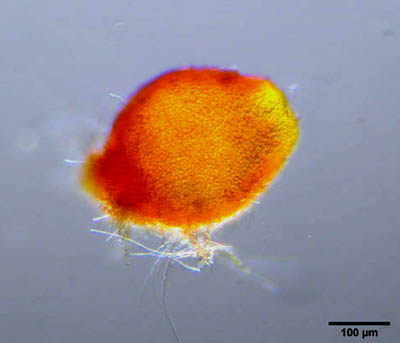
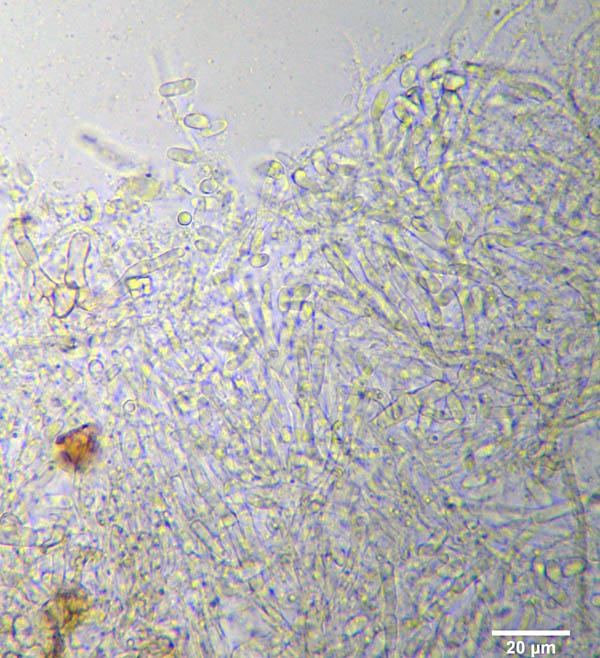
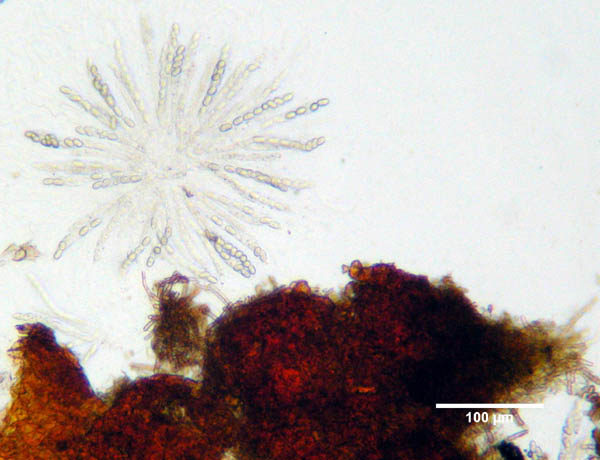
I have kept the stick in a moist environment. Most of the white lumps are dissolved now, but some were still there. Under the microscope it looks like this:
I have kept the stick in a moist environment. Most of the white lumps are dissolved now, but some were still there. Under the microscope it looks like this:
Martin Bemmann,
14-04-2010 13:00
Re:Nectria
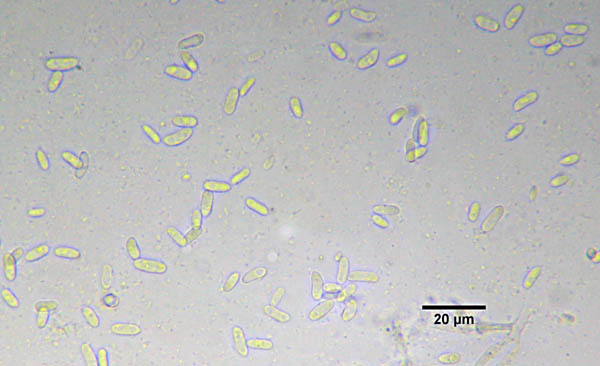
The conidia measure 8,2-10,4x2,8-4,1µm
Martin Bemmann,
14-04-2010 13:02
Re:Nectria
The ascocarps have developed asci now:
Martin Bemmann,
14-04-2010 13:04
Re:Nectria
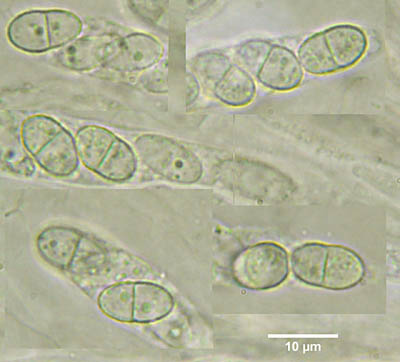
There were no free spores yet. But I measured some of the more mature looking ones: 9,3-10,5 x 5,5-6,2 µm
Martin Bemmann,
14-04-2010 13:06
Re:Nectria
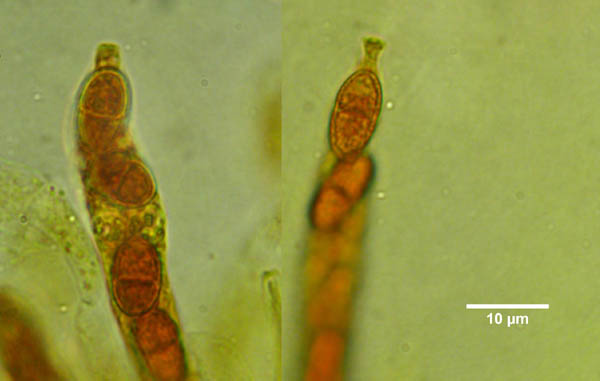
Finally I tested the asci with IKI. To my opinion the reaction was negative. But one photograph one can think of a small bluish tint at the tip.
Does this help to get further?
Best regards,
Martin
Does this help to get further?
Best regards,
Martin
Christian Lechat,
14-04-2010 14:00
Re:Nectria
I Martin,
Anamorph on the substratum looks like an Acremonium, it would be correct for "Cosmospora" but I would like to see some conidiophores and phyalides with conidia to know if it is really an Acremonium. However, nothing proves that this anamorphe is in relation to your Cosmospora
Your fungus is immature, you should wait until it is mature to study it.
Besides, without anamorph in culture it is nearly impossible to know what it is.
Cheers,
Christian
Anamorph on the substratum looks like an Acremonium, it would be correct for "Cosmospora" but I would like to see some conidiophores and phyalides with conidia to know if it is really an Acremonium. However, nothing proves that this anamorphe is in relation to your Cosmospora
Your fungus is immature, you should wait until it is mature to study it.
Besides, without anamorph in culture it is nearly impossible to know what it is.
Cheers,
Christian
Martin Bemmann,
14-04-2010 23:48
Re:Nectria
Hi Christian,
your estimation was well done, regarding the separation of the anamorph and the unsolvable problem of the teleomorph.
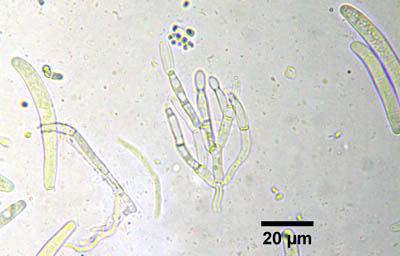
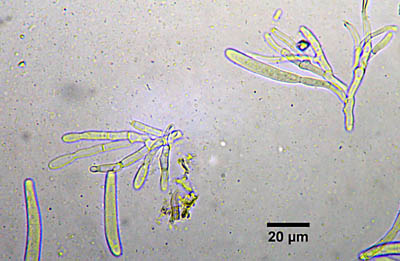
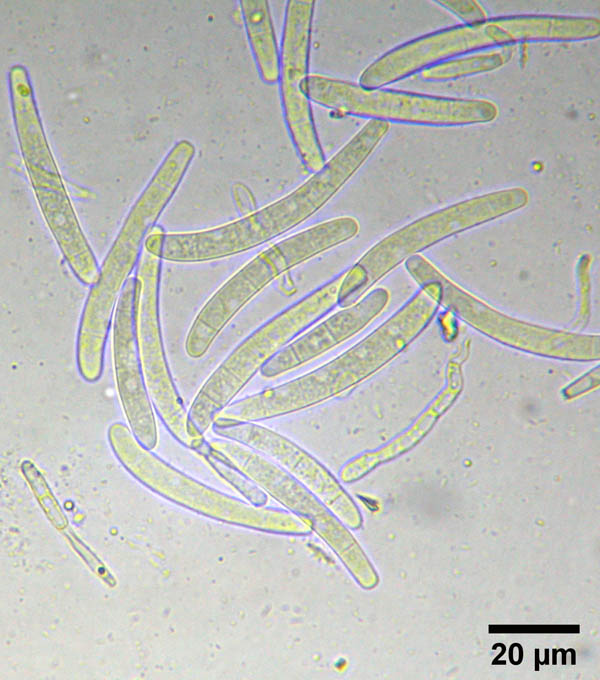
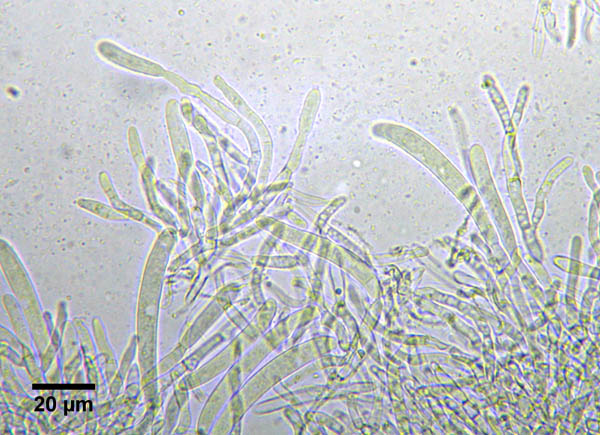
I made a new preparation of these white lumps and it turned out to be something very different than the first one.This time a Fusarium, maybe.
As for the "Cosmospora" I will wait some time to look at it, not expecting to get a name for it, but just having seeing it at a mature stage
Best regards,
Martin
adding some pictures of the "Imperfect of the Day" ;-)
.
your estimation was well done, regarding the separation of the anamorph and the unsolvable problem of the teleomorph.
I made a new preparation of these white lumps and it turned out to be something very different than the first one.This time a Fusarium, maybe.
As for the "Cosmospora" I will wait some time to look at it, not expecting to get a name for it, but just having seeing it at a mature stage
Best regards,
Martin
adding some pictures of the "Imperfect of the Day" ;-)
.
Martin Bemmann,
14-04-2010 23:49
Re:Nectria
next
Martin Bemmann,
14-04-2010 23:49
Re:Nectria
another
Martin Bemmann,
14-04-2010 23:50
Re:Nectria
Conidia are this time 51-57x5,6-7,9 µm
Christian Lechat,
15-04-2010 06:58
Re:Nectria
Hi Martin,
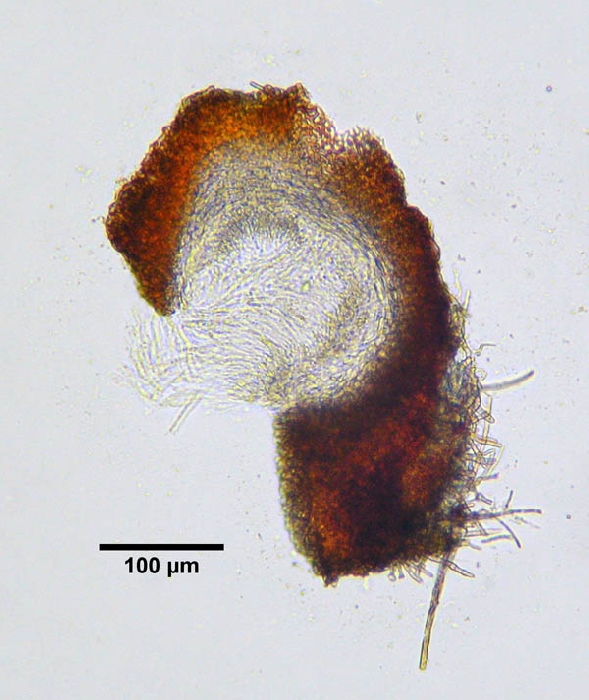
I think this anamorph is a Cylindrocarpon / Neonectria . Could you please to send us an image of ascomatal wall in vertical section?
Christian
I think this anamorph is a Cylindrocarpon / Neonectria . Could you please to send us an image of ascomatal wall in vertical section?
Christian
Martin Bemmann,
15-04-2010 22:26
Re:Nectria
Hi Christian,
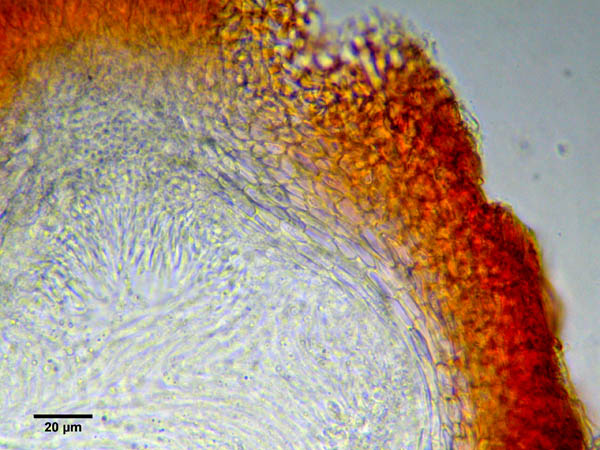
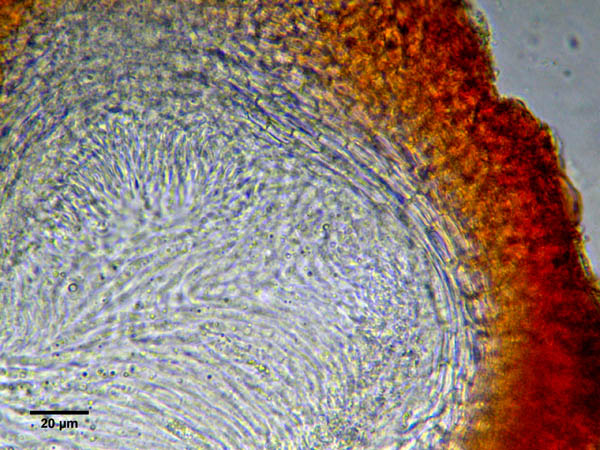
what a difficult task to cut a "vertical section" of this tiny fungus! I tried with more then 10 specimen. In vain. Then I experimented with PEG for the first time. And in the second attempt I got this result. Not nice but maybe enough to study:
what a difficult task to cut a "vertical section" of this tiny fungus! I tried with more then 10 specimen. In vain. Then I experimented with PEG for the first time. And in the second attempt I got this result. Not nice but maybe enough to study:
Martin Bemmann,
15-04-2010 22:27
Re:Nectria
These are two close-ups:
Martin Bemmann,
15-04-2010 22:27
Re:Nectria
Best regards,
Martin
Martin
Martin Bemmann,
17-04-2010 00:15
Re:Nectria
Dear Christian,
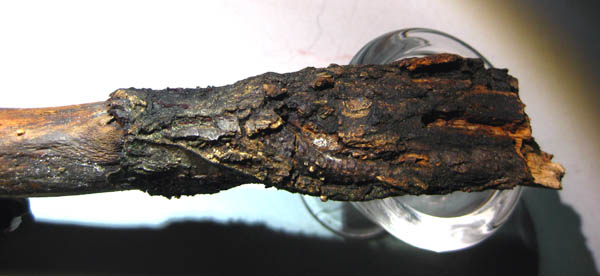
I read some papers today and saw that Nn. galligena would be an option. It causes a certain canker that I could observe at "my" twig as well. But spore size is still too small (today 7,5-10,7x4,5-5,0 µm).
Best regards,
Martin
I read some papers today and saw that Nn. galligena would be an option. It causes a certain canker that I could observe at "my" twig as well. But spore size is still too small (today 7,5-10,7x4,5-5,0 µm).
Best regards,
Martin
Christian Lechat,
17-04-2010 13:45
Re:Nectria
Hi Martin,
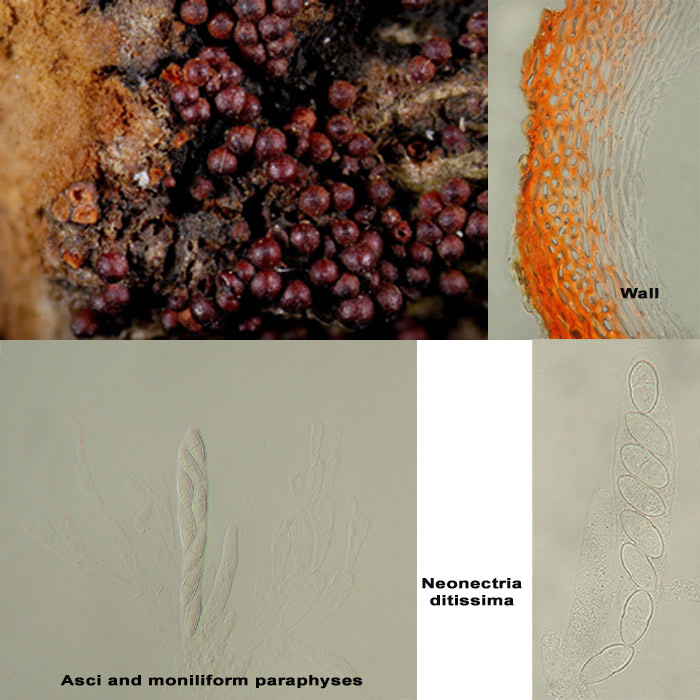
here is a plate showing Neonectria ditissima (= N. galligena), it is very different from your collection.
Christian
here is a plate showing Neonectria ditissima (= N. galligena), it is very different from your collection.
Christian
Martin Bemmann,
17-04-2010 19:19
Re:Nectria
Thank you Christian!
At least one species excluded! I will wait now until I find mature free spores, before I proceed.
Why is N. ditissima=galligena? Both are valid species in Index Fungorum?
Best regards,
Martin
At least one species excluded! I will wait now until I find mature free spores, before I proceed.
Why is N. ditissima=galligena? Both are valid species in Index Fungorum?
Best regards,
Martin
Christian Lechat,
17-04-2010 21:16
Re:Nectria
Neonectria ditissima (Tul. & C. Tul.) Samuels & Rossman, Canadian journal of botany
2006, vol. 84, no9, pp. 1417-1433
= Cylindrocarpon willkommii (Lindau) Wollenw., (1928)
= Fusarium willkommii J. Lindau, in Rabenhorst
= Nectria ditissima var. arctica Wollenw., (1926)
= Nectria ditissima var. major Wollenw., (1926)
= Nectria major (Wollenw.) J. Moravec, (1956)
All the best,
Christian
2006, vol. 84, no9, pp. 1417-1433
= Cylindrocarpon willkommii (Lindau) Wollenw., (1928)
= Fusarium willkommii J. Lindau, in Rabenhorst
= Nectria ditissima var. arctica Wollenw., (1926)
= Nectria ditissima var. major Wollenw., (1926)
= Nectria major (Wollenw.) J. Moravec, (1956)
All the best,
Christian
Martin Bemmann,
17-04-2010 21:29
Re:Nectria
Ok, thanks again for directing me to the Castlebury/Rossman/Hyten paper.
I will study it.
Cheers,
Martin
I will study it.
Cheers,
Martin