
16-03-2011 14:31
roman vargas albertoHi. I would like some opinion about this Peziza
14-05-2026 05:36
Ethan CrensonHi all, I haven't paid much attention to Lachnu
10-05-2026 23:17
 Andreas Gminder
Hello,today we found in a moist steep decidous for
11-05-2026 12:32
 Bernard CLESSE
Pourriez-vous m'aider à identifier cette héloti
13-05-2026 15:26
 François Freléchoux
Bonjour,Voici une récolte faite il y a quelques j
12-05-2026 15:41
 Nicolas VAN VOOREN
Dear Ascolovers, especially interested in Pezizale
13-05-2026 12:05
 Thierry Blondelle
Bonjour à tous,J'aimerais avoir confirmation de c
28-04-2026 20:07
 Lothar Krieglsteiner
... on twig in the air at standing Ceratonia siliq
27-04-2026 20:52
Lothar Krieglsteiner
Found on hanging tiwg of Olea europaea in dried-ou
11-05-2026 20:22
Lothar Krieglsteiner
on attached twig of standing Ficus caricaquite uns
50528 - Hymenoscyphus scutula ?
Roland Labbé,
24-03-2010 04:14
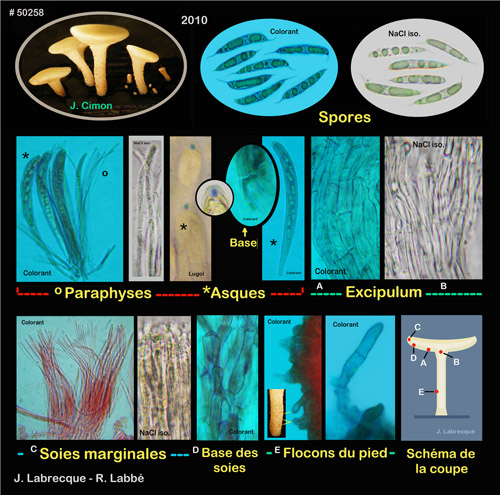
Voici un autre Hymenoscyphus récolté à Québec.
C'est peut être H. scutula, mais les spores et les soies ne semblent pas conforme.
Merci pour l'aide !
Roland
Détails :
Date de récolte : 18 / 10 / 2009
Habitat : tas de détritus à découvert
Substrat : tige d'herbacée
Spores cylindriques-fusoïdes, lisses, longuement apiculées aux deux extrémités, avec 5 guttules, verdâtre pâle en NaCl iso, réfringentes, 24-31 x 4-5um, 27,1 x 4,6 µm en moyenne (20 spores), Q = 5,89
Asques à 8 spores en majorité bisériées, avec pore apical amyloïde et sans crochet, 110-130- x 8-10 µm en moyenne (10 asques)
Paraphyses cylindriques, légèrement élargies à l'apex, non ramifiées, septées, à contenu huileux (?) finement granuleux à 90-100%, finement incrustées, surtout à l'apex, dépassant légèrement les asques de 2-3 µm
Soies marginales très abondantes, en palissade serrée, semblables aux paraphyses, 35-50 x 2-3 µm
Excipulum ental formé de cellules étroitement cylindriques, septées, 3-5 µm de diam.
Excipulum ectal en textura porrecta ascendant, formé de cellules largement cylindriques à subglobu- leuses, à angles obtus, septées, 15-30 x 11-16 µm
Flocons en surface du pied formés de cellules variées, cylindriques, lagéniformes, clavées à globuleuses, septées, avec excroissance à la base, pigmentées et incrustées d'ocre brunâtre en Nacl iso., en amas
Hans-Otto Baral,
24-03-2010 13:00

Re:50528 - Hymenoscyphus scutula ?
Hi Roland
I see no difference to typical H. scutula here. What do you think is different? Spore size and shape, and length of setulae seems typial to me.
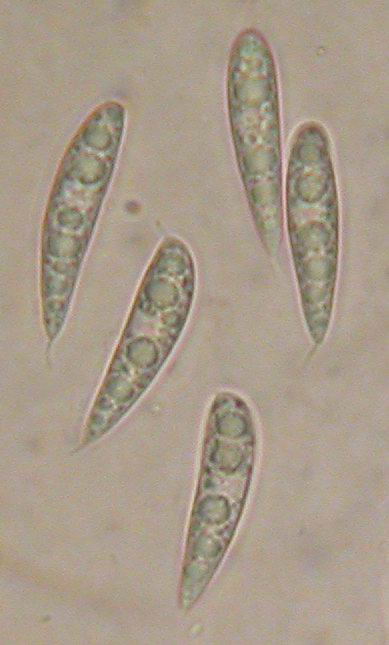
You apparently did this microscopy from the dried material because even the spores are dead. Oil drops in living spores often help to be more sure.
Here I add an image showing living spores. Spore size was distinctly shorter, yes: *19-22.5 x 4.8-5.5 µm. There are sometimes such long-spored collections, which are not sharply delimited from the short-spored ones. I think this is mere variation.
Zotto
I see no difference to typical H. scutula here. What do you think is different? Spore size and shape, and length of setulae seems typial to me.
You apparently did this microscopy from the dried material because even the spores are dead. Oil drops in living spores often help to be more sure.
Here I add an image showing living spores. Spore size was distinctly shorter, yes: *19-22.5 x 4.8-5.5 µm. There are sometimes such long-spored collections, which are not sharply delimited from the short-spored ones. I think this is mere variation.
Zotto
Roland Labbé,
24-03-2010 16:56
Re:50528 - Hymenoscyphus scutula ?
Thanks you Hans !
Acording to you, what serve the longs apiculus of these spores ?
Are they the same role than the flagella of certains organisms ?
Roland
Acording to you, what serve the longs apiculus of these spores ?
Are they the same role than the flagella of certains organisms ?
Roland
Hans-Otto Baral,
24-03-2010 17:09
Re:50528 - Hymenoscyphus scutula ?
They are non-motile, but they might play a role either in influencing the flight of the spore, or more probably to get entangled somewhere. Have no clear idea.
Zotto
Zotto