
19-05-2026 12:55
 Hardware Tony
After checking Gminder and Otto's library I cannot
19-05-2026 10:27
Patrice TANCHAUDBonjour, récolte récente sur terre retournée i
18-05-2026 12:43
Sylvie Le GoffBonjour à tousPuis je avoir votre aide sur ce que
19-05-2026 14:56
Åge OterhalsI found this white cushion-formed ascomycete on ro

18-05-2026 10:13
 Lieve Deceuninck
Dear forum members,I identified this as the teleom

17-05-2026 19:05
Thomas FlammerI have found this tiny 200 ym cup shaped apothecia
17-05-2026 16:41
Margot en Geert VullingsWe found this Lachnum on an old Rubus stem.Fruitbo
05-04-2026 22:46
 Lothar Krieglsteiner
on wood of Ceratonia, Algarve, 3.4.2026.The color
Lasiosphaeria stuppea?
Gernot Friebes,
23-01-2011 21:42
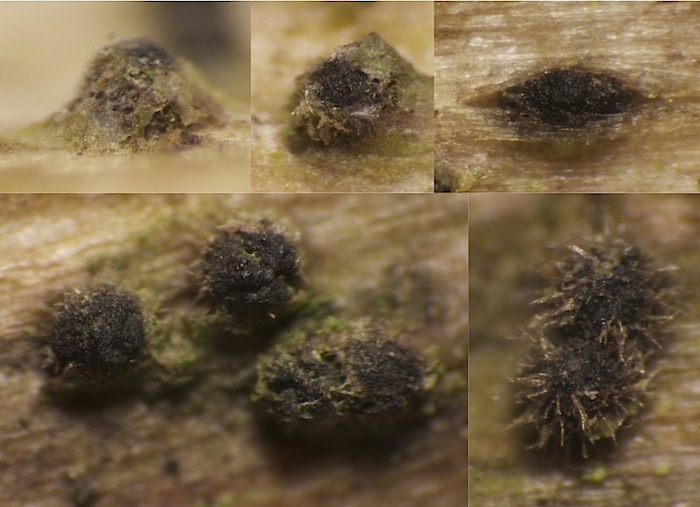
I think this collection is close to Lasiosphaeria stuppea but still differs a bit in some aspects. First of all the description:
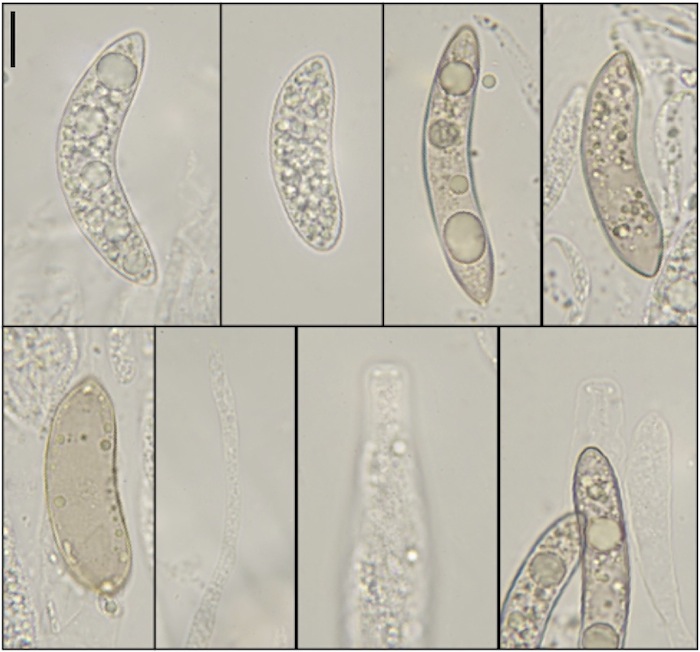
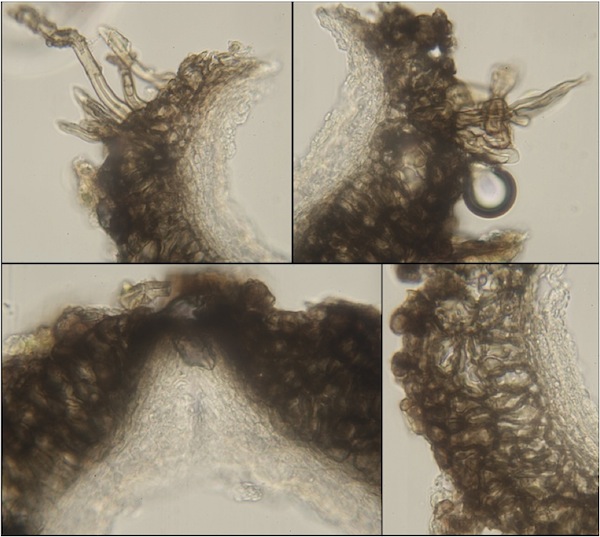
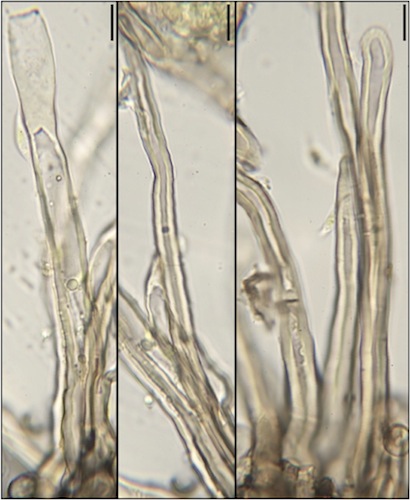
On a standing, dead, decorticated, little tree (Abies), approx. 150 cm above the ground. Ascomata black, rough, at first immersed in the substrate, when mature still often a bit immersed, usually covered with light brown setae but some ascomata also without; asci 8-spored, without subapical globulus, with well visible, simple apical ring; spores quite a long time hyaline, then turning brown, non-septate, smooth, bent in the middle, without appendages, 35-50 x 8-13 µm; peridium two-layered, with a thick, dark brown outer layer and a thinner, hyaline inner layer.
I hesitate to call my collection Lasiosphaeria stuppea because the spores seem too long and they are smooth, non-septate and the apical ring is simple and not double. The other characters fit well with the description by Candoussau, Fournier, & Magni. I am really interested in your opinion about this find!
Best wishes,
Gernot
Hans-Otto Baral,
23-01-2011 21:47

Re:Lasiosphaeria stuppea?
Hi Gernot
do you have any micros? I know mainly L. strigosa which is now Echinosphaeria strigosa. But your spores are actually much too large for this and stuppea. Are the setae very thick-walled?
Zotto
do you have any micros? I know mainly L. strigosa which is now Echinosphaeria strigosa. But your spores are actually much too large for this and stuppea. Are the setae very thick-walled?
Zotto
Gernot Friebes,
23-01-2011 21:55
Re:Lasiosphaeria stuppea?
sorry for the delay, I had problems with the computer.
spores (scale=10 µm):
spores (scale=10 µm):
Gernot Friebes,
23-01-2011 21:55
Re:Lasiosphaeria stuppea?
section:
Gernot Friebes,
23-01-2011 21:55
Re:Lasiosphaeria stuppea?
hairs
Jacques Fournier,
23-01-2011 23:05

Re:Lasiosphaeria stuppea?
Hi Gernot,
this fungus indeed resembles "Lasiosphaeria" stuppea in many respects but it apparently deviates in ascospore size and morphology and in lacking tubercles around the ostiole.
Several similar collections on various hosts, all somewhat different, are under investigation by Andrew Miller. You should contact him if he did not yet read your message.
Cheers,
Jacques
this fungus indeed resembles "Lasiosphaeria" stuppea in many respects but it apparently deviates in ascospore size and morphology and in lacking tubercles around the ostiole.
Several similar collections on various hosts, all somewhat different, are under investigation by Andrew Miller. You should contact him if he did not yet read your message.
Cheers,
Jacques
Gernot Friebes,
24-01-2011 07:39
Re:Lasiosphaeria stuppea?
Hi Zotto and Jacques,
thanks for your answers! I wonder if one species can be that variable or if there are some similar species in that complex. I will try to contact Andrew.
Best wishes,
Gernot
thanks for your answers! I wonder if one species can be that variable or if there are some similar species in that complex. I will try to contact Andrew.
Best wishes,
Gernot
Andrew N. Miller,
24-01-2011 16:33

Re:Lasiosphaeria stuppea?
Gernot,
Like many things fungal, this is a species complex that is currently trying to be sorted out by DNA.
Andy
Like many things fungal, this is a species complex that is currently trying to be sorted out by DNA.
Andy