
05-04-2026 22:46
 Lothar Krieglsteiner
on wood of Ceratonia, Algarve, 3.4.2026.The color
15-05-2026 13:33
Sylvie Le GoffBonjour à tousJe serais très reconnaissante enve
16-03-2011 14:31
roman vargas albertoHi. I would like some opinion about this Peziza
14-05-2026 05:36
Ethan CrensonHi all, I haven't paid much attention to Lachnu
10-05-2026 23:17
 Andreas Gminder
Hello,today we found in a moist steep decidous for
11-05-2026 12:32
 Bernard CLESSE
Pourriez-vous m'aider à identifier cette héloti
13-05-2026 15:26
 François Freléchoux
Bonjour,Voici une récolte faite il y a quelques j
12-05-2026 15:41
 Nicolas VAN VOOREN
Dear Ascolovers, especially interested in Pezizale
13-05-2026 12:05
 Thierry Blondelle
Bonjour à tous,J'aimerais avoir confirmation de c
28-04-2026 20:07
Lothar Krieglsteiner
... on twig in the air at standing Ceratonia siliq
Hysteropezizella diminuens
Nina Filippova,
12-02-2013 16:44
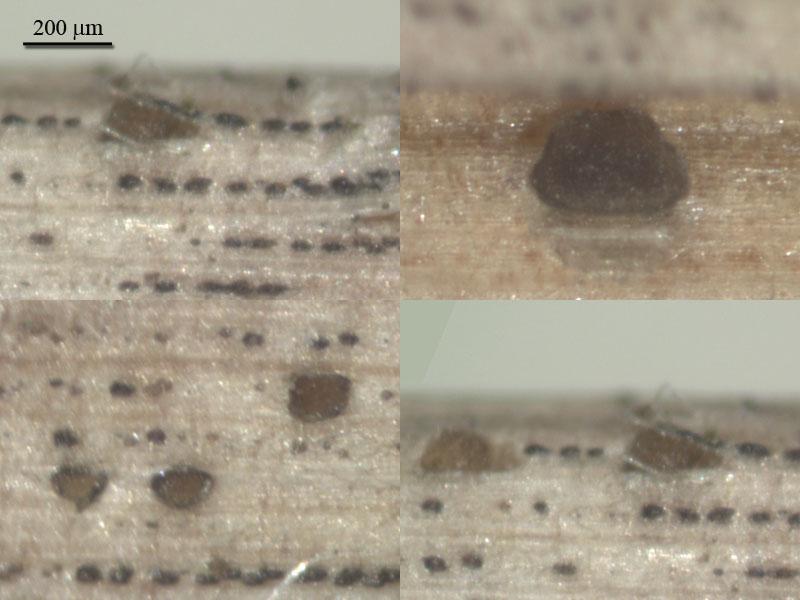
From dead leaves of Eriophorum angustifolium, wet bog hollow.
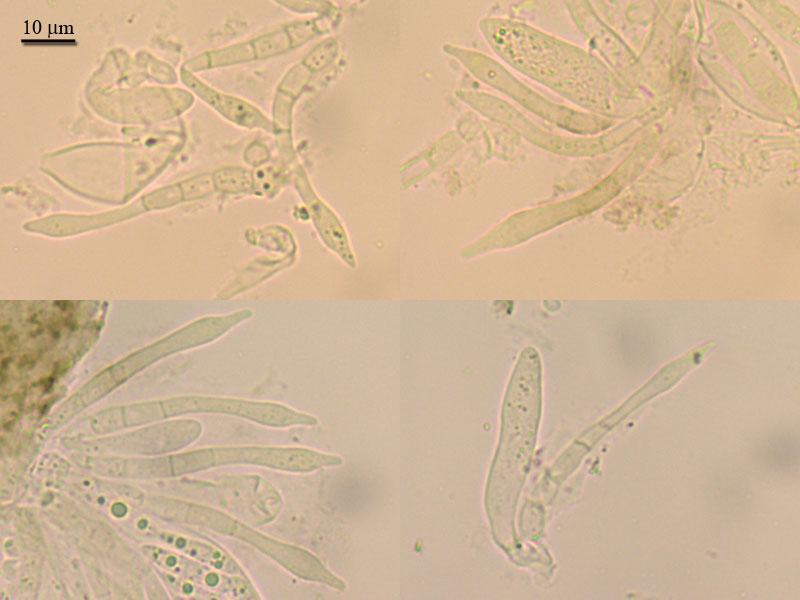
Apothecia immersed in tissue, ellipsoid, to 350 x 170 mk, opening by ellipsoid slit, disc pale, surrounded by dark brown edge.
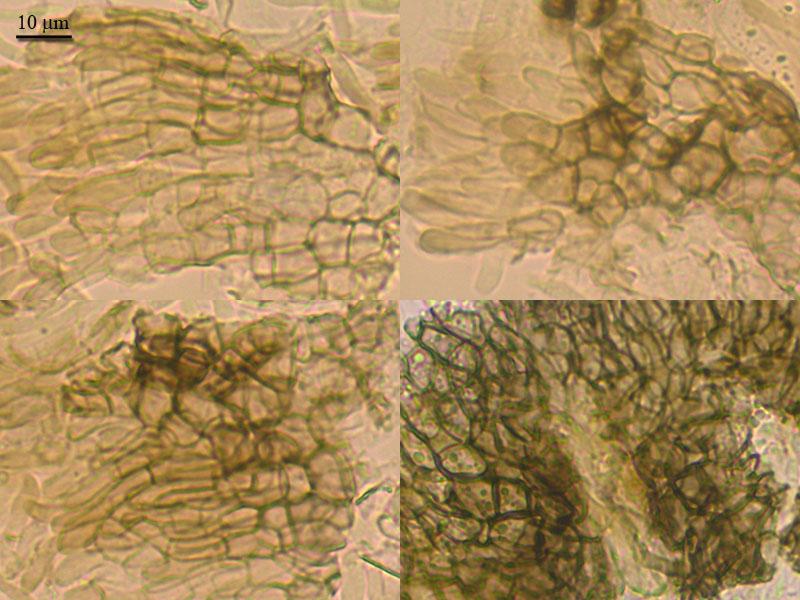
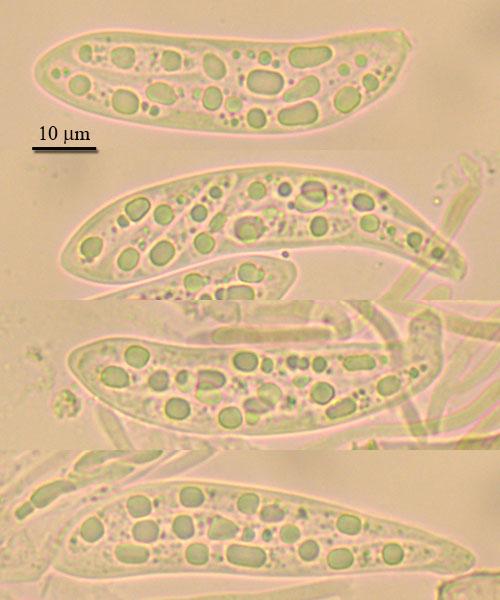
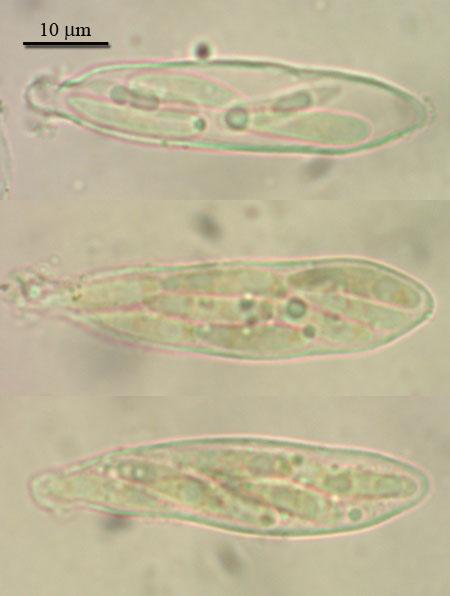
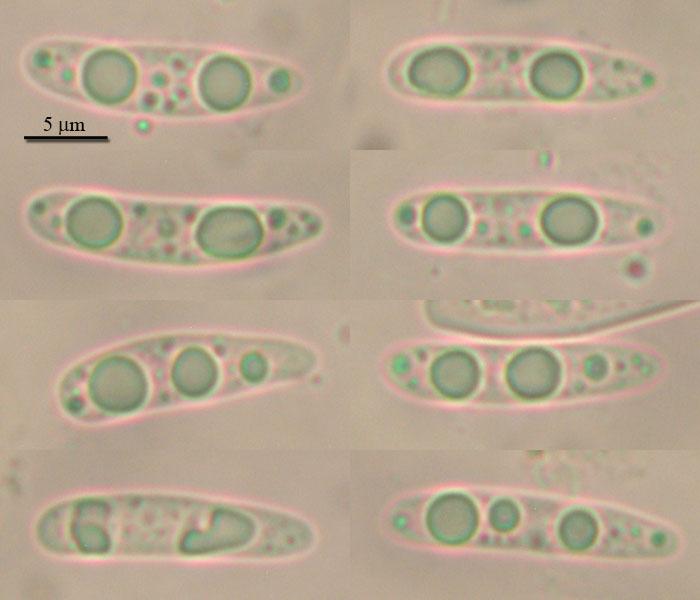
Excipulum from textura angularis at base, cells dark brown, about 10 mk in diam, textura prismatica at the edge, end cells (hairs) cylindrical or clavate, 15-20 x 5-8, brown, walls of end cells under immersion with roughness; asci clavate, inamyloid, 59-67 x 12,5-14,6; paraphyses cylindrical with ampulliform end cell, about 3 mk broad and segmented in lower part, ampulliform cell up to 5 mk in broadest part, hyaline, with small guttules (rarely seen in rehydrated), not or some exeeding the asci; spores subfusoid, many-guttulate, 17 (15,7-17,7) x 3,7 (3,4-4,2) (Q=4,67; N=13).
Hans-Otto Baral,
12-02-2013 18:09

Re : Hysteropezizella diminuens
Yes, these are globose, rather inconspicuous (low-refractive) VBs which stain turquoise-blue in Cresylblue, but you see them only in living state.
Did you pretread your asci with KOH?
Hysteronaevia olivacea would have inamyloid asci, and paraph. as yours, but has much broader spores with acute ends.
Zotto
Did you pretread your asci with KOH?
Hysteronaevia olivacea would have inamyloid asci, and paraph. as yours, but has much broader spores with acute ends.
Zotto
Nina Filippova,
12-02-2013 19:04
Re : Hysteropezizella diminuens
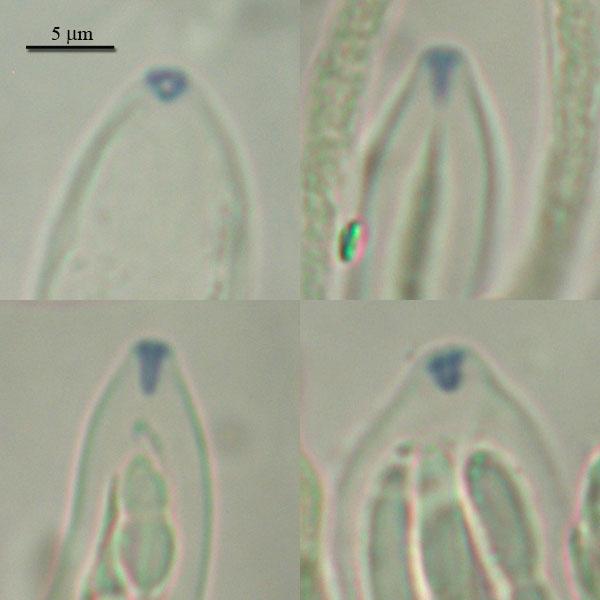
I used water-lugol, and MLZ and they were inamyloid, now added KOH, heated, and strong amyloid reaction happened. So, this shows they are actually amyloid?
Paraphyses hyaline and brownish in different fbs at one leaf, is seems variable.
I posted Hysteronaevia olivacea some before: http://www.ascofrance.fr/forum?page=1&id=21842
Paraphyses hyaline and brownish in different fbs at one leaf, is seems variable.
I posted Hysteronaevia olivacea some before: http://www.ascofrance.fr/forum?page=1&id=21842
Hans-Otto Baral,
12-02-2013 21:19
Re : Hysteropezizella diminuens
This is the very typical hemiamyloid reaction, and it shows that your Lugol is insufficient. You should get a bright red reaction in water + lugol. Maybe your solution is almost colourless (the photo looks so), or it contains unallowed ingredients. Hemiamyloid rings in Melzer are negative without KOH.
Sorry, I confused your two postings. So yes, this is H. diminuens. My answer on paraphyses, of course, concerned the Hysteronaevia, I will change it accordingly.
Zotto
Sorry, I confused your two postings. So yes, this is H. diminuens. My answer on paraphyses, of course, concerned the Hysteronaevia, I will change it accordingly.
Zotto
Nina Filippova,
13-02-2013 11:55
Re : Hysteropezizella diminuens
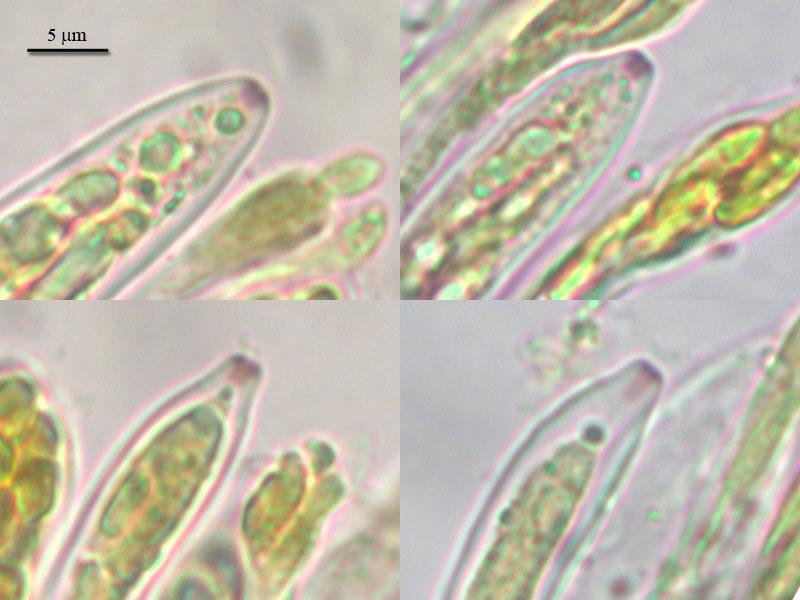
There is ascus pore in fresh prepared lugol, it is still not pure red, apparently since J crystals not fully dissolved yet and solution is some weaker. But finally, i can see red reaction too.
Hans-Otto Baral,
13-02-2013 12:09
Re : Hysteropezizella diminuens
Yes, this is fine! Possibly the reaction has a blue component that becomes visible at lower iodine concentrations, resulting in a more dirty red (type RB).