
18-05-2026 10:13
 Lieve Deceuninck
Dear forum members,I identified this as the teleom

17-05-2026 19:05
Thomas FlammerI have found this tiny 200 ym cup shaped apothecia
17-05-2026 16:41
Margot en Geert VullingsWe found this Lachnum on an old Rubus stem.Fruitbo
05-04-2026 22:46
 Lothar Krieglsteiner
on wood of Ceratonia, Algarve, 3.4.2026.The color
15-05-2026 13:33
Sylvie Le GoffBonjour à tousJe serais très reconnaissante enve
16-03-2011 14:31
roman vargas albertoHi. I would like some opinion about this Peziza
14-05-2026 05:36
Ethan CrensonHi all, I haven't paid much attention to Lachnu
10-05-2026 23:17
 Andreas Gminder
Hello,today we found in a moist steep decidous for
11-05-2026 12:32
 Bernard CLESSE
Pourriez-vous m'aider à identifier cette héloti
Blackening ascomycet
Gernot Friebes,
06-01-2010 13:14
at New Year's Day I found this very strange ascomycet which I cannot determine. What a good start for this year...
It grew in the marginal area of a swamp on a rotten, very mossy tree stump. I am not even sure about the genus. The most striking characters are the blackening apothecia and the IKI- asci.
Here is the description:
Apothecia:
White, soon conspicuously blackening (whole fungus, especially the stipe and the stipe base) or turning dirty yellowish, 3-12 mm high, head 1-3.5 mm ø, head on the underside smooth or, when older, rugose. Stipe smooth or a bit hairy-rugose.
Spores:
irregularly elliptic, elliptic, often flattened on one side, partly deformed and with a smaller end, also comma-shaped or rhomboid, with 0-2(3) septa, occasionally germinating, sometimes with a visible nucleus, alive with hardly any content, 20-25 x 5-6(8) µm. Immature spores in asci nearly spherical!
Asci:
8 spored, clavate, biseriate, IKI-, Melzer's reagent-, KOH 5% + Melzer's reagent-; however, there is an apical apparatus, croziers+, (107)120-130 x (8)12-14 µm. Dead asci (observed in Melzer's reagent) have an up to 3 µm high dome.
Paraphyses:
filiform to slightly clavate, with strongly refractive, hyalin, multiguttulate content, in KOH 5% turning brownish. Up to 5(7) µm broad.
Textura:
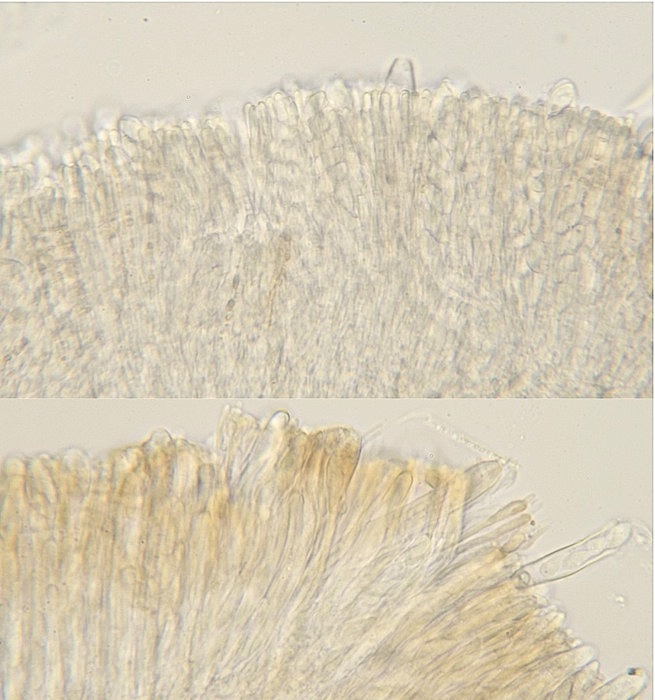
the medulla is a textura intricata with 1.5-5 µm wide, often branched hyphae. The excipulum is a textura prismatica with 4.5-20 µm wide, often brown hyphae.
Best wishes,
Gernot

Gernot Friebes,
06-01-2010 13:14
Re:Blackening ascomycet
micros 1
All scales = 10 µm
All scales = 10 µm
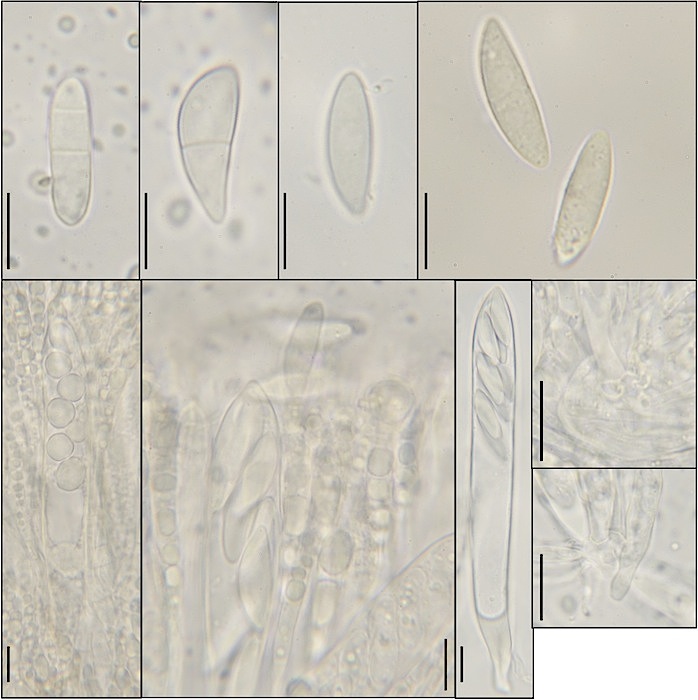
Gernot Friebes,
06-01-2010 13:16
Re:Blackening ascomycet
micros 2 (asci are in IKI)
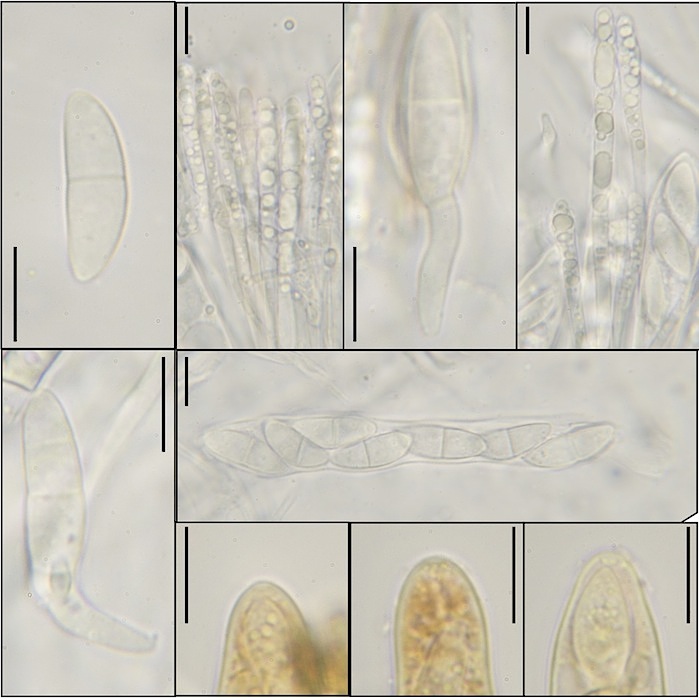
Gernot Friebes,
06-01-2010 13:19
Re:Blackening ascomycet
micros 3 (texturae: at the top medulla; at the bottom excipulum)
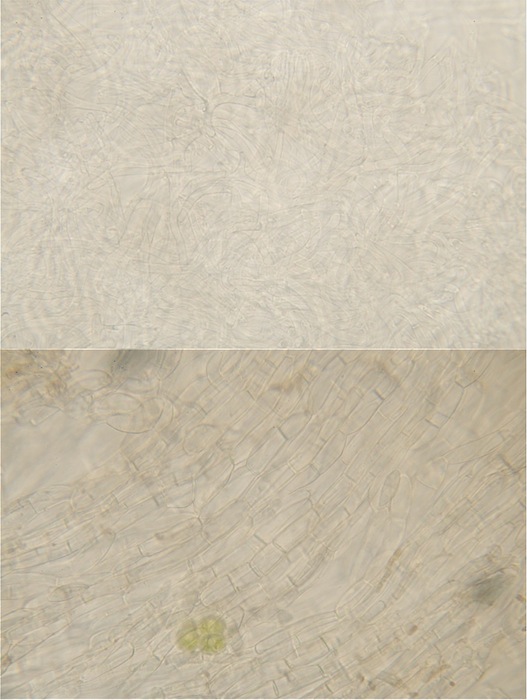
Gernot Friebes,
06-01-2010 13:20
Re:Blackening ascomycet
micros 4 (excipulum + asci in Melzer's reagent)
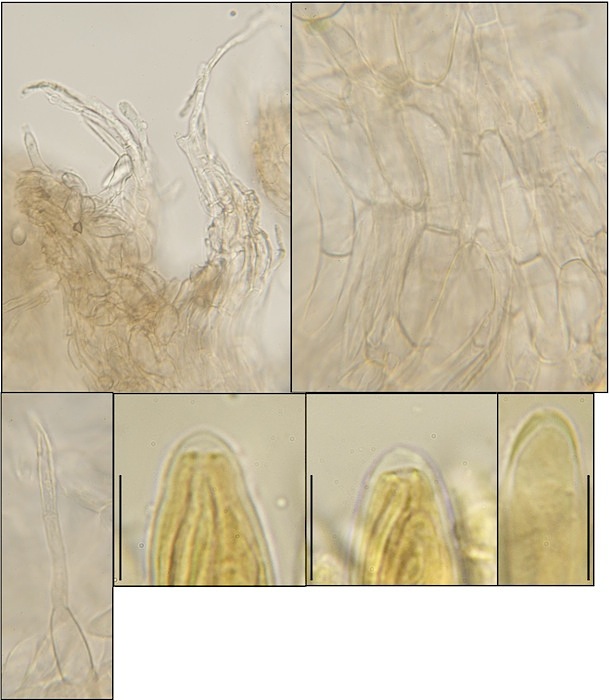
Gernot Friebes,
06-01-2010 13:20
Re:Blackening ascomycet
micros 5 (at the top hymenium in water; at the bottom hymenium in KOH 5%)
Raúl Tena Lahoz,
06-01-2010 13:35

Re:Blackening ascomycet
Cudoniella acicularis?
Very good photos.
Happy New Year for all.
Raúl
Very good photos.
Happy New Year for all.
Raúl
Gernot Friebes,
06-01-2010 14:13
Re:Blackening ascomycet
Hi Raúl,
wow, I really should have known that species...sometimes I'm a bit slow :(
Thank you very much!
Best wishes,
Gernot
wow, I really should have known that species...sometimes I'm a bit slow :(
Thank you very much!
Best wishes,
Gernot
Hans-Otto Baral,
06-01-2010 15:43

Re:Blackening ascomycet
Hi Gernot
C. acicularis is often on Quercus but also on Fagus etc. Have you an idea about the substrate? Did you collect it in January? How is that possible? We have deep frost. The fungus is usually from Aug.-Nov., but I have one coll. from Jan. and one from March.
Zotto
C. acicularis is often on Quercus but also on Fagus etc. Have you an idea about the substrate? Did you collect it in January? How is that possible? We have deep frost. The fungus is usually from Aug.-Nov., but I have one coll. from Jan. and one from March.
Zotto
Gernot Friebes,
06-01-2010 16:41
Re:Blackening ascomycet
Hi Zotto,
there was neither Quercus nor Fagus, only Pinus, Betula, Salix and Alnus. There was hardly any wood left so I could not determine it in the field but I have some little pieces of the wood which I can try to examine under the microscope. I collected it on 1.1.2010. The weather was fine at this day, some degrees above zero and the snow was melting, so quite nice for ascomycetes.
Best wishes,
Gernot
there was neither Quercus nor Fagus, only Pinus, Betula, Salix and Alnus. There was hardly any wood left so I could not determine it in the field but I have some little pieces of the wood which I can try to examine under the microscope. I collected it on 1.1.2010. The weather was fine at this day, some degrees above zero and the snow was melting, so quite nice for ascomycetes.
Best wishes,
Gernot